
Just a moment...

Top
Help
×

By creating an account you can:

Logo TaxTMI
>
Call Us / Help / Feedback

Contact Us At :

E-mail: [email protected]

Call / WhatsApp at: +91 99117 96707

For more information, Check Contact Us

FAQs :

To know Frequently Asked Questions, Check FAQs

Most Asked Video Tutorials :

For more tutorials, Check Video Tutorials

Submit Feedback/Suggestion :

Email :
Please provide your email address so we can follow up on your feedback.
Category :
Description :
Min 15 characters0/2000
Add to...
You have not created any category. Kindly create one to bookmark this item!
Create New Category
Hide
Title :
Description :
❮❮ Hide
Default View
Expand ❯❯
Close ✕
🔎 News - Adv. Search
TEXT SEARCH:

Press 'Enter' to add multiple search terms. Rules for Better Search

Search In:
Main Text + AI Text
  • Main Text
  • Main Text + AI Text
  • AI Text
Category: ?
Categorized by AI
---- All Categories ----
  • ---- All Categories ----
  • Income Tax
  • GST
  • Customs, DGFT & SEZ
  • FEMA & RBI
  • Corp. Laws, SEBI & IBC
  • PMLA, Black Money & ED
  • Budget
  • News and Press Release
  • PTI News
Month:
---- All Months ----
  • ---- All Months ----
  • January
  • February
  • March
  • April
  • May
  • June
  • July
  • August
  • September
  • October
  • November
  • December
Year:
---- All Years ----
  • ---- All Years ----
  • 2026
  • 2025
  • 2024
  • 2023
  • 2022
  • 2021
  • 2020
  • 2019
  • 2018
  • 2017
  • 2016
  • 2015
  • 2014
  • 2013
  • 2012
  • 2011
Sort By: ?
In Sort By 'Default', exact matches for text search are shown at the top, followed by the remaining results in their regular order.
RelevanceDefaultDate
    Government Notifies Inventory-based Cross-border E-Commerce Export Framework under Foreign Trade Policy 2023
    Customs official among 5 held for smuggling gold of Rs 1.44 crore at Indore airport
    Lok Sabha passes Bankers' Books Evidence Bill to replace colonial-era law
    Sensex gains 152 pts in volatile session as RBI keeps policy rates unchanged
    DRI seizes 364 metric tonne (MT) banned Pakistan-origin dry dates imports worth Rs. 3 crore
    Rupee gains 13 paise to close at 95.15 against US dollar post-RBI policy decision
    ED raids premises linked to ex-Andhra MLA Malla Vijaya Prasad in chit fund scam
    'Gungi gudiya' remark against Sunetra shows Cong's 'ideological bankruptcy': NCP leader Tatkare
    RBI holds interest rates for fourth straight meeting, awaits clearer inflation outlook
    Highlights of RBI's August monetary policy
    RBI targeting polymer currency notes launch in early FY28: Guv Malhotra
    Two women held at Delhi airport with 1 kg gold concealed as silver-coated armlet
    Sensex trades higher, Nifty flat post RBI policy
    India's services sector growth hits four-and-a-half-year low in July on weak demand: PMI
    SC grants interim bail to businessman Anwar Dhebar in manpower commission 'scam' case
    The Taxation and Other Laws Amendment Bill 2026 - Introduced in Lok Sabha on 4th August 2026
    RBI marginally raises FY27 GDP growth projection to 6.7 pc, lowers inflation forecast
    Collaboration, Inclusion and Entrepreneurship: How SIDBI MSME Samvaad Is Shaping the Future of India’s MSME Ecosystem
    RBI keeps policy rate unchanged for third time in row in FY27 amid West Asia crisis
    RBI keeps policy rate unchanged for third time in row amid West Asia crisis
❯❯
MaximizeMaximizeMaximize
0 / 200
Expand Note
Add to Folder

No Folders have been created

    +

    Are you sure you want to delete "My most important" ?

    NOTE:

    News
    Showing Results for :
    Reset Filters
    Results Found:
    Show All SummariesHide All Summaries
    August 5, 2026
    Show AI Summary
    Export-only e-commerce inventory framework enables seller exports through registered exporters while requiring traceability, timely payments and domestic-diversion controls.
    The export-only inventory framework permits eligible e-commerce entities to export through a registered Exporter-on-Record, which procures goods from Indian Sellers-on-Record against confirmed overseas orders and assumes export and destination-country compliance responsibilities. Inventory must be segregated, digitally traceable and cannot be diverted to domestic sale. The framework requires timely seller payments, visibility of overseas sales and shipment information, proportional pass-through of export rebates and refunds, annual compliance certification and digital records.
    August 5, 2026
    Show AI Summary
    Gold smuggling enforcement targets concealed foreign-origin gold, airport control evasion, and illicit railway transport under customs law.
    Gold smuggling enforcement operations under the Customs Act, 1962 involved alleged concealment and unlawful movement of foreign-origin gold. At an international airport, an alleged syndicate used an airline employee to transfer gold received from arriving passengers outside Customs and immigration controls, with gold disguised as silver-coloured bracelets. A separate railway operation concerned gold concealed in a specially made cloth waist belt and intended for delivery to a jeweller. The actions addressed concealment, evasion of Customs controls, and illicit transport of foreign-origin gold.
    August 5, 2026
    Show AI Summary
    Digital bank-record evidence gains a technology-neutral framework through expanded admissibility, certified authentication, and regulated production of bankers' books.
    The Bankers' Books Evidence Bill, 2026, modernises the evidentiary treatment of banking records by extending "bankers' books" to physical, electronic, digital, virtual and cloud-based records. It recognises electronic bank records as admissible evidence, allows production in physical or electronic form, and provides for standardised certificates authenticated by manual, digital or electronic signatures. The Bill also defines "special cause" for compelling bank officers to produce records or testify where the bank is not a party, and permits extension to specified financial-sector entities subject to conditions.
    August 5, 2026
    Show AI Summary
    Closing auction price discovery and unchanged policy rates shaped volatile equity trading amid inflation and geopolitical uncertainty.
    The Monetary Policy Committee retained the policy repo rate and neutral policy stance while seeking greater clarity on inflation risks from higher energy costs. Stock exchanges introduced the Closing Auction Session for eligible futures and options shares in the equity cash segment to determine closing prices through a more transparent and robust auction-based price-discovery mechanism. Equity markets showed volatile, limited gains amid geopolitical uncertainty, energy-price concerns, profit booking and the new mechanism's introduction.
    August 5, 2026
    Show AI Summary
    Pakistan-origin import prohibition covers third-country routing, false origin declarations, forged documents, and trans-shipment arrangements used to evade restrictions.
    The prohibition on direct or indirect import or transit of goods originating in or exported from Pakistan extends to goods routed through third countries and falsely declared as having another origin. Misdeclaration of country of origin, false descriptions, forged documentation, and trans-shipment arrangements may contravene that prohibition and invite action under the Customs Act, 1962. Dry dates declared as UAE-origin and Guggul resin declared as Somalia-origin were investigated as goods of Pakistan origin routed through Dubai.
    August 5, 2026
    Show AI Summary
    Foreign exchange stability measures support the rupee as policy continuity, capital inflows and global risk sentiment shape currency expectations.
    Foreign exchange market movement reflected a rupee appreciation against the US dollar following the monetary policy decision to retain the repo rate and neutral stance. Market sentiment was supported by softer crude oil prices, weakness in the US dollar, lower US Treasury yields and foreign equity inflows. The monetary policy framework sought to support capital inflows and maintain an orderly rupee trajectory, with geopolitical developments and US economic data remaining relevant to near-term exchange-rate expectations.
    August 5, 2026
    Show AI Summary
    Money-laundering investigation examines alleged proceeds from chit fund operations following searches linked to a former company managing director.
    A money-laundering investigation concerns alleged proceeds of crime arising from a multi-state chit fund operation associated with Welfare Building and Estates Pvt Ltd. The company is alleged to have collected investor deposits through investment schemes promising high returns before defaulting. Searches at premises linked to its former managing director form part of the inquiry into alleged laundering. The underlying alleged fraud had previously resulted in a CBI case and multiple police FIRs.
    August 5, 2026
    Show AI Summary
    Political restraint in public communications was urged, alongside adherence to principal-speaker protocol during press conferences and media interactions.
    Political restraint in public communications was urged after a social-media remark directed at Sunetra Pawar was criticised as ideologically irresponsible. It was stated that regret alone was insufficient and that leaders should exercise care in public comments. Press-conference protocol was also emphasised: the principal dignitary should respond to media questions, and those seated alongside should not participate in the interaction. Party colleagues were expected to act more responsibly in future media engagements.
    August 5, 2026
    Show AI Summary
    Neutral monetary policy stance continues as inflation clarity is awaited, alongside cooperative banking and lending-rate transparency measures.
    Monetary policy maintained the benchmark policy repo rate and a neutral stance pending clearer evidence that energy-cost pressures will generate broad-based inflation. Inflation is expected to rise temporarily due principally to food and fuel prices before moderating, while core inflation remains benign. The approach remains data-dependent, supported by two-way liquidity operations. Proposed measures include resuming urban cooperative bank licensing, revising rural cooperative bank credit-monitoring directions, and harmonising interest-rate regulation on advances across regulated entities to improve transparency and consumer protection.
    August 5, 2026
    Show AI Summary
    Repo rate stability preserves the policy stance amid lower inflation projections, stronger growth expectations and external-sector resilience.
    Monetary policy maintained the repo rate at 5.25 per cent following a unanimous policy committee decision. The growth forecast for FY27 was marginally increased, while the inflation projection was lowered. Inflation conditions remain uncertain because of monsoon, El Nino and geopolitical developments. Liquidity remained in surplus, and external-sector indicators reflected a current-account surplus, buoyant foreign direct investment inflows, renewed foreign portfolio investment inflows, and adequate foreign-exchange reserves.
    August 5, 2026
    Show AI Summary
    Polymer currency notes target improved durability as monetary policy remains data-dependent and rupee management pursues an orderly trajectory.
    Polymer currency notes are targeted for circulation at the beginning of the next financial year, subject to implementation proceeding as planned. They are intended to improve durability, especially for lower-denomination notes with high circulation velocity. Monetary policy decisions will remain data-dependent and focused on aligning headline inflation with its medium-term target. Foreign Currency Non-Resident (Bank) scheme inflows are expected to remain healthy until closure, with no proposal for premature termination. Rupee management aims to maintain an orderly exchange-rate trajectory.
    August 5, 2026
    Show AI Summary
    Customs anti-smuggling enforcement targets gold concealed as silver-coated armlets following passenger profiling and personal search at airport.
    Customs officers intercepted two passengers arriving from Istanbul after Advance Passenger Information System profiling and their activation of the Door Frame Metal Detector. A personal search recovered approximately one kilogram of gold, silver-coated and concealed as traditional armlets worn on the upper arms. The gold was seized under the Customs Act, a smuggling case was registered, and investigation was initiated into the source and any wider smuggling network.
    August 5, 2026
    Show AI Summary
    Closing auction price discovery for eligible derivatives shares begins as monetary policy retains the repo rate and neutral stance.
    The Reserve Bank retained the repo rate with a neutral stance amid uncertainty over energy prices and supply disruptions. Stock exchanges introduced the Closing Auction Session in the equity cash segment for eligible shares with futures and options contracts. This auction-based mechanism determines closing prices of eligible stocks and aims to make price discovery more transparent and robust.
    August 5, 2026
    Show AI Summary
    Services-sector growth slowed as weaker demand, competition and postponed orders moderated business activity, while employment improved modestly.
    Services-sector growth slowed as domestic and export orders moderated amid weaker demand, competitive pressures, softer market conditions and postponed orders. Output continued to expand, but at its weakest pace in more than four years. Employment growth improved modestly, while input costs rose and firms increased selling prices. Business confidence remained positive but declined, and the composite output indicator weakened due principally to the sharp slowdown in services activity.
    August 5, 2026
    Show AI Summary
    Interim bail conditions require residence outside the state and trial attendance in alleged manpower commission corruption proceedings.
    Interim bail was granted to Anwar Dhebar in a matter involving alleged corruption and an illegal commission mechanism linked to a state marketing corporation. Conditions require him to remain outside Chhattisgarh, attend the trial court, and provide his residential address. The allegations concern manpower supply agencies allegedly being compelled to pay commissions for clearance of legitimate bills, with proceeds routed through intermediaries. The case was registered under the Indian Penal Code and the Prevention of Corruption Act.
    August 5, 2026
    Show AI Summary
    Tax certainty measures revise fund-management safe harbours, electronic-payment charges, sectoral exemptions, business-trust treatment, and excess expenditure appropriation.
    The Taxation and Other Laws (Amendment) Bill, 2026 proposes to replace the Income-tax (Amendment) Ordinance, 2026 and amend payment-system and tax laws. It would prohibit charges on notified electronic payments, revise safe-harbour conditions for eligible investment funds and fund managers, and expand tax exemptions for Government securities, qualifying rough-diamond sales and bonded-warehouse component storage. It also modifies exemptions concerning electronic-goods contract manufacturing, data centres and business-trust dividends, while imposing a differentiated surcharge on qualifying special purpose vehicles. A separately included appropriation bill authorises excess expenditure from the Consolidated Fund of India.
    August 5, 2026
    Show AI Summary
    Growth and inflation projections reflect resilient domestic activity while energy volatility, supply disruptions, and food prices sustain inflation risks.
    Monetary policy projections for fiscal 2026-27 revise real GDP growth upward to 6.7 per cent and Consumer Price Index inflation downward to 5 per cent. Domestic activity is described as resilient amid global uncertainty, but inflationary risks persist from rainfall disruption, energy-price volatility, supply-chain uncertainty, and second-round effects of higher food, fuel and input costs. Core inflation is projected at 4.3 per cent for the fiscal year.
    August 5, 2026
    Show AI Summary
    Industry collaboration strengthens MSME competitiveness through shared resources, market linkages, capability building and inclusive support for women entrepreneurs.
    MSME development is linked to collaboration, knowledge-sharing, institutional support and capability building. Industry associations can provide networking, policy advocacy, business intelligence, skills programmes, shared infrastructure and market linkages, while collective procurement, shared logistics, digital commerce and export readiness may improve competitiveness. Women-led enterprises benefit from market-oriented capability development, mentorship, continuous learning, professional networks, capacity-building programmes and institutional support. The Development of Industry Associations initiative is intended to connect associations and facilitate the sharing of best practices.
    August 5, 2026
    Show AI Summary
    Monetary policy rate maintenance continues under a neutral stance amid energy disruption, inflation concerns and sustained currency depreciation.
    Monetary policy rate maintenance was continued with the repo rate retained at 5.25 per cent under a neutral stance amid uncertainty over energy prices and supply disruptions associated with the West Asia crisis. The growth forecast was marginally increased and the inflation projection reduced. Sustained rupee depreciation against the dollar was attributed to costly oil, capital outflows, widening trade deficits and a strong US dollar.
    August 5, 2026
    Show AI Summary
    Monetary policy rate pause maintains a neutral stance amid energy disruption, inflation concerns and sustained rupee depreciation pressures.
    Monetary policy rates were retained without change for a third consecutive review, with a neutral stance maintained amid uncertainty over energy prices and supply disruptions associated with the West Asia crisis. The policy assessment noted retail inflation above the medium-term target, alongside an upward revision to growth expectations and a downward revision to the inflation projection. Continued rupee depreciation was linked to higher oil prices, capital outflows, widening trade deficits and a stronger US dollar.

    News

    Back

    All News

    Showing Results for :
    Reset Filters
      No Records Found

      News

      Back

      All News

      whatsappJoin Channel
      Showing Results for : Reset Filters
      News and Press Release

      India’s Growing Influence in Global Innovation: A Look at WIPO 2024’s Intellectual Property Report.

      November 18, 2024

      Contents
      Summary
      Note

      Note

      -

      Bookmark

      Print

      Print

      The World Intellectual Property Organization (WIPO) annually publishes the World Intellectual Property Indicators (WIPI) report, which provides a comprehensive analysis of global trends in intellectual property filings. The 2024 report highlights the growth and evolution of patents, trademarks, and industrial designs across key global economies, with particular attention to emerging markets and innovation hubs. Among these economies, India stands out as a rapidly growing player in the global IP landscape, making significant strides in all three major IP categories—patents, trademarks and industrial design. India has solidified its position as a global leader in intellectual property filings, securing a spot in the top 10 countries for patents, trademarks, and industrial designs. This achievement underscores India's growing innovation capacity, with the country making remarkable strides in patent applications, brand protection, and design innovations. One of the most remarkable findings in the 2024 report is India’s exceptional performance in the global IP landscape. India recorded a phenomenal +15.7% growth in patent applications in 2023, continuing its streak of double-digit growth for the fifth consecutive year. This surge places India among the top countries contributing to global patent filings, signaling the country's increasing role as a global innovation hub. The resilience of IP filings during the COVID-19 crisis further underscores the enduring importance of intellectual property in driving economic recovery and growth.

      India’s Stellar Growth in Patent Applications Global Ranking:

      India now ranks 6th globally in terms of patent applications, with 64,480 patent filings in 2023. This puts India among the leading nations, including China, the United States, Japan, and South Korea, in terms of intellectual property activity. India’s rise in global patent rankings is particularly notable given its vast and diverse economy, ranging from traditional sectors like agriculture to cutting-edge industries like pharmaceuticals, information technology, and renewable energy.

      Resident Filings Lead:

      For the first time in history, more than half (55.2%) of India’s patent applications in 2023 were filed by residents, a significant milestone. This demonstrates India’s increasing domestic innovation capabilities, with Indian companies, universities, and research institutions now playing a major role in generating new technologies and intellectual property. This trend reflects the effectiveness of the government’s efforts to foster an innovation-friendly environment and to support local inventors through initiatives such as the National Intellectual Property Rights (IPR) Policy and the Atmanirbhar Bharat campaign.

      Growth in Patent Grants:

      India also saw a 149.4% increase in the number of patents granted in 2023 compared to the previous year. This rapid growth in granted patents underscores the efficiency of India’s patent office in processing applications and granting IP rights. It also reflects the rising quality of applications being filed, with many innovations meeting global standards. This progress signifies India’s growing maturity as a hub for technological and scientific development.

      Patent-to-GDP Ratio:

      India's patent-to-GDP ratio—a measure of the economic impact of patent activity—grew significantly, from 144 in 2013 to 381 in 2023. This means that as India’s economy expands, its patent activity is scaling up in tandem, signalling the increasing importance of innovation in driving economic growth. A higher patent-to-GDP ratio is often seen as a sign of a knowledge-driven economy, where innovation and intellectual property play a central role in economic development.

      Surge in Industrial Design Applications

      Record Growth:

      India’s industrial design applications surged by 36.4% in 2023, further emphasizing the country’s expanding focus on creativity, design, and manufacturing innovation. This growth reflects a greater emphasis on aesthetic and functional design across various sectors, such as consumer electronics, automobiles, fashion, and healthcare. The surge in design applications is indicative of India’s evolving capabilities not only in manufacturing but also in product development and value-added industries.

      Sectoral Focus:

      India’s industrial design filings were led by key sectors such as Textiles and Accessories, Tools and Machines, and Health and Cosmetics. These sectors accounted for nearly half of all design filings, underscoring India’s strength in both traditional industries like textiles and emerging sectors like health and cosmetics. The textile and fashion sectors, in particular, benefit from India’s rich cultural heritage and the increasing demand for innovative product designs, both domestically and internationally.

      Impact on India’s Manufacturing:

      The surge in industrial design applications highlights the ongoing transformation of India’s manufacturing sector. As industries focus more on product aesthetics, functionality, and user experience, India’s manufacturing ecosystem is diversifying beyond basic production into more value-added, design-driven industries. The growth in design applications is a clear indication of how the country is positioning itself as a global manufacturing hub that prioritizes innovation, quality, and design excellence.

      Comparison to Global Trends:

      India’s growth in industrial design applications is notable when compared to global IP filing trends. While countries like China and the United States continue to dominate in the patent and trademark space, India’s rising figures in industrial design reflect its increasing competitiveness in product design and creativity. This aligns with broader global trends where countries are investing more in industrial design as a strategic asset to drive economic growth and enhance product differentiation in the market.

      Trademark Filings: A Global Leader

      Global Trademark Ranking:

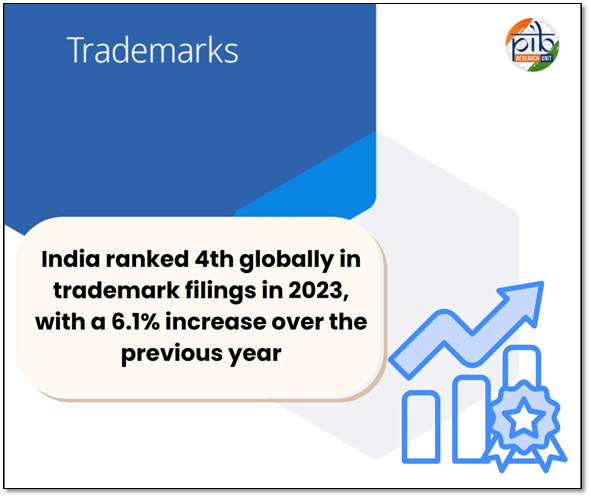
      India ranked 4th globally in trademark filings in 2023, with a 6.1% increase over the previous year. This growth underscores India’s growing emphasis on brand protection and intellectual property as essential drivers of business success. India’s ranking reflects the country’s increasing number of domestic and international businesses, all of which rely on trademarks to protect their brands and ensure consumer trust.
      Resident Filings Dominate:

      Nearly 90% of India’s trademark filings in 2023 were made by Indian residents, reflecting a strong domestic focus on brand protection. This shift suggests that Indian businesses, entrepreneurs, and startups are becoming more IP-savvy and are increasingly leveraging the trademark system to protect their innovations and brands.

      Active Trademark Registrations:

      India now holds the second-largest number of active trademark registrations in the world, with over 3.2 million trademarks in force. This indicates a highly active and competitive domestic marketplace, where businesses are not only creating new products but also working diligently to protect their brand identities. The large volume of active trademarks positions India as a major player in the global brand protection landscape, benefiting from both domestic innovation and the growing demand for Indian brands in international markets.

      Sectoral Trends:

      The largest proportion of trademark filings in India came from sectors such as Health (21.9%), Agriculture (15.3%), and Clothing (12.8%). These figures highlight India’s leadership in areas such as pharmaceuticals, food production, and fashion. As global demand for Indian products continues to rise, the importance of trademark filings as a tool for safeguarding brand equity becomes ever more critical, ensuring that Indian products and services maintain their competitive edge in international markets.

      India’s Position in Global IP Trends

      Contribution to Growth:

      India’s rising IP filings have been a significant part of the global trend of increased intellectual property activity. In 2023, a record 3.55 million patent applications were filed worldwide, with India contributing a meaningful share to this figure. As one of the fastest-growing markets in terms of IP filings, India is helping drive the global increase in innovation and IP protection, particularly in emerging markets.

      Shift Towards Local Innovation:

      The growth of resident filings in India—especially in patents and trademarks—demonstrates a shift towards local innovation. While global IP filings have traditionally been dominated by multinational corporations, India’s rising resident filings reflect a maturing domestic innovation ecosystem backed with the idea of Atmanirbhar Bharat campaign. More Indian companies and individuals are filing patents and trademarks, not just for protection, but as part of a strategy to strengthen their competitive advantage in both local and global markets.

      Government Initiatives Fuelling IP Growth

      National IP Policy:

      A key factor driving India’s growth in IP filings is the National Intellectual Property Rights (IPR) Policy, launched in 2016. This comprehensive framework is designed to guide the development and protection of intellectual property in India. The policy focuses on improving IP awareness, strengthening the IP ecosystem, and encouraging innovation by providing better access to IP services and protection mechanisms. By integrating all forms of intellectual property—such as patents, trademarks, industrial designs, copyrights, geographical indications, and more—the policy aims to foster a more robust and efficient IP environment. Objectives and activities undertaken under the National IPR Policy

      Amendments to IPR Laws: Improvements in procedural requirements to speed up the processing of applications.

      Modernization and Digitization of IP Offices: To enhance the performance and functioning of IP offices, streamlining workflows and reducing processing times.

      Awareness and Education: Programs such as the National Intellectual Property Awareness Mission (NIPAM) to spread IP awareness across educational institutions and businesses.

      IP Commercialization: Establishment of Technology Innovation Support Centres (TISC) in universities to support IP filings and the commercialization of patents and other IP.

      Scheme for Pedagogy & Research in IPRs for Holistic Education and Academia (SPRIHA), which aims to integrate IPR education into higher learning institutions across the country. Under the SPRIHA scheme, IPR Chairs have been established in various universities and academic institutions to facilitate specialized research, teaching, and training in intellectual property. These IPR Chairs provide a platform for faculty members and students to engage in cutting-edge research on intellectual property, its role in innovation, and its impact on industries and society.

      India’s vibrant start-up ecosystem is another key driver of the country’s growing IP activity. Government initiatives like Start-Up India, Digital India, Make in India and the Atal Innovation Mission, the Indian government has continuously fostered entrepreneurship, research, and technological advancement. Startup India was launched on January 16, 2016, with the goal of nurturing entrepreneurship, building a strong startup ecosystem, and transforming India into a nation of job creators rather than job seekers. This initiative includes a variety of programs designed to support emerging entrepreneurs. These efforts are coordinated by the Startup India Team, which reports to the Department for Promotion of Industry and Internal Trade (DPIIT). As of September 30, 2024, DPIIT has officially recognized 1,49,414 entities as startups.

      Atal Innovation Mission (AIM), established in 2016, is a flagship initiative of the Government of India to promote a culture of innovation and entrepreneurship across the country. AIM adopts a comprehensive approach to foster problem-solving and innovative thinking in schools, while also creating an entrepreneurial ecosystem in universities, research institutions, and the private and MSME sectors. Till date, AIM has established 10,000 Atal Tinkering Labs in Schools across the country, more than 3500 startups are incubated at Atal Incubation Centres and have created more than 32000 jobs in the ecosystem

      India as a Global Innovation Powerhouse

      India’s remarkable progress in the 2024 WIPO Report highlights its role as a rising global leader in intellectual property. With significant growth in patents, trademarks, and industrial designs, India is becoming a hub of global innovation. Its increasing number of resident filings demonstrates a shift toward homegrown creativity and invention, supported by an innovation-friendly ecosystem and government policies.
      Looking ahead, India is poised to continue its upward trajectory in global IP rankings. The country’s diverse and rapidly growing economy, coupled with its focus on research and development, makes it well-positioned to maintain its strong position in the global IP landscape. As more Indian companies and creators protect their innovations, India's global role in intellectual property will continue to expand.

      Reference:

      https://pib.gov.in/PressReleasePage.aspx?PRID=2072706

      https://www.meity.gov.in/writereaddata/files/National_IPR_Policy.pdf

      https://copyright.gov.in/Documents/SPRIHA.pdf

      https://www.wipo.int/edocs/pubdocs/en/wipo-pub-941-2024-en-world-intellectual-property-indicators-2024.pdf

      https://pib.gov.in/PressReleasePage.aspx?PRID=1941489

      https://pib.gov.in/PressNoteDetails.aspx?NoteId=153223&ModuleId=3&reg=3&lang=1

      Click here to see PDF. 

      Topics

      ActsIncome Tax

