
Just a moment...

Top
Help
×

By creating an account you can:

Logo TaxTMI
Call Us / Help / Feedback

Contact Us At :

E-mail: [email protected]

Call / WhatsApp at: +91 99117 96707

For more information, Check Contact Us

FAQs :

To know Frequently Asked Questions, Check FAQs

Most Asked Video Tutorials :

For more tutorials, Check Video Tutorials

Submit Feedback/Suggestion :

Email :
Please provide your email address so we can follow up on your feedback.
Category :
Description :
Min 15 characters0/2000
Make Most of Text Search
  1. Checkout this video tutorial: How to search effectively on TaxTMI.
  2. Put words in double quotes for exact word search, eg: "income tax"
  3. Avoid noise words such as : 'and, of, the, a'
  4. Sort by Relevance to get the most relevant document.
  5. Press Enter to add multiple terms/multiple phrases, and then click on Search to Search.
  6. Text Search
  7. The system will try to fetch results that contains ALL your words.
  8. Once you add keywords, you'll see a new 'Search In' filter that makes your results even more precise.
  9. Text Search
Add to...
You have not created any category. Kindly create one to bookmark this item!
Create New Category
Hide
Title :
Description :
❮❮ Hide
Default View
Expand ❯❯
Close ✕
🔎 News - Adv. Search
TEXT SEARCH:

Press 'Enter' to add multiple search terms. Rules for Better Search

Search In:
Main Text + AI Text
  • Main Text
  • Main Text + AI Text
  • AI Text
Category: ?
Categorized by AI
---- All Categories ----
  • ---- All Categories ----
  • Income Tax
  • GST
  • Customs, DGFT & SEZ
  • FEMA & RBI
  • Corp. Laws, SEBI & IBC
  • PMLA, Black Money & ED
  • Budget
  • News and Press Release
  • PTI News
Month:
---- All Months ----
  • ---- All Months ----
  • January
  • February
  • March
  • April
  • May
  • June
  • July
  • August
  • September
  • October
  • November
  • December
Year:
---- All Years ----
  • ---- All Years ----
  • 2026
  • 2025
  • 2024
  • 2023
  • 2022
  • 2021
  • 2020
  • 2019
  • 2018
  • 2017
  • 2016
  • 2015
  • 2014
  • 2013
  • 2012
  • 2011
Sort By: ?
In Sort By 'Default', exact matches for text search are shown at the top, followed by the remaining results in their regular order.
RelevanceDefaultDate
    Return of foreign investments shows revival of confidence in economy: RBI Bulletin
    India-US trade deal is almost complete: US State Department after Jaishankar-Rubio talks in Manila
    SC says legal error not sole ground to revoke liberty, flags growing trend of challenging bail
    Parliamentary joint committee on corporate laws amendment bill gets more time to submit report
    Archies Online Launches Pan-India Same-Day Cake, Flower & Gift Delivery Service
    DRI busts clandestine Mephedrone manufacturing facility in Ankleshwar, Gujarat and seizes Rs. 21 lakh; Three arrested
    SC rejects pleas of ED and state against grant of bail to Chaitanya Baghel in liquor scam cases
    US to impose steep tariffs on generic medicine imports from Aug 2028
    Asian shares edge higher after Wall Street climb, even as Brent oil keeps rising
    Rupee falls 11 paise to 96.36 against US dollar in early trade
    India Reaffirms Commitment to Rules-Based Multilateral Trading System at WTO Trade Policy Review in Geneva
    Government's Financial Inclusion Mission Continues to Foster Economic Empowerment Through Universal Banking, Social Security and Credit Access
    Tribunal absolves Lalit Modi of FEMA violation in 2009 South Africa IPL event
    NABARD sanctions Rs 15,056 cr for 6,175 rural infrastructure projects in Haryana
    SUPREME COURT HIGHLIGHTS
    Government and RBI Strengthen Digital Lending Ecosystem Through New Regulatory Framework, Digital Lending App Directory and Enhanced Customer Safeguar...
    A First for India: EbixCash World Money's Perpetual RBI Licence Brings Trade and Family Remittances Within Reach of Millions - Unlocking Opportunities...
    Rationalisation of Foreign Exchange Management (Non-Debt Instruments) Rules, 2019 – Draft Rules for Comments
    CARD91 offers its comprehensive PPI Suite to Indian Overseas Bank with RuPay NCMC Capability
    Government Expands FTAs, Export Promotion Measures to Diversify Export Markets
❯❯
MaximizeMaximizeMaximize
0 / 200
Expand Note
Add to Folder

No Folders have been created

    +

    Are you sure you want to delete "My most important" ?

    NOTE:

    News
    Showing Results for :
    Reset Filters
    Results Found:
    Show All SummariesHide All Summaries
    July 22, 2026
    Show AI Summary
    Foreign investment recovery signals improved economic confidence amid sustained trade momentum and renewed food- and fuel-led inflation pressures.
    Foreign investment recovery, external trade momentum and inflation developments are examined amid geopolitical and supply-chain uncertainty. Strong export and import growth, the operationalisation of the India-UK Comprehensive Economic and Trade Agreement, renewed portfolio inflows and higher foreign direct investment were identified as supporting external-sector confidence. Consumer price inflation increased, led by food and fuel, while core inflation remained unchanged. Food-price pressures continued across staples, edible oils and vegetables, although comfortable foodgrain stocks could mitigate food-inflation effects.
    July 22, 2026
    Show AI Summary
    Interim trade deal negotiations near completion as bilateral discussions advance tariffs, defence agreements, strategic cooperation, and regional security.
    India-US bilateral engagement focused on advancing an interim trade arrangement reported to be nearing completion, alongside discussions on tariffs, energy, defence and security, critical minerals, and artificial intelligence. The talks included a shared interest in finalising the interim trade deal and completing unspecified defence agreements connected with prior bilateral commitments. Regional security, West Asia, the Indo-Pacific, and Quad cooperation were also discussed amid efforts to restore bilateral relations following trade, immigration, and security-related strains.
    July 22, 2026
    Show AI Summary
    Bail cancellation requires harm to criminal justice administration, not merely a legally flawed order granting liberty.
    Bail cancellation must turn on whether continued liberty obstructs the administration of criminal justice, not solely on legal error in the order granting bail. A deficient bail order, without more, does not justify revoking liberty. Challenges to bail orders should not displace the objective of timely trials and securing convictions. Although erroneous legal principles may require correction for consistency, they may not alone warrant cancellation of bail. Broader questions concerning the governing cancellation standard remain open.
    July 22, 2026
    Show AI Summary
    Corporate law amendments face extended parliamentary review of proposals on compliance decriminalisation, ease of doing business, and governance modernisation.
    Parliament extended the Joint Parliamentary Committee's reporting deadline on the proposed Corporate Laws (Amendment) Bill, 2026 until the end of the Monsoon Session. The Committee is examining amendments to the Limited Liability Partnership Act, 2008 and the Companies Act intended to facilitate ease of doing business, decriminalise minor procedural defaults, and modernise the corporate governance framework.
    July 22, 2026
    Show AI Summary
    Same-day gifting delivery expands access to cakes, flowers and curated gifts through an integrated pan-India online platform.
    Archies Online has introduced a pan-India same-day delivery service for cakes, flowers, gifts and hampers across major cities. Its integrated online platform offers greeting cards, personalised gifts, chocolates, soft toys and curated hampers for personal, professional and festive occasions. Same-day options include Rakhi and Friendship Day collections, supported by product curation, fresh sourcing and a delivery network intended to provide timely and dependable gifting services.
    July 22, 2026
    Show AI Summary
    Mephedrone trafficking enforcement uncovered a clandestine laboratory, controlled precursors, alleged drug proceeds and an intended receiver.
    Illicit manufacture and trafficking of Mephedrone, a psychotropic substance under the Narcotic Drugs and Psychotropic Substances Act, 1985, were addressed through an intelligence-led operation involving a clandestine laboratory. Manufacturing equipment, Mephedrone, its controlled precursor, Monomethylamine, and other chemicals used in manufacture were seized under the Act. Cash believed to be drug-trafficking proceeds and a further amount intended as token payment for delivery were recovered. Three persons were arrested in connection with the alleged network.
    July 22, 2026
    Show AI Summary
    Bail parity in liquor-scam proceedings sustained where principal accused had bail; adverse investigative remarks were removed.
    Bail in the alleged liquor-scam proceedings was sustained on the basis of parity, the applicant's comparatively lesser alleged role, prolonged custody, and the documentary nature of the investigation. The evidentiary value of statements, financial records and digital material was regarded as an issue for trial rather than conclusive assessment at the bail stage. Adverse observations against the state economic-offence investigation were expunged.
    July 22, 2026
    Show AI Summary
    Generic medicine import tariffs are designed to encourage domestic pharmaceutical manufacturing while preserving policy for patented, branded and innovative drugs.
    Generic medicine imports into the United States are proposed to remain duty-free for two years, followed by escalating tariffs. The structure is intended to encourage pharmaceutical companies to establish manufacturing plants and equipment in the United States, with higher duties applying where companies do not do so within the stated period. The policy is confined to generic drugs, while the approach for patented, branded and innovative medicines is stated to remain unchanged.
    July 22, 2026
    Show AI Summary
    Oil-driven inflation pressures may prompt higher interest rates, despite equity gains led by artificial-intelligence and semiconductor shares.
    Asian equity markets largely rose following Wall Street gains led by artificial-intelligence and semiconductor shares. Rising crude oil prices are identified as a renewed inflation risk that could encourage central banks to raise interest rates, slowing economic activity and affecting equity valuations. Japan's reliance on imported energy and the effects of a weaker yen on trade values and energy costs are also highlighted.
    July 22, 2026
    Show AI Summary
    Foreign exchange market volatility pressures the rupee as oil-linked geopolitical risks boost safe-haven dollar demand and prompt market monitoring.
    Foreign exchange market movement saw the rupee depreciate against the US dollar amid higher crude oil prices, geopolitical tensions affecting oil-shipment security, and safe-haven demand for the dollar. RBI measures intended to attract overseas deposits were reported to support market confidence through foreign-currency inflows. Dealers were monitoring possible RBI participation through state-owned banks to moderate currency volatility while permitting gradual exchange-rate adjustment and preventing disorderly market movements.
    July 22, 2026
    Show AI Summary
    Rules-based multilateral trade engagement guides India's policy review, highlighting digital reforms, trade facilitation and clarification of market measures.
    India's WTO Trade Policy Review reaffirms commitment to a transparent, rules-based, inclusive and development-oriented multilateral trading system. It identifies reforms in trade facilitation, digital customs, logistics modernisation, quality infrastructure, Digital Public Infrastructure, innovation, sustainability, agricultural resilience and regional trade agreements. WTO Members recognised India's economic resilience and customs and digital modernisation, while seeking clarification on trade and investment regimes, Quality Control Orders, trade-remedy measures and WTO reforms.
    July 22, 2026
    Show AI Summary
    Financial inclusion expands universal banking, social insurance, pensions and collateral-free credit for underserved households and entrepreneurs.
    Financial inclusion is pursued through universal banking under Pradhan Mantri Jan Dhan Yojana, social-security coverage through life, accident and pension schemes, and credit access for underserved borrowers. Pradhan Mantri Mudra Yojana provides collateral-free institutional finance to micro and small business units for income-generating activities. The Stand-Up India Scheme supports Scheduled Caste, Scheduled Tribe and women entrepreneurs through loans for greenfield projects in manufacturing, trading, services and agriculture-allied activities.
    July 21, 2026
    Show AI Summary
    Foreign exchange contravention liability requires evidence that the person was responsible for the overseas transfer in question.
    Foreign exchange transfer for the 2009 South Africa cricket tournament was examined under the Foreign Exchange Management Act after funds were moved to an overseas entity without prior Reserve Bank approval. The appellate tribunal set aside the penalty imposed on Lalit Modi, finding no material establishing that he was in charge of the relevant affairs or personally responsible for the alleged contravention. Liability for a foreign-exchange contravention must rest on evidence connecting the person proceeded against with responsibility for the impugned transaction.
    July 21, 2026
    Show AI Summary
    Rural infrastructure financing under RIDF supports irrigation, roads, water supply, cooperative digitisation, producer organisations and climate-resilient livelihoods.
    Rural Infrastructure Development Fund financing supports rural infrastructure in Haryana, including irrigation, roads and drinking-water assets. Rural cooperative strengthening includes digitisation and financial viability of Primary Agricultural Credit Societies, alongside promotion and financial support for Farmer Producer Organisations. Climate-resilient measures include watershed development, groundwater management, micro-irrigation, direct seeding of rice and vegetable clusters, supplemented by livelihood training for rural women and agricultural lending and project-appraisal support.
    July 21, 2026
    Show AI Summary
    Supreme Court proceedings address juvenile adult trials, insolvency, electoral representation, environmental funds and foreign-exchange complaint requirements.
    Supreme Court proceedings covered election representation, criminal justice, insolvency and regulatory compliance. The Court considered challenges concerning political-party merger approval, separate insolvency proceedings for group entities, and espionage charges. It sought responses on an appeal mechanism for persons excluded from the National Register of Citizens and alleged non-utilisation of environmental relief funds. Criminal matters included medical assessment for interim bail, a fresh trial in a blast case, and the principle that a juvenile accused of murder may face adult trial where statutory conditions for a heinous offence are met.
    July 21, 2026
    Show AI Summary
    Digital lending safeguards require verified app associations, responsible recovery, data privacy, grievance redressal and reporting channels against illegal loan apps.
    Digital lending safeguards include a public directory enabling customers to verify a digital lending app's association with a regulated entity. The Digital Lending Directions, 2025 impose mandatory requirements on recovery practices, data privacy and customer grievance redressal for regulated entities, lending service providers and digital lending apps. Measures also include blocking illegal loan applications following due process, cybercrime reporting channels, complaint facilities for unlawful money collection, and public awareness programmes on fraud prevention and risk mitigation.
    July 21, 2026
    Show AI Summary
    Authorised Dealer Category-II remittances expand to specified trade and family-maintenance payments under the revised FEMA framework.
    FEMA framework revisions described as effective from May 2026 expand Authorised Dealer Category-II activities to include specified trade remittances and family-maintenance remittances, subject to the applicable RBI and FEMA framework. EbixCash World Money Limited states that its perpetual AD-II licence carries this expanded scope. The release describes a non-bank channel for MSME and SME cross-border payments, supported by Nostro-account settlement, remittance and travel-card services, and technology-enabled compliance measures including document verification, sanctions screening, fraud detection and transaction monitoring.
    July 21, 2026
    Show AI Summary
    Foreign investment regulation: Draft rules propose simpler, principle-based compliance and clearer separation of procedural requirements from investment policy.
    Draft Foreign Exchange Management (Foreign Investment) Rules, 2026 propose a simplified, principle-based foreign investment framework. The proposals rationalise provisions, harmonise definitions, and separate procedural foreign-exchange requirements from foreign direct investment policy and sector-specific conditions. They aim to streamline procedures, reduce compliance burdens, enhance operational flexibility, and apply investor-neutral and investee-neutral provisions while preserving regulatory safeguards. The draft Rules remain subject to public consultation before finalisation.
    July 21, 2026
    Show AI Summary
    Prepaid payment instrument programme adds mobility and gift card capabilities with digital servicing subject to applicable programme conditions.
    Prepaid payment instrument programme launched for Indian Overseas Bank through CARD91's technology stack, incorporating RuPay National Common Mobility Card and Gift Card capabilities. The programme was implemented following requisite approvals, testing and compliance validation. The RuPay NCMC facility supports prepaid, tap-based payments for metro, bus and parking transactions, subject to the bank's programme conditions and user eligibility. Digital card servicing may include balance enquiry, transaction history, reload or top-up functions, and customer support, subject to applicable programme terms.
    July 21, 2026
    Show AI Summary
    Free trade agreements and e-commerce export reforms expand preferential market access, address non-tariff barriers, and support small exporters.
    Export market diversification is advanced through trade agreements, export-promotion measures and capacity building. Free Trade Agreements seek preferential market access, increased trade and investment, and support for labour-intensive exports, while technical barriers to trade provisions and engagement mechanisms address standards, regulatory requirements and non-tariff barriers. Cross-border e-commerce exports are supported through trade-finance and compliance assistance, E-Commerce Export Hubs, District Export Hubs, simplified courier-export procedures, reverse-logistics facilitation, logistics planning, duty-and-tax remission, and MSME export facilitation.

    News

    Back

    All News

    Showing Results for :
    Reset Filters
      No Records Found

      News

      Back

      All News

      whatsappJoin Channel
      Showing Results for : Reset Filters
      News and Press Release

      India’s Growing Influence in Global Innovation: A Look at WIPO 2024’s Intellectual Property Report.

      November 18, 2024

      Contents
      Summary
      Note

      Note

      -

      Bookmark

      Print

      Print

      The World Intellectual Property Organization (WIPO) annually publishes the World Intellectual Property Indicators (WIPI) report, which provides a comprehensive analysis of global trends in intellectual property filings. The 2024 report highlights the growth and evolution of patents, trademarks, and industrial designs across key global economies, with particular attention to emerging markets and innovation hubs. Among these economies, India stands out as a rapidly growing player in the global IP landscape, making significant strides in all three major IP categories—patents, trademarks and industrial design. India has solidified its position as a global leader in intellectual property filings, securing a spot in the top 10 countries for patents, trademarks, and industrial designs. This achievement underscores India's growing innovation capacity, with the country making remarkable strides in patent applications, brand protection, and design innovations. One of the most remarkable findings in the 2024 report is India’s exceptional performance in the global IP landscape. India recorded a phenomenal +15.7% growth in patent applications in 2023, continuing its streak of double-digit growth for the fifth consecutive year. This surge places India among the top countries contributing to global patent filings, signaling the country's increasing role as a global innovation hub. The resilience of IP filings during the COVID-19 crisis further underscores the enduring importance of intellectual property in driving economic recovery and growth.

      India’s Stellar Growth in Patent Applications Global Ranking:

      India now ranks 6th globally in terms of patent applications, with 64,480 patent filings in 2023. This puts India among the leading nations, including China, the United States, Japan, and South Korea, in terms of intellectual property activity. India’s rise in global patent rankings is particularly notable given its vast and diverse economy, ranging from traditional sectors like agriculture to cutting-edge industries like pharmaceuticals, information technology, and renewable energy.

      Resident Filings Lead:

      For the first time in history, more than half (55.2%) of India’s patent applications in 2023 were filed by residents, a significant milestone. This demonstrates India’s increasing domestic innovation capabilities, with Indian companies, universities, and research institutions now playing a major role in generating new technologies and intellectual property. This trend reflects the effectiveness of the government’s efforts to foster an innovation-friendly environment and to support local inventors through initiatives such as the National Intellectual Property Rights (IPR) Policy and the Atmanirbhar Bharat campaign.

      Growth in Patent Grants:

      India also saw a 149.4% increase in the number of patents granted in 2023 compared to the previous year. This rapid growth in granted patents underscores the efficiency of India’s patent office in processing applications and granting IP rights. It also reflects the rising quality of applications being filed, with many innovations meeting global standards. This progress signifies India’s growing maturity as a hub for technological and scientific development.

      Patent-to-GDP Ratio:

      India's patent-to-GDP ratio—a measure of the economic impact of patent activity—grew significantly, from 144 in 2013 to 381 in 2023. This means that as India’s economy expands, its patent activity is scaling up in tandem, signalling the increasing importance of innovation in driving economic growth. A higher patent-to-GDP ratio is often seen as a sign of a knowledge-driven economy, where innovation and intellectual property play a central role in economic development.

      Surge in Industrial Design Applications

      Record Growth:

      India’s industrial design applications surged by 36.4% in 2023, further emphasizing the country’s expanding focus on creativity, design, and manufacturing innovation. This growth reflects a greater emphasis on aesthetic and functional design across various sectors, such as consumer electronics, automobiles, fashion, and healthcare. The surge in design applications is indicative of India’s evolving capabilities not only in manufacturing but also in product development and value-added industries.

      Sectoral Focus:

      India’s industrial design filings were led by key sectors such as Textiles and Accessories, Tools and Machines, and Health and Cosmetics. These sectors accounted for nearly half of all design filings, underscoring India’s strength in both traditional industries like textiles and emerging sectors like health and cosmetics. The textile and fashion sectors, in particular, benefit from India’s rich cultural heritage and the increasing demand for innovative product designs, both domestically and internationally.

      Impact on India’s Manufacturing:

      The surge in industrial design applications highlights the ongoing transformation of India’s manufacturing sector. As industries focus more on product aesthetics, functionality, and user experience, India’s manufacturing ecosystem is diversifying beyond basic production into more value-added, design-driven industries. The growth in design applications is a clear indication of how the country is positioning itself as a global manufacturing hub that prioritizes innovation, quality, and design excellence.

      Comparison to Global Trends:

      India’s growth in industrial design applications is notable when compared to global IP filing trends. While countries like China and the United States continue to dominate in the patent and trademark space, India’s rising figures in industrial design reflect its increasing competitiveness in product design and creativity. This aligns with broader global trends where countries are investing more in industrial design as a strategic asset to drive economic growth and enhance product differentiation in the market.

      Trademark Filings: A Global Leader

      Global Trademark Ranking:

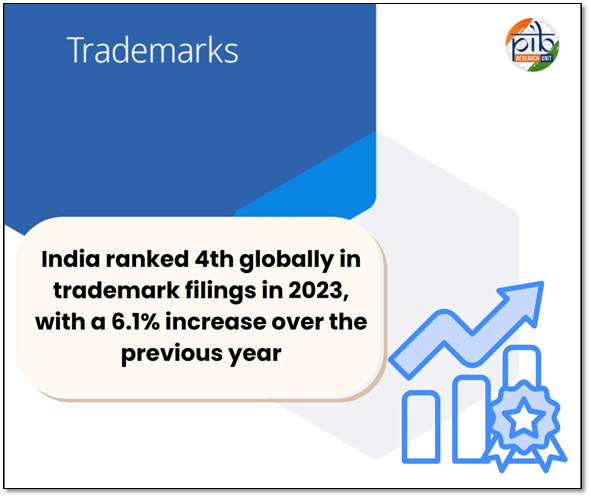
      India ranked 4th globally in trademark filings in 2023, with a 6.1% increase over the previous year. This growth underscores India’s growing emphasis on brand protection and intellectual property as essential drivers of business success. India’s ranking reflects the country’s increasing number of domestic and international businesses, all of which rely on trademarks to protect their brands and ensure consumer trust.
      Resident Filings Dominate:

      Nearly 90% of India’s trademark filings in 2023 were made by Indian residents, reflecting a strong domestic focus on brand protection. This shift suggests that Indian businesses, entrepreneurs, and startups are becoming more IP-savvy and are increasingly leveraging the trademark system to protect their innovations and brands.

      Active Trademark Registrations:

      India now holds the second-largest number of active trademark registrations in the world, with over 3.2 million trademarks in force. This indicates a highly active and competitive domestic marketplace, where businesses are not only creating new products but also working diligently to protect their brand identities. The large volume of active trademarks positions India as a major player in the global brand protection landscape, benefiting from both domestic innovation and the growing demand for Indian brands in international markets.

      Sectoral Trends:

      The largest proportion of trademark filings in India came from sectors such as Health (21.9%), Agriculture (15.3%), and Clothing (12.8%). These figures highlight India’s leadership in areas such as pharmaceuticals, food production, and fashion. As global demand for Indian products continues to rise, the importance of trademark filings as a tool for safeguarding brand equity becomes ever more critical, ensuring that Indian products and services maintain their competitive edge in international markets.

      India’s Position in Global IP Trends

      Contribution to Growth:

      India’s rising IP filings have been a significant part of the global trend of increased intellectual property activity. In 2023, a record 3.55 million patent applications were filed worldwide, with India contributing a meaningful share to this figure. As one of the fastest-growing markets in terms of IP filings, India is helping drive the global increase in innovation and IP protection, particularly in emerging markets.

      Shift Towards Local Innovation:

      The growth of resident filings in India—especially in patents and trademarks—demonstrates a shift towards local innovation. While global IP filings have traditionally been dominated by multinational corporations, India’s rising resident filings reflect a maturing domestic innovation ecosystem backed with the idea of Atmanirbhar Bharat campaign. More Indian companies and individuals are filing patents and trademarks, not just for protection, but as part of a strategy to strengthen their competitive advantage in both local and global markets.

      Government Initiatives Fuelling IP Growth

      National IP Policy:

      A key factor driving India’s growth in IP filings is the National Intellectual Property Rights (IPR) Policy, launched in 2016. This comprehensive framework is designed to guide the development and protection of intellectual property in India. The policy focuses on improving IP awareness, strengthening the IP ecosystem, and encouraging innovation by providing better access to IP services and protection mechanisms. By integrating all forms of intellectual property—such as patents, trademarks, industrial designs, copyrights, geographical indications, and more—the policy aims to foster a more robust and efficient IP environment. Objectives and activities undertaken under the National IPR Policy

      Amendments to IPR Laws: Improvements in procedural requirements to speed up the processing of applications.

      Modernization and Digitization of IP Offices: To enhance the performance and functioning of IP offices, streamlining workflows and reducing processing times.

      Awareness and Education: Programs such as the National Intellectual Property Awareness Mission (NIPAM) to spread IP awareness across educational institutions and businesses.

      IP Commercialization: Establishment of Technology Innovation Support Centres (TISC) in universities to support IP filings and the commercialization of patents and other IP.

      Scheme for Pedagogy & Research in IPRs for Holistic Education and Academia (SPRIHA), which aims to integrate IPR education into higher learning institutions across the country. Under the SPRIHA scheme, IPR Chairs have been established in various universities and academic institutions to facilitate specialized research, teaching, and training in intellectual property. These IPR Chairs provide a platform for faculty members and students to engage in cutting-edge research on intellectual property, its role in innovation, and its impact on industries and society.

      India’s vibrant start-up ecosystem is another key driver of the country’s growing IP activity. Government initiatives like Start-Up India, Digital India, Make in India and the Atal Innovation Mission, the Indian government has continuously fostered entrepreneurship, research, and technological advancement. Startup India was launched on January 16, 2016, with the goal of nurturing entrepreneurship, building a strong startup ecosystem, and transforming India into a nation of job creators rather than job seekers. This initiative includes a variety of programs designed to support emerging entrepreneurs. These efforts are coordinated by the Startup India Team, which reports to the Department for Promotion of Industry and Internal Trade (DPIIT). As of September 30, 2024, DPIIT has officially recognized 1,49,414 entities as startups.

      Atal Innovation Mission (AIM), established in 2016, is a flagship initiative of the Government of India to promote a culture of innovation and entrepreneurship across the country. AIM adopts a comprehensive approach to foster problem-solving and innovative thinking in schools, while also creating an entrepreneurial ecosystem in universities, research institutions, and the private and MSME sectors. Till date, AIM has established 10,000 Atal Tinkering Labs in Schools across the country, more than 3500 startups are incubated at Atal Incubation Centres and have created more than 32000 jobs in the ecosystem

      India as a Global Innovation Powerhouse

      India’s remarkable progress in the 2024 WIPO Report highlights its role as a rising global leader in intellectual property. With significant growth in patents, trademarks, and industrial designs, India is becoming a hub of global innovation. Its increasing number of resident filings demonstrates a shift toward homegrown creativity and invention, supported by an innovation-friendly ecosystem and government policies.
      Looking ahead, India is poised to continue its upward trajectory in global IP rankings. The country’s diverse and rapidly growing economy, coupled with its focus on research and development, makes it well-positioned to maintain its strong position in the global IP landscape. As more Indian companies and creators protect their innovations, India's global role in intellectual property will continue to expand.

      Reference:

      https://pib.gov.in/PressReleasePage.aspx?PRID=2072706

      https://www.meity.gov.in/writereaddata/files/National_IPR_Policy.pdf

      https://copyright.gov.in/Documents/SPRIHA.pdf

      https://www.wipo.int/edocs/pubdocs/en/wipo-pub-941-2024-en-world-intellectual-property-indicators-2024.pdf

      https://pib.gov.in/PressReleasePage.aspx?PRID=1941489

      https://pib.gov.in/PressNoteDetails.aspx?NoteId=153223&ModuleId=3&reg=3&lang=1

      Click here to see PDF. 

      Topics

      ActsIncome Tax

