 TaxTMI
 Login
 TaxTMI
Login
Loading...
Press 'Enter' to add multiple search terms. Rules for Better Search

Press 'Enter' after typing page number.
Press 'Enter' after typing page number.


No Folders have been created
Are you sure you want to delete "My most important" ?
NOTE:
Press 'Enter' after typing page number.
Press 'Enter' after typing page number.

All News
Press 'Enter' after typing page number.
All News

Note

Bookmark

Share


Good morning to you all!
In the Indian tradition, Namaskar, which means I salute the divinity in you.
It is always fulfilling to be here at the Annual Central Banking Seminar of the Federal Reserve Bank of New York. Over the years the seminar has become a landmark forum for the intermingling and cross-fertilisation of ideas and experiences among central bankers from all over the world. It is no wonder, therefore, that it has come to be regarded as a favoured stamping ground where practitioners of the profession rub shoulders and learn from each other about the ‘soiling of the hands’ in topically relevant issues in central banking.
I am grateful to Dr. Narahari Phatak, Head of International Policy and Strategy at the New York Fed – Hari – for inviting me to this year’s seminar. When Hari reached out to me in July, the world was characterised by considerable differentiation in the macroeconomic pathways being charted in different jurisdictions. Hence the defining feature of the conduct of monetary policy by central banks at that time was divergence, motivating the choice of the theme of this year’s seminar. Since then, however, much water has flown underneath the bridge and the world has changed in fundamental ways. After the US Federal Open Market Committee (FOMC) began its rate cutting cycle aggressively on September 18th this year, preceded by the second rate cut of the year by the European Central Bank (ECB) and followed by a fusillade of stimulus measures by China, convergence has become the dominant theme, barring some holdouts as in Japan, Brazil and Russia. Hence, I chose “Recalibrating from Divergence to Convergence” as the theme of my address under which I propose to share with you some aspects of the Indian experience (please see the Annex for relevant charts and tables).
II. Shock and Awe
The world is awash in an ocean of uncertainty, whipped up by hurricanes in the form of geopolitical conflict, geoeconomic fragmentation, financial market volatility, and overall policy uncertainty, including political spillovers during the Great Election year when more than half of the world’s population faces the ballot box. Financial markets continue to front run and second guess central banks on the size and timing of policy pivots and their consequences.
Frenzy rose to a flash point on August 5th following the rate hike by the Bank of Japan on July 31st and the release of US non-farm payrolls data on August 2nd. A blood bath reminiscent of Black Monday of 1987 was unleashed across financial markets worldwide as Yen carry trade unwound. The fear gauge – the CBOE2 Volatility Index or VIX – jumped more than 50 per cent, to its highest level since 2020.
Once again, on a single data release on September 3rd – the US Institute of Supply Management (US ISM) manufacturing index – recessionary fears resurfaced, setting off a rout in US equity markets that quickly spread to Asia and Europe. Thus, markets are recalibrating – albeit in a disorderly manner – from divergence to convergence. Every incoming data seems to be dispelling the gathering good feeling of soft landing and sparking fears of a jarring end to disinflationary monetary policy. Overall, however, markets have demonstrated substantial resilience. The speed of recovery from the shocks I described has been remarkable. Magnitudes of exchange rate changes were not outsized compared to past episodes. It is estimated that about half or US$ 250 billion of Yen carry trade was unwound3. Leveraged positions have been rebuilt. Risk taking has resumed, although the widening of the conflict in the Middle East in October has depressed equity market sentiment and pushed up commodity prices, especially of gold and crude oil.
III. Assessing Global Risks:
III.1. Geopolitical Stress, Trade and Overall Policy Uncertainty
In the Reserve Bank of India, we closely monitor global risks through: (1) the Geopolitical Risk (GPR) Index4, which tracks adverse geopolitical events through newspaper articles; (2) the Trade Policy Uncertainty (TPU) Index5, which covers the frequency of articles mentioning trade policy uncertainty and heightened trade tensions; and (3) the Global Economic Policy Uncertainty (GEPU) Index, which is a GDP-weighted average of national EPU indices for 21 countries representing about 71 per cent of global output on a PPP-adjusted basis and roughly 80 per cent at market exchange rates6. The GEPU Index gauges the impact of policy-related uncertainty on global economic activity.
These indices7 collectively provide insights into how uncertainty stemming from trade, geopolitical events and economic policy measures can influence economic conditions globally which can potentially spillover to influence macroeconomic and financial conditions in India.
As of mid-2024, the GEPU Index remains elevated, reflecting ongoing concerns about economic policies worldwide. The TPU Index has also been rising since November 2023, particularly influenced by trade tensions and policy changes among major economies. Meanwhile, the GPR Index points to significant global risks, with recent increases driven by ongoing conflicts.
Tensions in the Middle East have disrupted trade through one of the critical shipping routes – the Suez Canal (shortest shipping route between Europe and Asia). About 15 per cent of global maritime trade volume normally passes through the Suez Canal. Instead, several shipping companies have diverted their ships around the Cape of Good Hope, which has increased delivery times by 10 days or more, on average. These disruptions have also led to higher freight rates across major shipping routes, such as the China-Europe and China-US West Coast, which have gone up by 3 times over their pre-pandemic levels.
III.2. Global Financial Conditions
The global financial conditions index (GFCI) represents the cost and availability of credit in the global financial system8. The GFCI captures the co-movement of common latent factors in credit spreads, asset prices and volatility across money, bond, and equity markets – they tend to move in tandem during stress periods.
The GFCI vividly captures the tight financial conditions witnessed during the global financial crisis of 2008-09, the Eurozone debt crisis during 2011-12 and the recent experience during the COVID-19 pandemic. Interestingly, unlike previous episodes, tighter financial conditions during the COVID-19 Pandemic and the Russia-Ukraine War were reversed quickly, reflecting synchronous monetary policy actions.
III.3. Financial Market Spillovers
Global spillovers are typically transmitted to India through the financial market channel, mainly in equity and currency segments. Hence, volatility spillovers in these market segments are tracked through time-varying indices constructed by using high-frequency data on 21 major equity markets and 22 major currencies (measured against the US dollar), based on the Diebold-Yilmaz connectedness approach (2009; 2012)9. The path of the indices is shown by the thick lines (i.e., median) while the shaded region around the indices represents the range of spillovers across markets. For instance, global volatility spillovers across both equity and currency market segments reached unprecedented highs during 2020 as the COVID-19 pandemic unfolded across the world; and again from 2022 with the Russia-Ukraine war.
IV. Implications for India
IV.1. Economic Policy Uncertainty
Drawing on these global indices, a novel text mining-based policy uncertainty index for India has been constructed and updated by economists in the Reserve Bank of India. The index uses internet search data from Google Trends to construct a measure of policy uncertainty due to both domestic and global events. The index is updated in real time10.
Applying a one standard deviation shock to the index in a structural vector autoregression (SVAR) framework on quarterly data for India produces an interesting result. In the case of advanced economies such as the US, research suggests that uncertainty shocks lead to lower output and lower prices11. In the Indian context, however, uncertainty shocks tend to mimic aggregate supply shocks such that heightened uncertainty leads to slower growth but higher inflation. These results have been confirmed by multiple studies using different measures and identification approaches12. This presents a dilemma for monetary policy: tighten to control high inflation or ease to respond to lower growth!
IV.2. Supply Chain Pressures
The Global Supply Chain Pressure Index (GSCPI), developed by the Federal Reserve Bank of New York integrating over 27 variables, has also been found relevant for Indian conditions. We have developed an Index of Supply Chain Pressures for India (ISPI) - based on the methodology used in the GSCPI - to track supply chain pressures impacting India by extracting common factors from 19 domestic and global variables. The ISPI efficiently predicts industrial production and GDP and serves as a lead indicator for export volumes and inflation – Supply chain pressures impact growth in industrial production and core inflation with lags.
After witnessing significant spikes in the post-pandemic and post-Ukraine war periods, both global and domestic supply chain pressures have hovered around normal or less than normal levels since early 2023. Their relative softness has played a key role in the ebbing of inflation both globally and in India.
IV.3. Geoeconomic Fragmentation and Trade Flows
Global uncertainty also impinges on world trade volume growth. Growth in India’s merchandise exports and imports volume has been negatively impacted during episodes of rising geopolitical risk, especially since the start of the Russia-Ukraine war in February 2022 and the rise of Middle East tensions since October 2023. India’s merchandise exports, on an average, recorded a negative growth of 1.4 per cent during 2023-25 (up to September 2024).
IV.4. Capital Flows at Risk Analysis
Amidst global uncertainties, capital flows to India have been relatively robust, driven by equity flows. With the inclusion of Indian government bonds in global bond indices, debt flows have also improved.
The capital flows at risk (CaR) approach is a useful indicator to gauge the magnitude of expected capital outflows in response to specific shocks13. The kernel density function or distribution of capital flows over time in response to push and pull factors shows that in normal times, the chances of capital flight from India are negligible in view of strong pull factors. A shock to the US CBOE VIX mimicing the global financial crises makes the distribution of capital flows flatter and increases the tails of the distribution. This indicates higher probability of capital outflows in the occurrence of high intensity tail risk events such as the GFC.
The estimated tail risks (CaR at 5 per cent) to capital flows in case of India are found to be high and they match with the actual capital outflows during the GFC and the taper tantrum periods. This analysis helps us to make a realistic assessment of the adequacy of reserves.
IV.5. Financial Market Volatility Spillovers and Spillbacks
Time-varying measures of net volatility spillovers to Indian equity and currency markets from the rest of the world show that on a net basis, as with any other emerging market economy, India tends to be at the receiving end of global risk externalities14. These spillovers became heightened in the aftermath of the COVID-19 pandemic and the breakout of the Russia-Ukraine war. More recently, divergent monetary policies have produced less severe spillovers to equity markets, but they remained significant in the currency market. Instances of “spillbacks” - India transmitting volatility to the rest of the world – remain rare.
IV.6. Global Events and Financial System Stress
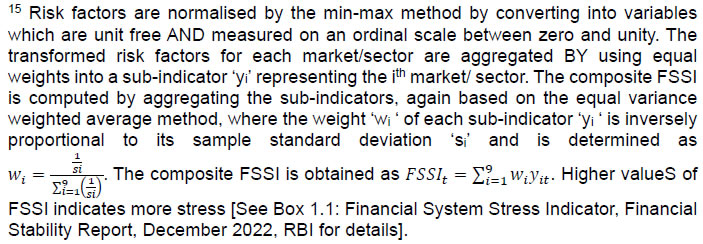
We also compile a financial system stress indicator (FSSI) to monitor the aggregate stress level in the Indian financial system. The FSSI features risk factors pertaining to five financial market segments – equity; foreign exchange; money; government debt; and corporate debt markets – and three groups of financial intermediary segments – banks; non-bank financial companies (NBFCs); and mutual funds15. It also features a real sector component encompassing real variables that have a bearing on financial stability due to their strong interlinkages with the financial sector. In all, 39 risk factors spread across nine markets/sectors are considered. The FSSI aims to (a) identify periods of stress; (b) assess the intensity and duration of stress in the financial system; and (c) gauge the ability of financial markets and intermediaries to withstand shocks and imbalances. The FSSI has tracked major stress events in the past. As per the latest FSSI update, India has witnessed a consistent decline in financial system stress since the Russia-Ukraine conflict.
V. Outlook for India
V.1. Growth
Against this backdrop, let me turn to the outlook for the Indian economy. We believe that the best defence against global risks is to strengthen the macroeconomic fundamentals and build adequate buffers, supported by prudent macroeconomic policies.
As Victor Hugo, the celebrated French writer, famously said: there is nothing more powerful than an idea whose time has come. Taking a cue from that influential remark, I do believe with all the strength of my conviction that India’s time has come. India heads into its future with the youngest population in the world with a median age of 28 years. Unlike in many parts of the world, the working age population is growing – every sixth working age person is an Indian. Since independence in 1947, India’s growth path has undergone three structural shifts with trend growth, having risen to 7 per cent during 2002-2019. After the severe contraction in the pandemic, a new growth trajectory averaging 8 per cent seems to be forming during 2021-24. India is now regarded as the fastest growing major economy in the world. Already the fifth largest economy in terms of market exchange rates, it is poised to become the third largest economy by 2030.
It is already the third largest economy in terms of purchasing power parity. Our projections show that India’s real GDP growth will be 7.2 per cent in 2024-25 and around 7.0 per cent in 2025-26 in a cyclical correction to the rebound from the pandemic. Thereafter, there is a strong likelihood that India’s growth will revert to the 8 per cent trend.
V.2. Inflation
Since 2016, India has adopted flexible inflation targeting (FIT) as its monetary policy framework. The inflation target is set at 4 per cent in terms of consumer price index (CPI) headline inflation with a tolerance band of +/- 2 per cent around it. In the aftermath of the war in Ukraine, inflation rose to a peak of 7.8 per cent in April 2022. Frontloaded monetary policy tightening with a cumulative 250 bps increase in the policy rate and a stance of withdrawal of accommodation guided inflation down to an average of 5.4 per cent in 2023-24, i.e., back into the tolerance band. It is projected to average 4.5 per cent in 2024-25 and 4.1 per cent in 2025-26. Inflation fell below target during July-August but rose to 5.5 per cent in September on the back of a pickup in price momentum in some food items and adverse base effects inherent in year-on-year measurement. Our projection indicates that these price pressures will persist in October and November before headline inflation realigns with the target from December 2024 and remains aligned in 2025-26.
V.3. Improving Financial Soundness and Buffers
Since 2018, India has engaged intensely in fortifying the soundness of financial institutions and building up adequate capital and liquidity buffers. Through a variety of processes including recognition, restructuring, resolution and write-offs, impairment in banks’ balance sheets has been brought down. Gross non-performing assets were just 2.7 per cent of total assets at the end of June 2024. Adjusted for provisions, the net non-performing asset ratio was only 0.6 per cent. As against the Basel minimum capital adequacy ratio of 8 per cent, India applies a minimum ratio of 9 per cent with a minimum of 7 per cent for Tier I capital. A capital conservation buffer of 2.5 per cent has to be maintained in addition to the minimum capital requirement, taking the overall regulatory capital requirement to 11.5 per cent of total risk weighted assets. At the end of June 2024, banks in India maintained a capital ratio of 16.7 per cent with Tier I capital of 13.9 per cent. Other buffers include the liquidity coverage ratio, which is well above 100 per cent, and the provision coverage ratio which is close to 80 per cent. Macro stress test reveals that no bank in India will fall below the regulatory minimum capital even under a severe stress scenario.
V.4 External Sector Indicators
Since the external sector receives the first blow from global spillovers, the policy endeavour has been to build up external sector soundness. The current account deficit (CAD) is modest at around 1 per cent of GDP. India has been a recipient of capital inflows, drawn by its robust macroeconomic fundamentals and stability. Hence external financing requirements are comfortably met. India has utilised the opportunity provided by strong international investors’ interest to build up foreign exchange reserves. Currently, as the fourth largest reserve holding country in the world, India’s reserves cover entirely the level of external debt, comfortably cover all debt servicing requirements and are equivalent or close to 12 months of imports. India’s exchange rate is among the least volatile in the world. We intervene in the foreign exchange market on both sides – sell and buy – to ensure adequate liquidity and minimise volatility so as to preserve financial stability, but without any view on the level of the exchange rate.
VI. Conclusion
In conclusion, I will briefly address some recent opportunities that have opened in the Indian context. India is emerging as a world leader in leveraging digital technologies for transformative change. The trinity of JAM – Jan Dhan (basic no-frills accounts); Aadhaar (universal unique identification); and mobile phone connections – is expanding the ambit of formal finance, boosting tech start-ups and enabling the targeting of direct benefit transfers. India’s Unified Payment Interface (UPI), an open-ended system that powers multiple bank accounts into a single mobile application of any participating bank, is propelling inter-bank peer-to-peer and person-to-merchant transactions seamlessly. Payment systems in India operate on a 24 by 7 by 365 basis. Functionalities like offline payments, payments through feature phones and conversational payments have been incorporated. The internationalisation of the UPI is progressing rapidly.
Taking these developments into account, a summary measure of digitalisation for India has been constructed by using a dynamic factor model (DFM)16. The index has been rising, reflecting the ongoing digital revolution.
The spread of digitalisation has spurred research on assessing the effects of digitalisation on the economy and the transmission of monetary policy. Early results for India suggest steepening of the Phillips curve and improvement in factor productivity, indicating improvement in the effectiveness of monetary policy transmission.
India is on the move and transforming rapidly in the quest of its aspirations. As various forces I have described coalesce and fall in place, this century could well mark the ascent of India on the world stage.
Thank you.
----------
1 Inaugural Address delivered by Michael Debabrata Patra, Deputy Governor, Reserve Bank of India (RBI) at the New York Fed Central Banking Seminar organised by the Federal Reserve Bank, New York, on October 21, 2024 at New York, USA. Valuable comments received from Binod B Bhoi, Harendra Behera, Bhanu Pratap, Subrat Seet, Sujata Kundu, Dhirendra Gajbhiye, Sangeeta Mathews, Sneharthi Gayen, Asish Thomas George, and editorial help from Vineet Kumar Srivastava are gratefully acknowledged.
2 The Chicago Board of Options Exchange.
3 https://www.ft.com/content/c6596fdd-d184-4dee-b6ff-f70c7081003a
4 Caldara, D., and Lacoviello, M. (2022). Measuring Geopolitical Risk. American Economic Review, 112(4), 1194-1225.
5 Caldara, D., Lacoviello, M., Molligo, P., Prestipino, A., and Raffo, A. (2020). The Economic Effects of Trade Policy Uncertainty. Journal of Monetary Economics, 109, 38-59.
6 Each national EPU index measures the frequency of newspaper articles discussing economic policy uncertainty, normalized to a mean of 100 from 1997 to 2015. Please see Baker, S. R., Bloom, N., and Davis, S. J. (2016). Measuring Economic Policy Uncertainty. The Quarterly Journal of Economics, 131(4), 1593-1636.
7 All these indices are hosted by https://www.policyuncertainty.com/
8 The index is constructed as a Z-score, such that a positive value represents tranquil times underlined by easy financial conditions i.e., low cost and easy availability of funding, while a negative value indicates tight financial conditions.
9 Diebold, F. X., and Yilmaz, K. (2009). Measuring financial asset return and volatility spillovers, with application to global equity markets. The Economic Journal, 119 (534), 158-171.
- Diebold, F. X., and Yilmaz, K. (2012). Better to give than to receive: Predictive directional measurement of volatility spillovers. International Journal of forecasting, 28(1), 57-66.
10 When faced with heightened uncertainty, it is typical of economic agents to 'search' for more information. The Google Trends-based uncertainty index (India-GUI) leverages this behaviour to measure overall uncertainty by using internet search volumes for a list of keywords pertaining to fiscal, monetary and trade policy in India. The policy-related keywords are curated, based on mentions in central bank policy statements as well as coverage in the financial press. For more details, please see Pratap, B., and Priyaranjan, N. (2023). Macroeconomic Effects of Uncertainty: a Google trends-based Analysis for India. Empirical Economics, 65(4), 1599-1625.
11 Leduc, S., and Liu, Z. (2016). Uncertainty Shocks are Aggregate Demand Shocks. Journal of Monetary Economics, 82, 20-35; Kumar, A., Mallick, S., and Sinha, A. (2021). Is Uncertainty the Same Everywhere? Advanced versus Emerging Economies. Economic Modelling, 101, 105524.
12 Pratap, B., and Priyaranjan, N. (2023), op cit.
13 In this framework, first, a link between different quantiles of capital flows and their drivers is established by using a quantile regression to predict capital flows for various quantiles. In the second step, the predicted capital flows are used to obtain the empirical distribution of future capital flows. The risks to capital flows are then quantified by estimating the size of outflows for a given probability (i.e., usually at 5 per cent) from the empirical distribution. The predicted capital flows of lower and higher quantiles show the dynamics of CaR over time. For details, please refer to Patra, M.D., Behera, H., and Muduli, S. (2022). Capital Flows at Risk: India’s Experience. RBI Bulletin, June.
14 While negative values of the measure indicate that India “receives” spillovers from the rest of the world; positive values highlight that India “transmits” volatility to the rest of the world. Please refer to Gupta, R. K., Pratap B., Raut S., and Sonna, T. (2024). Measuring Inter-Connectedness between Global Financial Markets: A Study for India. RBI Monthly Bulletin, Reserve Bank of India (forthcoming).
16 The index is based on digital payments, number of internet users, number of mobile phone subscriptions, number of QR codes generated per 100 persons, credit to the software industry, investment in ICT (information and communication technology) and people employed in the ICT sector.

