 TaxTMI
 Login
 TaxTMI
Login
Loading...
Press 'Enter' to add multiple search terms. Rules for Better Search

Press 'Enter' after typing page number.
Press 'Enter' after typing page number.


No Folders have been created
Are you sure you want to delete "My most important" ?
NOTE:
Press 'Enter' after typing page number.
Press 'Enter' after typing page number.

All News
Press 'Enter' after typing page number.
All News

Note

Bookmark

Share


MISSION LiFE FOCUSSES ON HUMAN-NATURE HARMONY PROMOTING MINDFUL CONSUMPTION THAN OVERCONSUMPTION THAT LIES AT THE ROOT OF GLOBAL CLIMATE CHANGE PROBLEM
Taking a critical view of the Western approach of tackling Climate Change, the Economic Survey 2023-24 gives a clarion call to all developing countries to look at climate change problem from a ‘local lens’. It states that a ‘one-size-fits-all’ approach will not work, and developing countries need to be free to choose their own pathways since they are tasked with balancing developmental goals with meaningful climate action.
The Economic Survey 2023-24, tabled by the Union Minister for Finance and Corporate Affairs Smt. Nirmala Sitharaman in Parliament today, clearly states that current global strategies for climate change are flawed and not universally applicable. It states that adopting the practices of the West could prove to be disastrous for India where culture, economy, societal norms are already intertwined with the environment.
The document highlights that India, despite making significant strides in climate action, often faces criticism for not aligning with Western solutions. This criticism stems from a lack of appreciation for India's unique social and cultural fabric, which is already rich with sustainable development ideas. It further goes on to point out inherent inconsistencies where the prescriptions to tackle Climate Change from the developed world do not hold ground globally. These are:
The Economic Survey 2023-24 stresses that India’s ethos emphasizes a harmonious relationship with nature, in sharp contrast to the culture of overconsumption prevalent in other parts of the developed world, thus offering sustainable solutions to problems plaguing Western societies. For instance:
The Survey notes that traditional farming practices from the developing world, where several agricultural activities are integrated with livestock rearing, offer one solution to the problem. Repurposing farm waste and by-products from other agricultural activities as animal feed not only lowers the financial and environmental cost of meat production but also brings balance to the natural cycle. Shifting livestock to human-inedible feed can free up significant shares of global arable land to address global hunger, it adds.
A shift towards the ‘traditional multi-generational households’ would create the pathway towards sustainable housing, notes the Survey. Sourcing materials and labour locally for the construction of houses, central courtyards with well-ventilated spaces, and avenues for natural lighting and cooling would all exert a positive externality on the environment by lowering resource and energy requirements. Such a household would also prove immensely beneficial for the elderly, it states.
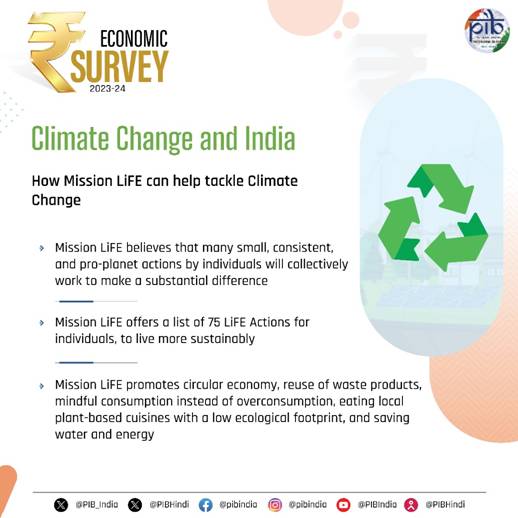
In order to profess a solution to these issues, the Economic Survey brings in perspective Prime Minister Shri Narendra Modi’s vision of Mission LiFE. It embodies a ‘Lifestyle For Environment’ seeking to address the ‘wants’ of the people without letting them hurt Nature. The approach seeks to bring individual responsibility to the forefront of the fight against climate change, as sustenance is at the core of Indian ethos.
The Mission encompasses a comprehensive but non-exhaustive list of 75 LiFE Actions for adoption by individuals to live more sustainably. At its heart, it promotes mindful consumption instead of overconsumption, encourages a circular economy and the reuse of waste products, eating local plant-based cuisines with a low ecological footprint, saving water and energy, notes the Survey.
The document quotes the International Energy Agency and states that adoption of the kinds of actions and measures targeted by the LiFE initiative worldwide would reduce annual global carbon di-oxide emissions by more than 2 billion tonnes in 2030 (20% of the emissions reductions needed by 2030) and in consumer savings of about USD 440 billion.
In conclusion, the Survey document upholds the tenets of Mission ‘LiFE’ and notes that the global movement on climate change must be accommodative of sovereign choices and economic needs, but centered on individual behavior. ‘It’s time to rebuild societies with equanimity’, it adds.

