

Loading...

Top
Help
×

By creating an account you can:

Logo TaxTMI
Call Us / Help / Feedback

Contact Us At :

E-mail: [email protected]

Call / WhatsApp at: +91 99117 96707

For more information, Check Contact Us

FAQs :

To know Frequently Asked Questions, Check FAQs

Most Asked Video Tutorials :

For more tutorials, Check Video Tutorials

Submit Feedback/Suggestion :

Email :
Please provide your email address so we can follow up on your feedback.
Category :
Description :
Min 15 characters 0/2000
Make Most of Text Search
  1. Checkout this video tutorial: How to search effectively on TaxTMI.
  2. Put words in double quotes for exact word search, eg: "income tax"
  3. Avoid noise words such as : 'and, of, the, a'
  4. Sort by Relevance to get the most relevant document.
  5. Press Enter to add multiple terms/multiple phrases, and then click on Search to Search.
  6. Text Search
  7. The system will try to fetch results that contains ALL your words.
  8. Once you add keywords, you'll see a new 'Search In' filter that makes your results even more precise.
  9. Text Search
Add to...
You have not created any category. Kindly create one to bookmark this item!
Create New Category
Hide
Title :
Description :
❮❮ Hide
Default View
Expand ❯❯
Close ✕
🔎 News - Adv. Search
TEXT SEARCH:

Press 'Enter' to add multiple search terms. Rules for Better Search

Search In:
Main Text + AI Text
  • Main Text
  • Main Text + AI Text
  • AI Text
Category: ?
Categorized by AI
---- All Categories ----
  • ---- All Categories ----
  • Income Tax
  • GST
  • Customs, DGFT & SEZ
  • FEMA & RBI
  • Corp. Laws, SEBI & IBC
  • PMLA, Black Money & ED
  • Budget
  • News and Press Release
  • PTI News
Month:
---- All Months ----
  • ---- All Months ----
  • January
  • February
  • March
  • April
  • May
  • June
  • July
  • August
  • September
  • October
  • November
  • December
Year:
---- All Years ----
  • ---- All Years ----
  • 2026
  • 2025
  • 2024
  • 2023
  • 2022
  • 2021
  • 2020
  • 2019
  • 2018
  • 2017
  • 2016
  • 2015
  • 2014
  • 2013
  • 2012
  • 2011
Sort By: ?
In Sort By 'Default', exact matches for text search are shown at the top, followed by the remaining results in their regular order.
Relevance Default Date
    AssetPlus Launches Portfolio Management Services to Help MFD Partners Grow and Retain High-Net-Worth Clients
    APEDA Facilitates Flag-Off of 18 MT of NPOP-Certified Ethnic Rice from Tripura for Export to Austria and the Netherlands
    VR LIVIN’s ‘THE FIRST’ Records Sale of 20 Villas Within Two Days of Launch
    IAAPI Calls for GST Rationalisation to Support Growth and Consumer Demand in India’s Amusement Industry
    ED raids multiple locations in Keralam in hybrid ganja smuggling money laundering case
    Rupee jumps 47 paise to 94.26 against US dollar in early trade
    ED raids multiple locations in Kolkata in bank loan fraud case
    Commerce & Industry Minister Shri Piyush Goyal Calls Upon Auto Component Industry To Go Global
    18th Meeting of Heads of IP Offices of BRICS Countries Held in New Delhi
    India’s Sovereign Credit Rating upgraded to 'A-' with Stable Outlook by Japan Credit Rating Agency
    Secretary, DFS Chairs Review Meeting on Financial and Business Performance of Public Sector General Insurance Companies (PSGICs)
    GIFT IFSC emerges as a strong and vibrant international banking hub, mobilises over $52.8 billion under RBI’s FCNR(B) Swap Facility, $11.62 bn in EC...
    Ex-CII executive Shuchita Sonalika appointed COO of Canada-India Business Council
    India's 7.8% growth despite global disruptions remarkable: FM Sitharaman at investors meet in US
    After 35 years, India's sovereign rating upgraded to 'A-' by JCR on solid growth, resilient financial system
    Rupee rises 22 paise to close at 94.73 against US dollar
    India draws record USD 127 bn forex deposit in special drive
    Banks mobilise USD 127.23 billion in deposits from Indian diaspora: RBI
    CBI Arrests CGST Additional Commissioner and Two others in Rs. 40 Lakh Bribery Case in Raigad, Maharashtra
    Haryana: SGST collections grow 29 pc in first 5 months of 2026-27
❯❯
Maximize Maximize Maximize
0 / 200
Expand Note
Add to Folder

No Folders have been created

+

Are you sure you want to delete "My most important" ?

NOTE:

News
Showing Results for :
Reset Filters
Results Found:
Show All Summaries Hide All Summaries
September 3, 2026
Show AI Summary
Portfolio management services distribution enables certified mutual fund distributors to digitally onboard and report for eligible high-net-worth clients through AssetPlus.
AssetPlus has launched Portfolio Management Services for certified Mutual Fund Distributor partners to digitally onboard, track, manage and report PMS investments for eligible high-net-worth clients. PMS distribution requires NISM Series-XXI-A certification and operates within the APRN distributor-registration framework. PMS comprises individually managed portfolios run by SEBI-registered Portfolio Managers and held in clients' demat accounts. The minimum investment is Rs. 50 lakh, and offerings are governed by the SEBI (Portfolio Managers) Regulations, 2020. The platform provides daily reconciliation of holdings, performance and valuations.
September 3, 2026
Show AI Summary
NPOP-certified ethnic rice exports strengthen organic producer access to international markets through certification, traceability, and organised export production.
NPOP-certified ethnic rice exports from Tripura to Austria and the Netherlands connect local farmers and Farmer Producer Companies with international markets through organised, export-oriented production. The initiative emphasises certification, traceability, food safety and quality as requirements for access to markets for certified organic products. Buyer-seller linkages support export opportunities, while coordinated organic value-chain engagement strengthens certification and quality systems and supports producers in meeting international standards.
September 3, 2026
Show AI Summary
Gated residential community launch combines smart-home villas, extensive lifestyle amenities and planned expansion into future residential developments.
VR LIVIN Ventures LLP launched 'THE FIRST', an 83-villa gated residential community in Madhavaram, North Chennai, which recorded sales of 20 villas during its first two launch days. The development includes smart-home villas and more than 50 lifestyle amenities, with access to nearby metro connectivity and social infrastructure. It forms part of the company's intended expansion of residential projects in Chennai and other South Indian locations.
September 3, 2026
Show AI Summary
GST rationalisation for amusement park admissions could lower ticket prices, stimulate consumer demand, and support investment without input tax credit.
GST rationalisation for amusement park, water park and indoor entertainment admission tickets is sought through a flat 5% GST rate without Input Tax Credit. The proposed rate is intended to reduce ticket prices, improve affordability and increase customer demand in a capital-intensive tourism and entertainment sector. Many smaller and mid-sized operators report limited ability to offset GST liability through ITC. Lower taxation is projected to support facility expansion, revenue growth, new investment, employment and reinvestment in recreational services.
September 3, 2026
Show AI Summary
Money laundering linked to hybrid ganja smuggling involves alleged illicit cross-border transfers and foreign-exchange violations.
Enforcement Directorate searches form part of a money-laundering investigation into alleged hybrid ganja smuggling from Thailand. A case under the Prevention of Money Laundering Act concerns suspected laundering of drug-trafficking proceeds and transfer of funds to Thailand through illegal channels. The inquiry also examines possible foreign-exchange violations and an alleged arrangement involving carriers, visas and funds for transporting narcotic substances.
September 3, 2026
Show AI Summary
Foreign-currency deposit mobilisation supports currency appreciation while creating surplus-liquidity sterilisation pressures through deposit swaps in domestic banking markets.
Foreign-currency deposit mobilisation strengthened foreign-exchange liquidity and supported rupee appreciation. FCNR(B) deposits, together with overseas foreign-currency borrowings and external commercial borrowings, increased aggregate foreign-currency resources. Bank swaps of such deposits with the central bank may create surplus banking-system liquidity and a sterilisation challenge, while oil prices, global yields, dollar movements and foreign equity inflows remain relevant currency-market factors.
September 3, 2026
Show AI Summary
Money laundering investigation examines alleged diversion of bank loans from a power project to group entities and personal use.
Money laundering investigation under the Prevention of Money Laundering Act concerns alleged diversion of bank loans obtained by Kohinoor Power for a power plant in Jharkhand. The loan proceeds were allegedly transferred to other group entities and used personally. Searches were conducted at eleven premises associated with the group's promoters, directors and auditors. The company entered liquidation proceedings before the National Company Law Tribunal, with limited recovery for creditors.
September 3, 2026
Show AI Summary
Globalisation of auto component manufacturing is linked to trade access, resilient supply chains, technology adoption, safety, and vehicle scrappage.
The auto component industry is encouraged to expand globally through reciprocal market access, overseas manufacturing, international investment and trade partnerships. Supply-chain resilience is to be strengthened through indigenisation of vulnerable products, access to critical minerals, and domestic capacity in auto components, speciality steel, technical textiles and semiconductors. Priority is also given to high-value integrated solutions, artificial intelligence-enabled quality control, vehicle safety and industrial parks offering manufacturing infrastructure. Vehicle scrappage requires coordinated government incentives and fair industry valuation to support replacement demand for new-age vehicles.
September 3, 2026
Show AI Summary
Updated IP cooperation guidelines strengthen cross-border innovation, patent examination coordination, traditional knowledge protection, and geographical indication commercialisation.
IP BRICS Heads adopted Updated Operational Guidelines to direct result-oriented intellectual property cooperation, promote cross-border innovation, and reinforce joint engagement in global IP standards. Priority areas include protection of traditional knowledge and traditional systems of medicine, reinforced patent examination cooperation, exchange of search results, patent analytics, and geographical indication protection and commercialisation. Coordination mechanisms and periodic progress reviews are emphasised for effective implementation and continuity of cooperation.
September 3, 2026
Show AI Summary
Sovereign credit rating upgrade reflects resilient growth, improved fiscal expenditure quality, stronger financial systems, and a robust external position.
India's long-term foreign-currency and local-currency issuer ratings were upgraded from 'BBB+' to 'A-', with a Stable Outlook, reflecting resilient economic growth, improved fiscal expenditure quality, strengthened financial-sector soundness, and a robust external position. Fiscal improvement is linked to greater capital expenditure and lower fiscal deficit. Financial resilience is supported by improved banking and non-banking sector asset quality and capital adequacy. External strength arises from a contained current account deficit, services surplus, and foreign-exchange reserves exceeding short-term external debt.
September 3, 2026
Show AI Summary
Public sector general insurance performance requires profitable underwriting, lower claim ratios, digitalisation, standardised monitoring, and quality grievance redressal.
Public Sector General Insurance Companies were advised to focus on profitable business lines, reduce the Incurred Claim Ratio, and accelerate technology use and digitalisation while optimising related expenditure. They are to improve insurance penetration, density, outreach and customer awareness, particularly in underserved segments, while reducing protection gaps. A robust, standardised KPI framework should enable comparable financial and non-financial performance assessment and be reviewed quarterly. Customer grievances require expeditious and quality redressal.
September 3, 2026
Show AI Summary
Cross-border financing through GIFT-IFSC expands foreign currency mobilisation, external commercial borrowing disbursements, and international bond market access.
GIFT-IFSC's IBUs mobilised foreign-currency liquidity under the RBI's FCNR(B) deposit swap facility, with 20 IBUs sanctioning USD 54.02 billion and disbursing approximately USD 52.82 billion as at 31 August 2026. Between April and August 2026, IBUs disbursed USD 11.62 billion in External Commercial Borrowings, while Indian banks raised USD 11.12 billion through bond listings on IFSC exchanges. These activities support cross-border financing, international capital-market access and foreign-exchange inflows.
September 3, 2026
Show AI Summary
Bilateral business council leadership appointment strengthens operational capacity to advance Canada-India economic and investment partnerships.
Operational leadership for bilateral economic engagement is strengthened through the appointment of Shuchita Sonalika as the first Chief Operating Officer of the Canada-India Business Council. The appointment is directed toward enhancing the council's capacity to support expanding investment and economic relations between Canada and India, in coordination with its board, members and partners. Sonalika brings international affairs experience in advancing India's economic partnerships across global markets.
September 3, 2026
Show AI Summary
Regulatory certainty and compliance reforms support investment facilitation, infrastructure development, MSME credit access, and reduction of bank non-performing assets.
Regulatory certainty, ease of compliance and investment facilitation are identified as central elements of India's economic reform orientation. The Insolvency and Bankruptcy Code is included among reforms supporting regulatory certainty, reduced paperwork and easier compliance. Policy priorities include infrastructure development, artificial intelligence and data centres, credit access for MSMEs, reduction of banks' non-performing assets, fiscal discipline, and investment facilitation by central and state governments.
September 2, 2026
Show AI Summary
Sovereign credit rating upgrade reflects resilient economic growth, fiscal quality, financial-system soundness, and external-sector resilience.
Japan Credit Rating Agency upgraded India's foreign-currency and local-currency long-term issuer ratings to A-, citing solid economic growth, strengthened growth-oriented policies and improved financial-system soundness. Improved banking asset quality, insolvency mechanisms, government capital infusion and stronger central-bank supervision support financial resilience. Fiscal quality has improved through greater infrastructure-focused capital expenditure and restraint in current spending, while a contained current-account deficit, services surplus and substantial foreign-exchange reserves support resilience to external shocks.
September 2, 2026
Show AI Summary
Currency-market intervention and foreign capital inflows supported rupee resilience amid higher crude prices and dollar strength.
Foreign capital inflows and modest foreign institutional equity purchases supported rupee appreciation against the US dollar despite weak domestic equities, elevated crude oil prices and a stronger dollar. RBI monitoring and apparent currency-market intervention supported the rupee amid risk aversion, higher US Treasury yields and concerns over crude supply disruptions. Forthcoming US employment data remained relevant to dollar and rupee direction.
September 2, 2026
Show AI Summary
Foreign-currency non-resident deposits bolster external liquidity through hedging support and lending flexibility during global market uncertainty.
Foreign Currency Non-Resident (Bank) [FCNR(B)] deposits are fixed-term foreign-currency deposits for non-resident Indians, with principal and interest repayable in the deposit currency and without direct rupee exchange-rate risk. A special central-bank programme mobilised substantial FCNR(B) deposits, alongside overseas foreign-currency borrowings and external commercial borrowings, to strengthen foreign-exchange liquidity. Banks received hedging-cost support and permission to lend against the deposits. The facility was closed earlier than scheduled after its mobilisation objective was met.
September 2, 2026
Show AI Summary
Foreign currency swap facility accelerated FCNR(B) deposit window closure after substantial diaspora inflows, while borrowing windows remain open.
Special USD-INR foreign-exchange swap facility for FCNR(B) deposits, Overseas Foreign Currency Borrowings and External Commercial Borrowings was introduced to strengthen the external sector and support foreign-exchange liquidity. FCNR(B) deposits, under which principal and interest are repayable in the same foreign currency, generated the principal share of inflows. Strong diaspora participation led to advancement of the FCNR(B) window closure. The swap facility for Overseas Foreign Currency Borrowings and External Commercial Borrowings remains open until December 31, 2026.
September 2, 2026
Show AI Summary
GST bribery allegations led to a trap operation against officials and an intermediary in a quarrying matter.
Criminal investigation concerns alleged solicitation and acceptance of an undue advantage by CGST officials in connection with settling a GST/royalty matter involving a stone-quarrying firm. The officials allegedly arranged for a private person to collect the payment. A trap operation resulted in the private person being caught while accepting the alleged undue advantage. Searches at the accused persons' premises led to recovery of cash and jewellery, while further investigation continues.
September 2, 2026
Show AI Summary
State GST collection growth outpaced national expansion during the first five months, alongside increased VAT and CST receipts.
Haryana's SGST collections increased by 29 per cent during April-August of financial year 2026-27, exceeding the national growth rate of 16 per cent. August 2026 post-settlement SGST revenue rose by 21 per cent, compared with national average growth of 13 per cent. Haryana accounted for less than 4 per cent of national GST taxpayers but contributed approximately 7.7 per cent of aggregate national SGST, CGST and IGST collections. VAT/CST collections rose by 13.8 per cent during the same period.

News

Back

All News

Showing Results for :
Reset Filters
No Records Found

News

Showing Results for : Reset Filters

INDUSTRIAL SECTOR GROSS VALUE ADDED (GVA) ROSE BY 3.7 PER CENT IN FIRST HALF OF FY23

January 31, 2023

Contents
Summary
Note

Note

-

Bookmark

Print

Print

INDUSTRIAL SECTOR GROSS VALUE ADDED (GVA) ROSE BY 3.7 PER CENT IN FIRST HALF OF FY23

PRIVATE FINAL CONSUMPTION EXPENDITURE (PFCE) AS A SHARE OF GDP IN H1 OF FY23 WAS HIGHEST AMONG ALL HALF YEARS SINCE FY15

FDI INFLOW AT US$ 21.3 BILLION IN FY22 MARKING 76 PER CENT RISE FROM FY21

INDIAN PHARMACEUTICAL EXPORTS ACHIEVED 24 PER CENT GROWTH IN FY21

CUMULATIVE FDI IN PHARMA SECTOR CROSSED US$ 20 BILLION MARK BY SEPTEMBER 2022

COAL PRODUCTION FOR FY23 ESTIMATED TO INCREASE TO 911 MILLION TONNES

INDIA IS NOW THE 3RD LARGEST AUTOMOBILE MARKET

INDIA IS 2ND LARGEST MOBILE PHONE MANUFACTURER GLOBALLY

CREDIT TO INDUSTRY GROWING, PARTICULARLY FOR MSMEs

PLI SCHEME EXPECTED TO ATTRACT CAPEX OF APPROX ₹4 LAKH CRORE OVER THE NEXT FIVE YEARS

INDUSTRY 4.0 IS INDIA’S WAY FORWARD IN ACHIEVING THE GOALS OF AATMANIRBHARTA AND AMBITIONS OF BECOMING A KEY PLAYER IN GLOBAL VALUE CHAINS

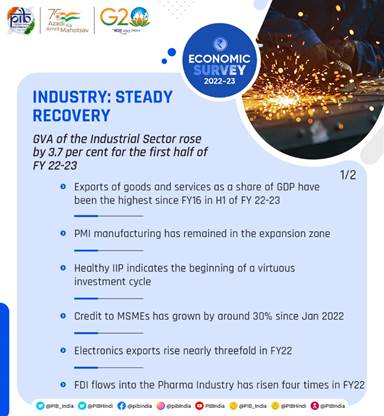
The Overall Gross Value Added (GVA) by the Industrial Sector rose 3.7 per cent, based on data available for the first half of the FY23, which is higher than the average growth of 2.8 per cent achieved in H1 of the last decade, stated the Economic Survey 2022-23 presented by the Union Minister for Finance & Corporate Affairs Smt. Nirmala Sitharaman in Parliament today.

OVERVIEW OF INDUSTRIAL SECTOR

Economic Survey tabled in the Parliament stated that Industry sector witnessed modest growth of 4.1 per cent in FY23 compared to the strong growth of 10.3 per cent in FY22. It explained that this is likely on account of input cost-push pressures, supply chain disruptions and the China lockdown impacting the availability of essential inputs and slowing the global economy.

The Survey highlighted that the PLI schemes are set to unlock manufacturing capacity, boost exports, reduce import dependence and lead to job creation for both skilled and unskilled labour. The Survey was optimistic that easing input prices and conducive demand conditions will support overall Industrial growth.

DEMAND STIMULUS TO INDUSTRIAL GROWTH

Private Final Consumption Expenditure (PFCE) as a share of GDP in H1 of FY23 was the highest among all half years, H1 or H2, since FY15, the Survey stated. The Survey optimistically expressed that with world commodity prices on a downward trajectory and showing up in declining rates of India’s wholesale inflation, core retail inflation is expected to relent, making domestic consumption demand much stronger to further induce industrial growth in the country.

Economic Survey stated that the strong export performance of FY22 continued somewhat in the first half of FY23 while exports of goods and services as a share of GDP have been the highest since FY16 during H1 of FY23.

The Survey warned that export growth may slow further in the second half of the current financial year and remain weak beyond that, too, if the global economy falls into recession. It added that however, the strong domestic consumption growth and investment revival is expected to keep industrial production humming.

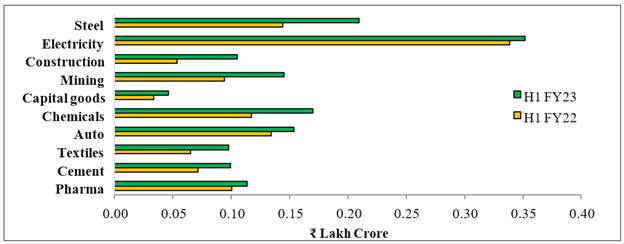
The Survey emphasized that New Investment announced in the manufacturing sector during April-December of FY23 was five times the corresponding level in FY20. The Survey analyzed this increase in investment demand was triggered by the augmented capex of the central government in the current and the previous year as compared to the pre-pandemic years. The leap also has crowded in private investment, already upbeat on the pent-up demand, export stimulus, and strengthening of the corporate balance sheets. It added that Capacity utilization in the manufacturing sector has been rising which bodes well for new investment activity in creating additional capacity.

SUPPLY RESPONSE OF INDUSTRY

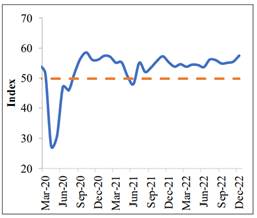
Purchaser’s Manufacturing Index (PMI) manufacturing has remained in the expansion zone for 18 months since July 2021, and its sub-indices indicate an easing of input cost pressures, improving supplier delivery times, robust export orders, and future output, highlighted the Survey.

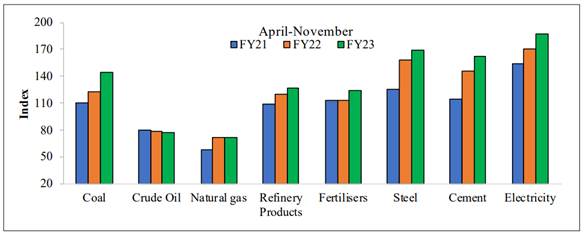
The Survey noted the growth of the eight core industries of coal, fertilizers, cement, electricity, steel, and refinery products has held steady, reflecting a broad momentum in industrial activity.

The Survey added that while growth in the consumer durables component of the Index of Industrial Production (IIP) is on account of the release of ‘pent-up’ demand, the increase in capital goods and infrastructure/ construction goods is indicative of the beginnings of a virtuous investment cycle that is expected to be led by the private sector.

ROBUST GROWTH IN BANK CREDIT TO INDUSTRY

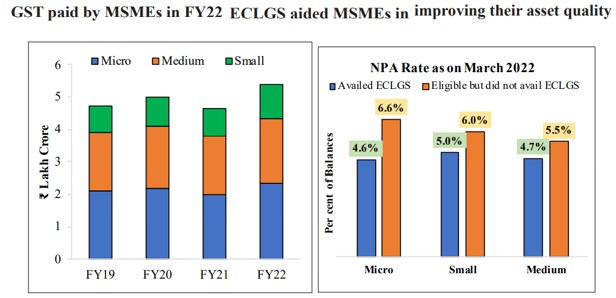
The Survey highlighted that the credit to industry started recovering from January 2022 and has been growing in double digits since July 2022. It added that Credit to MSMEs has also seen a significant increase in part, assisted by the introduction of the Emergency Credit Linked Guarantee Scheme (ECLGS).
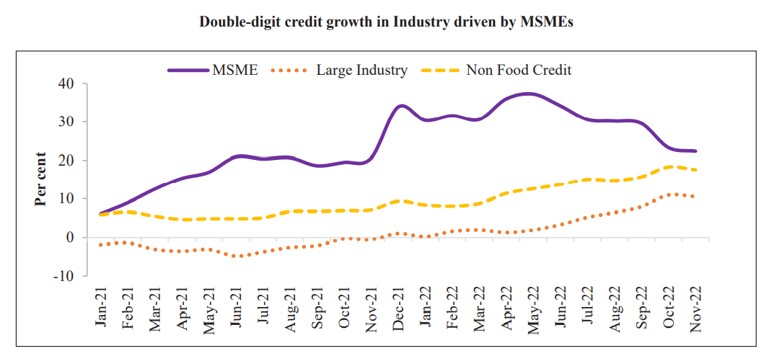
The Survey stated that the impact of ECLGS on increasing the growth of credit to MSME was felt most during the pandemic impacted years of 2020 and 2021. It continued in 2022 as the scheme was extended to March 2023.

Further it added, growth in credit to MSME was buttressed by rebounding consumption levels, particularly in the services sector. Consequently, the share of MSMEs in gross credit offtake to the industry rose from 17.7 per cent in January 2020 to 23.7 per cent in November 2022.

The Survey expressed that robust growth in credit demand combined with rising capacity utilization and investment in manufacturing underscores businesses’ optimism regarding future demand.

RESILIENT FDI INFLOW IN MANUFACTURING SECTOR

The Survey highlighted that the FDI inflow jumped to US$ 21.3 billion in FY22 from US$ 12.1 billion in FY21 as the pandemic-driven expansionary policies of advanced economies led to a surge in global liquidity.
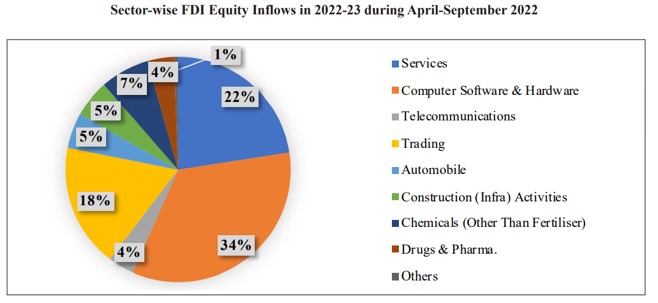
The Survey mentioned that FDI equity inflow in manufacturing in the first half of FY23 fell below its corresponding level in the first half of FY22, with the rise in global uncertainty in the wake of the Russia-Ukraine conflict.

A rebound in FDI inflows is, however, expected as the Indian economy sustains its high growth while monetary tightening the world over eventually eases with the weakening of inflationary pressures, the Survey expressed optimism.

HIGHLIGHTS OF INDUSTRY GROUPS

1. MICRO, SMALL AND MEDIUM ENTERPRISES (MSMEs)

The Survey noted that the MSME contribution to the manufacturing sector’s GVA also marginally fell to 36.0 per cent in FY21. The Survey further emphasized that the AatmaNirbhar Bharat Package by the Government provided cushion to the economic impact of the pandemic on MSMEs, which has helped post smart recovery from pandemic.

The Survey expressed that the recovery of the MSME sector from the pandemic-induced shock is evident in the trend in GST paid by the units of MSME sector in FY22 has crossed the pre-pandemic level in FY20.

Government’s initiative of the Samadhaan Portal, CHAMPIONS:the single-window grievance redressal portal for MSMEs, Trade Receivables Discounting System (TReDS) platform for facilitating the discounting of trade receivables of MSMEs with a turnover of ₹200 crore or more, ‘Raising and Accelerating MSME Performance’ scheme (RAMP) etc. has helped in strengthening the MSMEs stated the Economic Survey.
      

2. ELECTRONICS INDUSTRY

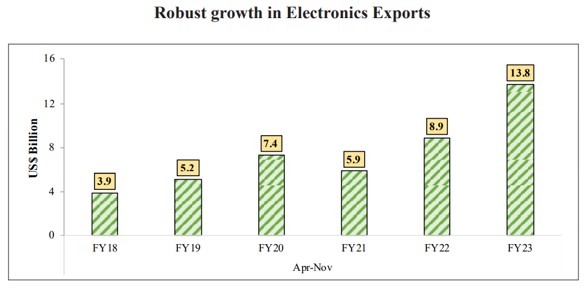
The Survey emphasized that Electronic goods were among the top five commodity groups exhibiting positive export growth in November 2022, with the exports in this segment growing YoY by 55.1 per cent.

Elaborating on the Electronics industry, the Survey stated that major drivers were mobile phones, consumer electronics and industrial electronics. It highlighted that India has become the second-largest mobile phone manufacturer globally, with the production of handsets going up from six crore units in FY15 to 31 crore units in FY22.
The Survey also mentioned that various initiatives and incentives of Government like PLI scheme for Large Scale Electronics Manufacturing, the PLI scheme for IT hardware, the Scheme for Promotion of Manufacturing of Electronic Components and Semiconductors (SPECS) has nurtured and enhanced the electronics manufacturing base.

Additionally, under the Programme for Development of Semiconductors and Display Manufacturing Ecosystem in India, the Cabinet approved the comprehensive development of a sustainable semiconductor and display ecosystem in the country with an outlay of ₹76,000 crore.

3. COAL INDUSTRY

The coal production for FY23 is estimated to increase to 911 million tonnes, about 17 per cent higher compared to the previous year, highlighted the Survey. Consequent to the well-timed measures of the Government, India has been placed in a better position to cater to excess energy demand. It further added that the coal industry is expected to grow at 6-7 per cent annually to reach a production level of 1 billion tonnes by FY26 and about 1.5 billion tonnes by 2030.

4. STEEL INDUSTRY

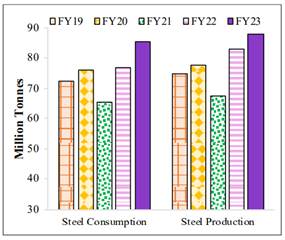
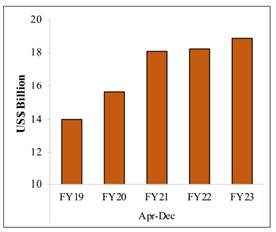
Economic Survey highlighted the steel sector’s performance in the current fiscal year as robust, with cumulative production and consumption of finished steel at 88 MT and 86 MT, respectively, during April-December 2022, higher than the corresponding period during the previous four years.

The Survey stated that iron and steel exports are higher by 20 per cent over the corresponding pre-pandemic levels of FY20, despite moderation in the first eight months of the current fiscal owing to a slowdown in the global economy.

Increasing Steel production and Consumption (Apr-Dec)
5. TEXTILE INDUSTRY

In the current financial year, the textile industry has been facing the challenge of moderating exports compared to FY22, mentioned the Survey. It added that export of readymade garments registered a growth of 3.2 per cent YoY basis during the same period.

The Government approved the setting up of seven PM Mega Integrated Textile Region and Apparel (PM MITRA) Parks and launched the Textile PLI Scheme with an approved outlay of ₹10,683 crore over five years starting from 1st January 2022 to promote investments. These would help to develop integrated large-scale and modern industrial infrastructure facilities for the entire value chain of the textile industry, the Survey stated.

6. PHARMACEUTICALS INDUSTRY

The Survey highlighted that Indian pharmaceutical exports achieved a healthy growth of 24 per cent in FY21. It expressed hope that India’s domestic pharmaceutical market is estimated to grow to US$ 65 billion by 2024 from estimated US$ 41 billion in 2021 and is further expected to reach US$ 130 billion by 2030.

Strong Growth in pharma exports     
 High Inflow of FDI in Pharma sector
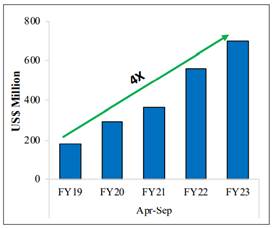
       

Carrying forward this growth momentum, drug and pharmaceutical exports during April-October 2022 was 22 per cent higher than the corresponding pre-pandemic period of FY20, noted the Survey. It added that Cumulative FDI in the pharma sector crossed the US$ 20 billion mark in September 2022 and FDI inflows have increased four-fold over five years until September 2022, to US$ 699 million, supported by investor-friendly policies and a positive outlook for the industry.

7. AUTOMOBILE INDUSTRY

India became the 3rd largest automobile market, surpassing Japan and Germany in terms of sales, in December 2022, stated the Economic Survey. It added that in 2021, India was the largest manufacturer of two-wheeler and three-wheeler vehicles and the world’s fourth-largest manufacturer of passenger cars.

Elaborating on the domestic electric vehicles (EV) market, the Survey stated that it is expected to grow at a compound annual growth rate (CAGR) of 49 per cent between 2022 and 2030 and is expected to hit one crore units annual sales by 2030. It added that the EV industry will create 5 crore direct and indirect jobs by 2030.

FOSTERING INNOVATION 

Economic Survey stated that there was a 46 per cent growth in the domestic filing of patents over 2016-2021, signaling India’s transition towards a knowledge-based economy.

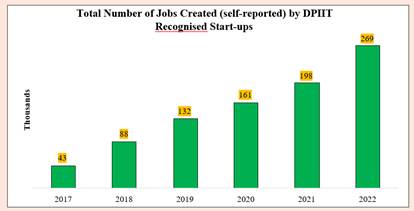
Discussing the achievements of Start-ups, the Survey highlighted that an impressive 9 lakh+ direct jobs have been created by the DPIIT recognized startups (self-reported), with a notable 64 per cent increase in 2022 over the average number of new jobs created in the last three years. About 48 per cent of our startups are from Tier II & III cities, a testimony of our grassroots’ tremendous potential.
INDUSTRY 4.0

The Survey highlighted that adoption of Industry 4.0 technologies such as cloud computing, IoT, machine learning, and artificial intelligence (AI) in the Indian manufacturing sector is underway, however, large-scale adoption is yet to happen and an enabling environment is rapidly developing.

The Survey mentioned that various Government Initiatives such as SAMARTH (Smart Advanced Manufacturing and Rapid Transformation Hubs) Udyog Bharat 4.0, establishment of the Centre for Fourth Industrial Revolution is the way forward in achieving the goals of Aatmanirbharta and its ambitions of becoming a key player in global value chains.

MAKE IN INDIA 2.0

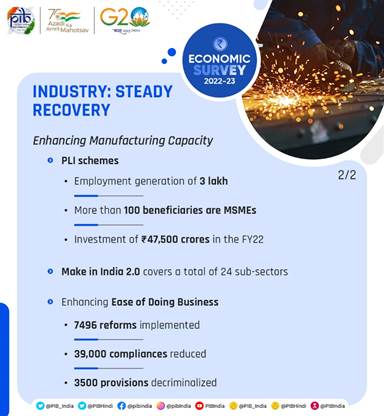
The Survey mentioned that ‘Make in India 2.0’ is now focusing on 27 sectors, which include 15 manufacturing sectors and 12 service sectors. Amongst these, 24 sub-sectors have been chosen while keeping in mind the Indian industries’ strengths and competitive edge, the need for import substitution, the potential for export and increased employability.

PERFORMANCE LINKED INCENTIVE (PLI) SCHEME

PLI scheme is expected to attract a capex of approximately ₹4 lakh crore over the next five years having a potential of generate employment for over 60 lakh in India stated the Economic Survey. It added that Sectors under which the PLI scheme has been announced currently constitute around 40 per cent of the total imports. The scheme, spread across 14 sectors, can enhance India’s annual manufacturing capex by 15 to 20 per cent from FY23.

The Survey mentioned that around ₹47,500 crore (US$ 6 billion) of actual investment has been made (As per recent reporting from implementing Ministries/ Departments); production/ sales of ₹3.85 lakh crore (US$ 47 billion) of eligible products and employment generation of around 3 lakh has been reported and 106 per cent achievement of actual investment reported versus the corresponding projections of FY22.

The Survey stated that more than 100 MSMEs are among the PLI beneficiaries in sectors such as Bulk Drugs, Medical Devices, Telecom, White Goods and Food Processing. Key sectors such as Large-Scale Electronics Manufacturing, Pharmaceuticals, Telecom & Networking Products, Food Processing and White Goods have contributed considerably to investment, production, sales and employment.
Topics

Acts Income Tax

