 TaxTMI
 Login
 TaxTMI
Login
Loading...
Press 'Enter' to add multiple search terms. Rules for Better Search

Press 'Enter' after typing page number.
Press 'Enter' after typing page number.


No Folders have been created
Are you sure you want to delete "My most important" ?
NOTE:
Press 'Enter' after typing page number.
Press 'Enter' after typing page number.

All News
Press 'Enter' after typing page number.
All News

Note

Bookmark

Share


PROACTIVE MEASURES BY THE GOVERNMENT BRINGS INFLATION WITHIN RBI’S TOLERANCE LIMIT
CONSUMER PRICE INFLATION AND WHOLESALE PRICE INFLATION DECLINES TO 5.7% AND 5.0% IN DECEMBER 2022 RESPECTIVELY
INFLATION RISKS FROM GLOBAL COMMODITY PRICES LIKELY TO BE LOWER IN FISCAL YEAR 2024
Prompt and adequate measures by the Government of India and the Reserve Bank of India (RBI) have reined in the rise in inflation and brought it within the Central Bank’s tolerance limit, says the Economic Survey 2022-23 tabled by the Union Minister for Finance & Corporate Affairs, Smt Nirmala Sitharaman in Parliament today.
Consumer Price Inflation: (CPI)
The Survey states that the Consumer price inflation in India went through three phases in 2022. A rising phase up to April 2022 when it crested at 7.8 per cent, then a holding pattern at around 7.0 per cent up to August 2022 and then a decline to around 5.7 per cent by December 2022. The rising phase was largely due to the fallout of the Russia-Ukraine war and a shortfall in crop harvests due to excessive heat in some parts of the country. Excessive heat in summer and uneven rainfall thereafter in some parts of the country affected the farm sector, reducing supply and causing prices of some major products to rise.
Prompt and adequate measures by the Government of India and the Reserve Bank of India (RBI) reined in the rise in inflation and brought it within the Central Bank’s tolerance limit. Good monsoons also helped in ensuring adequate food supply.
Wholesale Price Inflation: (WPI)
The Survey notes that, WPI-based inflation remained low during the Covid-19 period, and it started to gain momentum in the post-pandemic period as economic activities resumed. The Russia-Ukraine conflict further exacerbated the burden as it worsened global supply chains along with the free movement of essential commodities. As a result, the wholesale inflation rate climbed to about 13.0 per cent in FY22. The WPI has been sliding from its peak of 16.6% in May 2022 to 10.6% in September 2022 and further to 5.0% in December 2022.
The rise in WPI has been attributed in part to the rise in food inflation and in part to the imported inflation. The transitory effect of rising international prices of edible oils has also reflected in domestic prices. India’s exchange rate was also adversely affected in the first half of FY 23 thereby leading to high prices of imported inputs.
WPI and CPI trends:
The Survey advises that the divergence between a relatively high Wholesale Price Index (WPI) inflation and lower Consumer Price Index (CPI) inflation widened in May 2022 primarily owing to a difference in relative weights of the two indices and the lagged effect of imported input costs on retail prices. However, the gap between the two measures of inflation has reduced since then, demonstrating a tendency towards convergence.
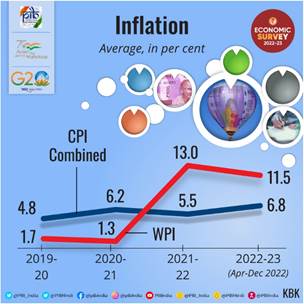
The Survey observes that the convergence between the WPI and CPI indices was mainly driven by two factors. Firstly, a cooling in inflation of commodities such as crude oil, iron, aluminium and cotton led to a lower WPI. Secondly, CPI inflation rose due to an increase in the prices of services.
Domestic Retail Inflation:
Retail price inflation mainly stems from the agriculture and allied sector, housing, textiles, and pharmaceutical sectors. The Survey observes that in FY23, retail inflation was mainly driven by higher food inflation. Food inflation ranged between 4.2 per cent to 8.6 per cent between April and December 2022. International prices of edible oils surged in FY22 owing to a shortfall in global production and an increase in export tax levies by various countries. India meets 60 per cent of its edible oils demand through imports, making it vulnerable to international movements in prices.
The Survey observes that there have been significant variations in retail inflation rates among the States and Union Territories (UTs) of India. Most of the States and UTs have witnessed higher rural inflation than urban inflation in the current year, mainly owing to marginally higher food inflation in rural areas.
To insulate vulnerable sections from the rise in prices, the Government launched a new integrated food security scheme, ‘Pradhan Mantri Garib Kalyan Ann Yojana’ on 1 January 2023, to provide free food grains to more than 80 crore beneficiaries.
Policy measures for price stability:
RBI’s Monetary Policy Committee increased the policy repo rate under the liquidity adjustment facility (LAF) by 225 basis points from 4.0 per cent to 6.25 per cent between May and December 2022. Central Government has undertaken fiscal measures like reduction in excise duty on petrol and diesel, prohibition of the export of wheat products, imposition of export duty on rice, reduction in import duties and cess on pulses, rationalization of tariffs and imposition of stock limits on edible oils and oil seeds, maintenance of buffer stock for onion and pulses and rationalization of import duties on raw materials used in the manufactured products.
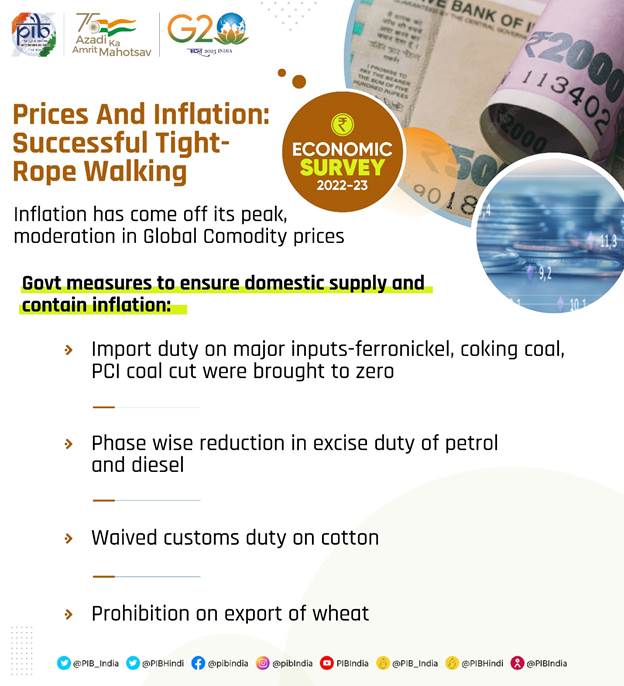
India’s inflation management has been particularly noteworthy and can be contrasted with advanced economies that are still grappling with sticky inflation rates, says the Economic Survey. Due to the anticipated slowdown in advanced economies, inflation risks coming from global commodity prices are likely to be lower in FY24 than in FY23 and the survey expresses that the inflation challenge in FY24 must be a lot less stiff than it has been this year.

