

Loading...

Top
Help
×

By creating an account you can:

Logo TaxTMI
Call Us / Help / Feedback

Contact Us At :

E-mail: [email protected]

Call / WhatsApp at: +91 99117 96707

For more information, Check Contact Us

FAQs :

To know Frequently Asked Questions, Check FAQs

Most Asked Video Tutorials :

For more tutorials, Check Video Tutorials

Submit Feedback/Suggestion :

Email :
Please provide your email address so we can follow up on your feedback.
Category :
Description :
Min 15 characters 0/2000
Make Most of Text Search
  1. Checkout this video tutorial: How to search effectively on TaxTMI.
  2. Put words in double quotes for exact word search, eg: "income tax"
  3. Avoid noise words such as : 'and, of, the, a'
  4. Sort by Relevance to get the most relevant document.
  5. Press Enter to add multiple terms/multiple phrases, and then click on Search to Search.
  6. Text Search
  7. The system will try to fetch results that contains ALL your words.
  8. Once you add keywords, you'll see a new 'Search In' filter that makes your results even more precise.
  9. Text Search
Add to...
You have not created any category. Kindly create one to bookmark this item!
Create New Category
Hide
Title :
Description :
❮❮ Hide
Default View
Expand ❯❯
Close ✕
🔎 News - Adv. Search
TEXT SEARCH:

Press 'Enter' to add multiple search terms. Rules for Better Search

Search In:
Main Text + AI Text
  • Main Text
  • Main Text + AI Text
  • AI Text
Category: ?
Categorized by AI
---- All Categories ----
  • ---- All Categories ----
  • Income Tax
  • GST
  • Customs, DGFT & SEZ
  • FEMA & RBI
  • Corp. Laws, SEBI & IBC
  • PMLA, Black Money & ED
  • Budget
  • News and Press Release
  • PTI News
Month:
---- All Months ----
  • ---- All Months ----
  • January
  • February
  • March
  • April
  • May
  • June
  • July
  • August
  • September
  • October
  • November
  • December
Year:
---- All Years ----
  • ---- All Years ----
  • 2026
  • 2025
  • 2024
  • 2023
  • 2022
  • 2021
  • 2020
  • 2019
  • 2018
  • 2017
  • 2016
  • 2015
  • 2014
  • 2013
  • 2012
  • 2011
Sort By: ?
In Sort By 'Default', exact matches for text search are shown at the top, followed by the remaining results in their regular order.
Relevance Default Date
❯❯
Maximize Maximize Maximize
0 / 200
Expand Note
Add to Folder

No Folders have been created

+

Are you sure you want to delete "My most important" ?

NOTE:

News
Showing Results for :
Reset Filters
Results Found:
Show All Summaries Hide All Summaries
September 1, 2026
Show AI Summary
Personal guarantor insolvency: repayment plan stayed pending majority determination, with restraint on direct or indirect asset alienation.
Personal-guarantee insolvency proceedings involve a stay on implementation of a repayment plan because the earlier members' views did not produce a clear majority capable of taking effect. The personal guarantor has been restrained from directly or indirectly alienating assets pending further hearing. The dispute follows split views on approval of the plan, claim admission and voting, followed by a third-member opinion that did not resolve the absence of a determinative majority. Creditors dispute the proposed recovery, claim treatment and declared net worth relevant to the guarantees.
September 1, 2026
Show AI Summary
Rupee exchange-rate movement reflects portfolio inflows, growth data and possible central-bank support, while crude oil prices constrain gains.
Foreign-exchange market conditions strengthened the rupee by 28 paise to 94.94 against the US dollar, supported by domestic growth, controlled fiscal slippage and portfolio inflows. Possible Reserve Bank of India intervention was also identified as supportive. Higher crude oil prices, weak domestic equities and hawkish US monetary-policy signals were identified as constraints on further appreciation. Foreign investment flows, stronger-than-expected domestic growth and the fiscal-deficit position remained material factors affecting currency conditions.
September 1, 2026
Show AI Summary
Money-laundering probe into public service recruitment irregularities examines alleged question-paper leaks, selection manipulation, and laundering through purported CSR donations.
Money-laundering investigation under the Prevention of Money Laundering Act concerns alleged irregularities in Public Service Commission recruitment examinations. Allegations include question-paper leaks, manipulation of candidate selection, and illegal gratification for securing appointments of relatives and favoured candidates. Recruitment rules were allegedly amended to facilitate selection of relatives. Alleged proceeds of crime were collected in cash and routed through layered banking transactions, including through a family-controlled samiti presented as receiving corporate social responsibility donations for a non-existent college.
September 1, 2026
Show AI Summary
Personal guarantor settlement scrutiny intensifies as asset alienation is restrained pending review of a disputed creditor repayment proposal.
A five-member special bench found that no clear majority view existed under section 419(5) of the Companies Act and stayed the third member's order that had permitted the proposed recovery. Notices were directed to all parties, and the guarantor was restrained from directly or indirectly alienating property pending further consideration. The dispute concerns approval of a personal guarantor's repayment proposal, treatment of guarantee claims, creditor voting support, assessment of the personal estate, and scrutiny of declared net worth.
September 1, 2026
Show AI Summary
Personal insolvency proceedings restrict property alienation while notices issue to parties in the debtor's case.
A five-member special National Company Law Tribunal bench hearing Subhash Chandra's personal insolvency matter issued notices to all parties and restrained him from alienating property directly or indirectly. The restraint applies during the continuing insolvency proceedings and concerns dealings with the relevant property. The procedural measure requires the interested parties to participate in the matter.
September 1, 2026
Show AI Summary
Aadhaar authentication alternatives enable eligible farmers with failed fingerprint verification to access loan-waiver benefits after identity verification.
Elderly farmers whose fingerprints cannot be captured for Aadhaar authentication may approach an Aaple Sarkar Seva Kendra with their Aadhaar card and bank passbook. Loan-account details are verified on the scheme portal before authentication is initiated. If authentication fails, the concerned tehsildar verifies identity using the Aadhaar card, bank passbook and 7/12 land record extract. Eligible farmers receive loan-waiver benefits directly in their bank accounts after authentication, identity verification and satisfaction of the scheme's eligibility criteria.
September 1, 2026
Show AI Summary
GST collection growth reflected higher domestic and import revenue, while increased refunds moderated net collections during August.
GST collections recorded year-on-year growth in August, with gross receipts reaching about Rs 2 lakh crore. Domestic transaction revenue increased to over Rs 1.37 lakh crore, while import-related revenue rose to Rs 62,604 crore. Refunds increased to Rs 31,795 crore, and net GST collections stood at Rs 1.68 lakh crore after refunds.
September 1, 2026
Show AI Summary
Personal insolvency repayment plan faces fresh hearing after a split bench prevents enforcement and restrains guarantor property transfers.
Personal insolvency proceedings were reopened before a five-member special bench after a split view on a repayment plan. As no majority view existed, including that of the third member, no final order was in force and the repayment-plan determination could not be acted upon. Notices were issued to all parties, including dissenting creditors, and the guarantor was restrained from directly or indirectly alienating property pending further consideration. Dissenting creditors also challenged the repayment-plan determination before the appellate tribunal.
September 1, 2026
Show AI Summary
Equity market sentiment weakens as higher crude prices, geopolitical tensions and tighter monetary policy expectations curb risk appetite.
Equity-market sentiment weakened as higher crude oil prices, renewed US-Iran tensions, and expectations of prolonged tight US monetary policy reduced emerging-market risk appetite. The Sensex and Nifty declined, while domestic GDP growth above projections offered partial support. Weakness in several Asian markets, a lower US market close, and net foreign institutional equity sales reinforced cautious trading conditions.
September 1, 2026
Show AI Summary
Money laundering investigation triggers searches linked to alleged Public Service Commission irregularities, including premises of a former chief minister's assistant.
A money-laundering investigation under the Prevention of Money Laundering Act has led to searches at seven locations in Chhattisgarh in connection with alleged irregularities at the Chhattisgarh Public Service Commission. The search operation includes the premises of K. K. Chandrakar, personal assistant to former Chief Minister Bhupesh Baghel. The investigation remains at the search and inquiry stage.
September 1, 2026
Show AI Summary
Income-tax return filing: non-audit business and professional taxpayers use applicable forms by prescribed due dates.
August 31, 2026 was the due date for taxpayers having business or professional income who were not subject to audit. Such non-audit taxpayers may use ITR-3, ITR-4, ITR-5 or ITR-7, as applicable. ITR-3 applies to individuals and Hindu Undivided Families with proprietary business or professional income, while ITR-4 is intended for small and medium taxpayers. ITR-5 applies to firms, limited liability partnerships and cooperative societies, and ITR-7 applies to trusts and charitable institutions.
September 1, 2026
Show AI Summary
Gold smuggling enforcement targets transit abuse, concealed carriage, and border routes through coordinated seizures and arrests nationwide.
Intelligence-led enforcement against organised gold smuggling resulted in the seizure of over 42 kg of foreign-origin gold and around 10 kg of foreign-origin silver, collectively valued at more than Rs. 65 crore, and the arrest of 25 persons. Operations targeted networks using airport transit routes, airport personnel, land-border corridors, coastal routes, and domestic road transport. Gold was concealed in wax, compound, paste, raw-chain and bar forms, including through body concealment, internally secreted capsules, clothing, and specially created cavities.
September 1, 2026
Show AI Summary
Predictive consumption-expenditure framework will use household survey data to support poverty estimation, consumption analysis, and economic planning.
MoSPI and Thapar Institute of Engineering & Technology have entered into a memorandum of understanding for a research study to develop a predictive and analytical framework for monthly consumption expenditure in India. The study will use Household Consumption Expenditure Survey data to estimate Monthly Per Capita Consumption Expenditure at national and state levels, analyse household consumption patterns, and generate evidence relevant to poverty estimation and broader economic planning.
August 31, 2026
Show AI Summary
Personal insolvency repayment plans: conflicting views on binding dissenting creditors prompted reconsideration through an expanded adjudicatory bench.
National Company Law Tribunal constituted a five-member bench after conflicting views on a personal insolvency repayment plan left no majority position for a formal order. The central issue is whether creditor approval of the plan binds dissenting creditors and extinguishes their claims against the personal guarantor. One view preserved dissenting creditors' independent recovery rights, while another applied the creditor-approved plan uniformly to all creditors. Disagreement also concerns the Adjudicating Authority's power to examine the resolution professional's report of the creditors' meeting.
August 31, 2026
Show AI Summary
Personal insolvency repayment plans raise unresolved questions on dissenting creditors' rights and uniform extinguishment of claims.
Personal insolvency proceedings were referred for fresh adjudication because no majority emerged on the repayment plan. The Technical Member rejected the plan; the Judicial Member confined it to consenting creditors while preserving dissentents' recovery rights; and the Third Member approved it with uniform extinguishment of all creditors' claims. The dispute concerns whether creditor approval under section 115(1) binds dissenting creditors, the effect of section 79(2)(g), and the Adjudicating Authority's power to examine the Resolution Professional's creditors' meeting report.
August 31, 2026
Show AI Summary
Rupee exchange-rate support through suspected intervention and FCNR(B) inflows offset pressure from dollar strength and higher crude prices.
Rupee exchange-rate movement reflected a recovery from early losses to close stronger against the US dollar, amid market expectations of Reserve Bank of India support at lower trading levels. Pressure arose from higher US Treasury yields, possible US rate-hike expectations and a broad dollar rally. Suspected intervention, FCNR(B)-related foreign-currency flows and the special USD-INR forex swap facility supported sentiment, while rising crude prices, geopolitical supply risks and foreign institutional equity outflows remained adverse factors.
August 31, 2026
Show AI Summary
Income-tax return filing for non-audit business and professional taxpayers closes at midnight, requiring use of applicable forms.
Income-tax return filing for Assessment Year 2026-27 reaches its due date on 31 August 2026 for taxpayers having business or professional income who are not subject to audit. Such taxpayers may file the applicable ITR-3, ITR-4, ITR-5 or ITR-7. ITR-3 applies to individuals and Hindu Undivided Families with proprietary business or professional income, ITR-4 to small and medium taxpayers, and ITR-5 to firms, limited liability partnerships and cooperative societies.
August 31, 2026
Show AI Summary
Monthly fiscal accounts track receipt composition, expenditure allocation, tax devolution, interest payments, and major subsidy outgo through July.
Union Government monthly accounts through July 2026 record total receipts comprising net tax revenue, non-tax revenue and non-debt capital receipts, with tax devolution transferred to State Governments. Total expenditure is divided between revenue and capital expenditure. Revenue expenditure includes interest payments and major subsidies.
August 31, 2026
Show AI Summary
Personal guarantor insolvency distinguishes guarantee liability from borrower debt while creditor voting challenges question repayment-plan approval.
Personal insolvency proceedings concerning personal guarantees distinguish a guarantor's liability from the underlying borrowing entities' debts. Claims against the guarantor arise from guarantees furnished for loans obtained by Essel Group-associated entities, while the borrowers' repayment obligations remain enforceable and creditors may pursue corporate assets and securities. Dissenting lenders have challenged the resolution-plan voting process, alleging that family-linked associates or related parties should have been excluded from committee of creditors voting.
August 31, 2026
Show AI Summary
National accounts revisions align GDP and sectoral estimates with updated price, production and banking service indicators.
National Accounts Statistics-2026 incorporates updated Producer Price Index, Index of Industrial Production and Banking Services Price Index series with base year 2022-23 into annual and quarterly GDP estimates. The revised indicators expand coverage, update weights and improve price mapping for national-account activities. GDP and gross value added estimates from 2022-23 onwards are revised at current and constant prices, with sector-specific effects in mining and quarrying, manufacturing, trade services, general government and departmental enterprises. Supply and Use Tables for 2022-23 and 2023-24 are also updated.

News

Back

All News

Showing Results for :
Reset Filters
No Records Found

News

Showing Results for : Reset Filters

ONCE THE GLOBAL SHOCKS OF THE PANDEMIC AND RUSSIAN-UKRAINE CONFLICT RESULTING IN SPIKE OF COMMODITY CRISES FADE AWAY, INDIAN ECONOMY IS POISED TO GROW FASTER IN THE COMING DECADE

January 31, 2023

Contents
Summary
Note

Note

-

Bookmark

Print

Print

ONCE THE GLOBAL SHOCKS OF THE PANDEMIC AND RUSSIAN-UKRAINE CONFLICT RESULTING IN SPIKE OF COMMODITY CRISES FADE AWAY, INDIAN ECONOMY IS POISED TO GROW FASTER IN THE COMING DECADE

WITH IMPROVED BALANCE SHEETS OF THE BANKING, NON-BANKING AND CORPORATE SECTORS, A FRESH CREDIT CYCLE HAS BEGUN AS IS EVIDENT FROM DOUBLE DIGIT GROWTH IN BANK CREDIT OVER THE PAST MONTHS

ECONOMY HAS STARTED BENEFITING FROM THE EFFICIENCY GAINS RESULTING FROM GREATER FORMALISATION, HIGHER FINANCIAL INCLUSION AND ECONOMIC OPPORTUNITIES CREATED BY DIGITAL TECHNOLOGY-BASED ECONOMIC REFORMS

INDIA’S GROWTH OUTLOOK SEEMS BETTER THAN IN THE PRE-PANDEMIC YEARS AND IT IS PREPARED TO GROW AT ITS POTENTIAL IN THE MEDIUM TERM

STRONG MEDIUM-TERM GROWTH MAGNETS TO AID INDIA’S ECONOMIC GROWTH

VARIOUS REFORMS UNDERTAKEN BETWEEN 2014-2022 STRENGHTENED THE INDIAN ECONOMY

EMPHASIS OF REFORMS ON ENHANCING THE EASE OF LIVING AND DOING BUSINESS

During the period of 2014-2022, the Indian Economy underwent a gamut of wide-ranging structural and governance reforms that strengthened the economy’s fundamentals by enhancing its overall efficiency. The Economic Survey 2022-23 presented in Parliament today by the Union Minister for Finance & Corporate Affairs, Smt. Nirmala Sitharaman stated that with an underlying emphasis on improving the ease of living and doing business, these reforms were based on the broad principles of creating public goods, adopting trust-based governance, co-partnering with the private sector for development, and improving agricultural productivity.
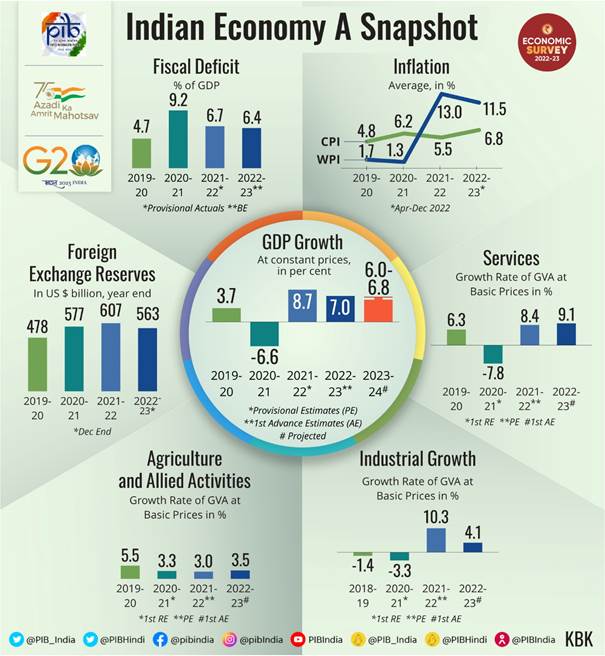
The Economic Survey highlights that the above transformative reforms undertaken by the government had lagged growth returns due to temporary shocks in the economy. However, in the present decade, the presence of strong medium-term growth magnets provides optimism and hope that once these global shocks of the pandemic and the spike in commodity prices in 2022 fade away, the Indian economy is well placed to grow faster in the coming decade.

Reforms for New India - Sabka Saath Sabka Vikaas

According to the Economic Survey, the reforms undertaken before 2014 primarily catered to product and capital market space. They were necessary and continued post-2014 as well. The government, however, imparted a new dimension to these reforms in the last eight years. With an underlying emphasis on enhancing the ease of living and doing business and improving economic efficiency, the reforms are well placed to lift the economy’s potential growth. The broad principles behind the reforms were creating public goods, adopting trust-based governance, co-partnering with the private sector for development, and improving agricultural productivity. “This approach reflects a paradigm shift in the growth and development strategy of the government, with the emphasis shifted towards building partnerships amongst various stakeholders in the development process, where each contributes to and reaps the development benefits (Sabka Saath, Sabka Vikaas)”, stated the Survey.

Creating public goods to enhance opportunities, efficiencies and ease of living

The Economic Survey notes that a quantum leap in policy commitment and outlay for infrastructure is now visible in the last few years, cushioning economic growth when the non-financial corporate sector was unable to invest due to balance sheet troubles. In doing so, the government has laid a good platform for crowding in private investments and growth in the coming decade. Besides the push to physical infrastructure, the government’s emphasis on developing public digital infrastructure during the last few years has been a game changer in enhancing the economic potential of individuals and businesses. With its strong forward linkages to the non-digital sectors, digitalisation strengthens potential economic growth through various channels. Some of these, such as higher financial inclusion, greater formalisation, increased efficiencies and enhanced opportunities.
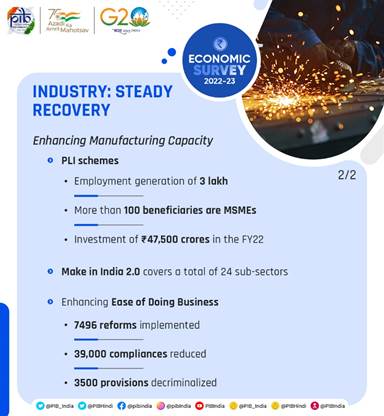
Trust-based Governance

According to the Economic Survey, building trust between the government and the citizens/businesses unleashes efficiency gains through improved investor sentiment, better ease of doing business, and more effective governance. Consistent reforms have been made in this direction during the last eight years. Simplification of regulatory frameworks through reforms such as the Insolvency and Bankruptcy Code (IBC) and the Real Estate (Regulation and Development) Act (RERA) have enhanced the ease of doing business. Decriminalisation of minor economic offences under the Companies Act of 2013, simplifying processes by doing away with 25000 unnecessary compliances, repealing more than 1400 archaic laws, abolishing the Angel tax and removing retrospective taxation on offshore indirect transfer of assets located in India, signal the government’s resolve to ensure a non-adversarial policy environment.  In particular, the taxation ecosystem in the country has undergone substantial reforms in the post-2014 period. Tax policy reforms such as adopting a unified GST, reducing corporate tax rates, exemption of sovereign wealth funds and pension funds from taxes, and removing the Dividend Distribution tax have reduced the tax burden on individuals and businesses; and removed the distortionary incentives from the economy.

Promoting the private sector as a co-partner in the development

The Survey notes that a fundamental principle behind the government’s policy in the post- 2014 period has been the engagement with the private sector as a partner in the development process. The New Public Sector Enterprise Policy for Aatmanirbhar Bharat has thus been introduced to realise higher efficiency gains by minimising the presence of the government in the PSEs to only a few strategic sectors. Significant initiatives have been introduced under Aatmanirbhar Bharat and Make in India programmes to enhance India’s manufacturing capabilities and exports across the industries. The National Logistics Policy (2022) has been launched to create an overarching logistics ecosystem for lowering the cost of logistics and bringing it to par with other developed countries. Liberalisation of FDI policy has resulted in a visible structural shift in the gross FDI flows to India during the last decade. Opening the strategic sectors, such as defence, mining and space, for the private sector has enhanced the business opportunities in the economy. Reforms to address the structural challenges faced by MSMEs have also been a vital part of the industrial policy in recent years.

Enhancing productivity in agriculture

The agriculture sector in India has grown at an average annual growth rate of 4.6 per cent during the last six years, as observed by the Economic Survey. This growth is partly attributable to good monsoon years and partly to the various reforms undertaken by the government to enhance agricultural productivity. Policies such as Soil Health Cards, the Micro Irrigation Fund, and organic and natural farming have helped the farmers optimise resource use and reduce the cultivation cost. The promotion of Farmer Producer Organisations (FPOs) and the National Agriculture Market (e-NAM) extension Platform have empowered farmers, enhanced their resources, and enabled them to get good returns. Agri Infrastructure Fund (AIF) has supported the creation of various agriculture infrastructures. Kisan Rail exclusively caters to the movement of perishable Agri Horti commodities. According to the survey, all these measures are directed towards supporting the growth in agricultural productivity and sustaining its contribution to overall economic growth in the medium term.

Shocks that the economy faced during 2014-22

The Economic Survey notes that during 1998- 2002, transformative reforms were launched but yielded lagged growth dividends. This phenomenon was attributed to a series of one-off shocks resulting from external factors and the domestic financial sector clean-up, which overshadowed the growth returns from 1998 to 2002. By 2003, when the shocks dissipated, India participated in the global boom and grew at a higher rate. Similarly, in the present context, as the global shocks of the pandemic and the spike in commodity prices in 2022 fade away, the Indian economy is well placed to grow at its potential in the coming decade.

Growth Magnets in this Decade (2023-2030)

The Economic Survey states that the health and economic shocks of the pandemic and the spike in commodity prices in 2022 wear off, the Indian economy is thus well placed to grow at its potential in the coming decade, similar to the growth experience of the economy after 2003. The Economic Survey observes that with improved and healthier balance sheets of the banking, non-banking and corporate sectors, a fresh credit cycle has already begun, evident from the double-digit growth in bank credit over the past months. This is the primary reason for expecting India’s growth outlook to be better than it was in the pre-pandemic years.
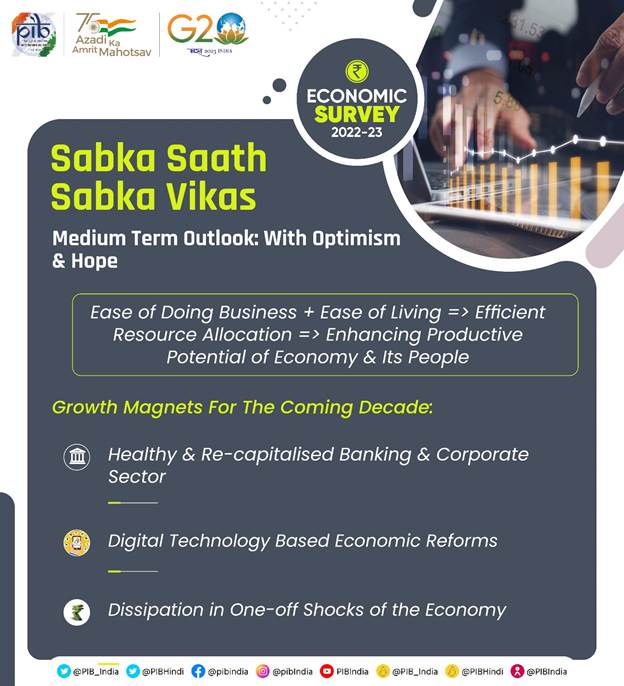
The Survey further states that the digitalisation reforms and the resulting efficiency gains in terms of greater formalisation, higher financial inclusion, and more economic opportunities will be the second most important driver of India’s economic growth in the medium term. These productivity-enhancing reforms along with the Government's Skilling initiatives, will also help unleash the benefits of the demographic dividend in the coming years.

Considering the evolving geo-political situation, the Survey notes that India has an opportunity to benefit from the diversification of global supply chains. The last few years have exposed multinational firms to unprecedented risks due to global trade tensions, pandemic-induced supply chain disruptions, and the conflict in Europe. With enabling policy frameworks, India presents itself as a credible destination for capital diversifying out of other countries.

Thus, India’s growth outlook seems better than in the pre-pandemic years, and the Indian economy is prepared to grow at its potential in the medium term.

Topics

Acts Income Tax
