 TaxTMI
 Login
Just a moment...

Press 'Enter' to add multiple search terms. Rules for Better Search
 of 3354
Press 'Enter' after typing page number.
of 3354Press 'Enter' after typing page number.


No Folders have been created
Are you sure you want to delete "My most important" ?
NOTE:
of 3354Press 'Enter' after typing page number.
of 3354Press 'Enter' after typing page number.

All News
of 3354Press 'Enter' after typing page number.
All News
 Join Channel
Note

Bookmark

Share


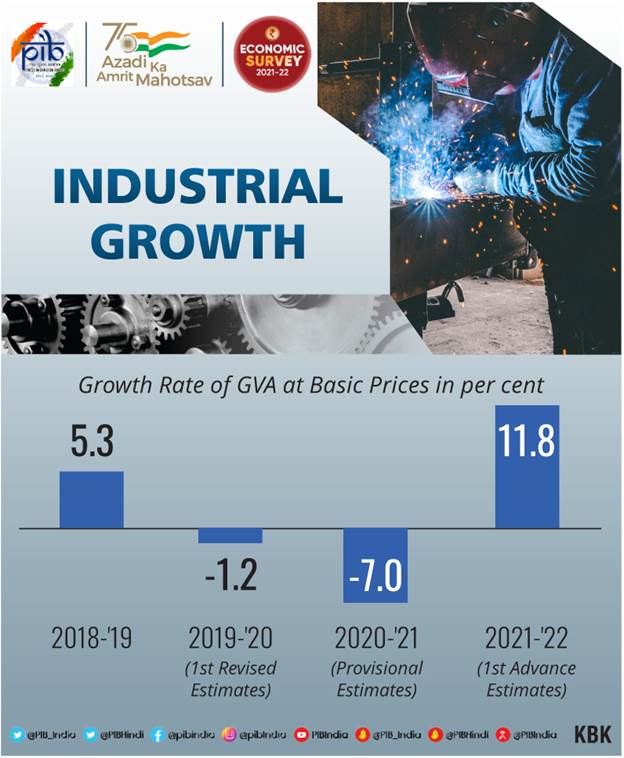
Initiatives under AatmaNirbhar Bharat including structural and procedural reforms reinforce performance of the industrial sector, expected to grow by 11.8 percent in this financial year
Investor friendly FDI policy sets up new records in FDI inflows registering highest ever annual FDI inflow of 81.97 billion US$ in 2020-21
Gross bank credit to the industrial sector records growth of 4.1 percent
Production Link Incentive scheme (PLI) Scheme reduces transaction costs, improves ease of doing business
National Infrastructure Pipeline (NIP), National Monetization Plan (NMP) propel infrastructure investment
UDYAM Registration Portal and revision in the definition of the MSMEs enhance productivity, facilitating expansion and growth
Setting up of seven PM Mega Integrated Textiles Region and Apparel Parks (MITRA) notified with a total outlay of ₹ 4,445 crore
Government approves outlay of ₹ 76,000 crore for the development of semiconductors and display manufacturing ecosystem
Construction of National Highways/roads registers an increase of 30.2 percent over the previous year
1835 track km per year of new track length added by Indian Railways through new-lines and multi-tracking projects
Lakshya Bharat Portal launched to provide clear demand projections by oil and gas organizations
Ujjwala 2.0 launched to provide additional 1 crore LPG connections
Government liberalizes drone rules, revises PLI Scheme for growth in aviation sector
Maritime India Vision 2030, envisages coordinated and accelerated growth of India’s maritime sector, 100 years old Inland Vessel Act 1917 replaced with Inland Vessel Act 2021 ushering in a new era
Telecom Reforms to boost 4G proliferation, infuse liquidity and create an enabling environment for investment in 5G networks
India witness fastest rate of growth in renewable energy capacity growing by 2.9 times and solar energy expanding by over 18 times, Green Energy Corridor Projects initiated
The Union Minister for Finance and Corporate affairs, Smt. Nirmala Sitharaman tabled the Economic Survey 2021-22 in Parliament today.
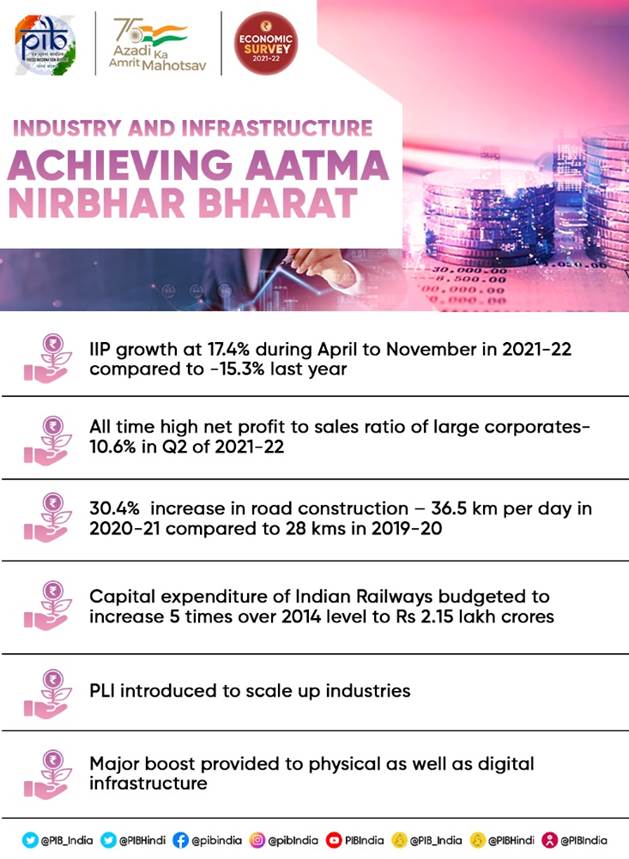
Global Industrial activity continued to be affected by the disruptions caused by the Covid-19 pandemic. While the Indian industry was no exception to these disruptions, its performance has improved in 2021-22. Gradual unlocking of the economy, record vaccinations, improvement in consumer demand, continued policy support towards industries by the Government in the form of Atma Nirbhar Bharat Abhiyan and further reinforcements in 2021-22 have led to an upturn in the performance of the industrial sector. The growth of the industrial sector in the first half of 2021-22, was 22.9 percent vis a vis the corresponding period of 2020-21 and is expected to grow by 11.8 percent in this financial year. The industrial performance has shown improvement as reflected in the cumulative growth of Index of Industrial Production (IIP). During April-November 2021-22 the IIP grew at 17.4 percent as compared to (-) 15.3 percent in April-November 2020-21. According to RBI – Studies and Corporate Performance, which is based on the results of select listed companies in the private corporate sector, the net profit to sales ratio of large corporate reached an all-time high despite the pandemic. Buoyant FDI inflows amid improvements in overall business sentiments, foretells a positive outlook for the industry.
The Economic Survey says the introduction of the production linked incentive scheme (PLI) to encourage scaling up of industries and major boost provided to infrastructure-both physical as well as digital-combined with continued measures to reduce transaction costs and improve ease of doing business, would support the pace of recovery. Several initiatives such as National Infrastructure Pipeline (NIP), National Monetization Plan (NMP), amongst others, have been taken to propel the infrastructure investment. Capital expenditure for the Indian Railways has been substantially increased form an average annual of ₹ 45,980 crores during 2009-14 to ₹ 155,181 crores in 2020-21 and it has been budgeted to further increase to ₹ 215,058 crores in 2021-22. This implies five times increase in comparison to the 2014 level. In addition, the extent of road construction per day increased substantially in 2020-21 to 36.5 kms per day from 28 kms per day in 2019-20, a rise by 30.4 percent as compared to the previous year. The Government has also heralded a major boost to the electronics hardware sector and brought in structural and procedural reform in the telecom sector.
Index of Industrial Production (IIP)
The IIP provides data for 23 subgroups of the manufacturing sector. In the period, April-November 2021-22, all the 23 sectors recorded a positive growth. The major industrial groups like textiles, wearing apparel, electrical equipment, motor vehicle staged a strong recovery. Improvement in the performance of textiles and wearing apparel which is a labor-intensive industry has significant implication for employment creation.
Eight Core Index (ICI)
The growth rate of ICI index during the period of April-November 2021-22 was 13.7 percent as compared to (-) 11.1 percent in the corresponding period of last financial year. This acceleration in ICI is mainly driven by improved performance in the steel, cement, natural gas, coal and electricity.
The Index of eight core industries has shown a pickup in growth in almost all its components barring crude oil and fertilizers in 2021-22 (April-November) as compared to 2019-20 (April-November). The steel, crude oil, fertilizer, electricity, natural gas recovered as compared to February 2020 level. In addition, the value of Index for steel, fertilizers, electricity, natural gas and coal is higher than the pre-lockdown level (November 2019).
It is clear that the extent of Capital utilization (CU) had decreased substantially during the first quarter of 2020-21 due to the Covid-19 as severe restrictions were imposed in the country. At the aggregate level, CU for the manufacturing sector declined to 40 percent in Q1: FY21 and than rose to 69.4 in Q4:FY21, however it fell to 60.0 in Q1: FY22.
Another indication of optimism about the economic performance is the RBI’s Business Expectations Index (BEI). This Index gives a glimpse of demand conditions in manufacturing sector by combining parameters which include overall business situation, production, order books, inventory of raw material and finished goods, profit margin, employment, exports and capacity utilization. BEI remained stable with only a slight downturn in the second quarter of 2020-21 owing to the onset of the pandemic the first quarter of that year. Since then, it has been on an upswing. It increased to 124.1 in the Q2:FY22 and to 135.7 in Q3:FY22 as compared to 119.6 in the first quarter of the same year. The uptick in the data suggests that the manufacturers perceive further improvement in overall business in Q3:FY22; and exhibit optimism for Q4:FY22. Capacity utilization and employment conditions are expected to improve.
Credit in Industry
Gross bank credit to the industrial sector, recorded a growth of 4.1 percent in October 2021 (Y-o-Y basis) compared to a negative growth of 0.7 growth in October 2020. The share of industry in non-food credit stood at 26 percent in October 2021. Certain industries such as mining, textiles, petroleum, cold products and nuclear fuels, rubber, plastic and infrastructure have shown consistent improvement in credit growth.
FDI in Industries
Measures taken by the Government to put in place an enabling investor friendly FDI Policy has resulted in increased FDI inflows setting up new records. FDI inflows in India stood at US$ 45.14 billion in 2014-15 and have continuously increased since then. India registered its highest ever annual FDI inflow of US$ 81.97 billion (provisional) in the 2020-21 reflecting the growth of 10 percent as compared to the previous year. The increase has been on the back of growth of 20 percent in 2019-20. In the year 2021-22, FDI inflows grew by 4 percent in the first six months to reach US$ 42.86 billion as compared to US$ 41.37 billion for the same period of last year.
Over the last seven financial years (2014-21), India received FDI inflow worth US$ 440.27 billion which is nearly 58 percent of the FDI received by the country in the last 21 years (US$ 763.83 billion).
Performance of Central Public Sector Enterprises (CPSEs)
As on 31.03.2020, 256 CPSEs were operational. The overall net profit of operating CPSEs during 2019-20 stood at ₹ 93,295 crore. Contribution of all CPSEs to central exchequer by way of excise duty, GST, corporate tax, dividend etc. stood at ₹ 3,76,425 crore. The CPSEs across sectors employed 14,73,810 persons, of which 9,21,876 were regular employees.
In accordance with the Union Budget 2021-22 announcements, the Government has approved a policy of strategic disinvestment of public sector enterprises that will provide a clear roadmap for disinvestment in all non-strategic and strategic sectors. The guidelines for implementation of new public sector enterprise policy for CPSEs have been notified on 13th December 2021. This will help the Government to make use of disinvestment proceeds to finance various social sectors and developmental programmes while disinvestment shall increase private capital, technology and best management practices in the disinvested CPSEs.
SECTOR WISE PERFORMANCE AND ISSUES IN INDUSTRY\
Steel
The performance of the steel industry is pivotal for the growth of the economy. Despite being hit by COVID-19, the steel industry has bounced back with cumulative production of crude and finished steel in 2021-22 (April-October) at 66.91 MT and 62.37 MT, an increase of 25.0 percent and 28.9 percent respectively, over corresponding period last year while consumption of finished steel at 57.39 MT increased by 25.0 percent over the same period.
Coal
Coal production increased by 12.24 percent in April-October 2021 as compared to (-) 3.91 percent in April-October 2020.
Micro Small Medium Enterprise
The relative importance of MSMEs can be gauged by the fact that the share of MSME GVA in total GVA (current prices) for 2019-20 was 33.08 percent. The Government has taken various initiatives to nurture and promote the MSMEs. The revision in the definition of MSMEs brought in w.e.f 1st July 2020 as part of AatmaNirbhar Bharat package introduce a composite criteria of investment and annual turnover and identical limits for manufacturing and service sectors. The recent measures taken by the Government to improve the ease of doing business for the MSMEs includes the launch of the Udyam Registration Portal in July 2020.
As on 17.01.2022, 66,34,006 enterprises have registered on Udyam Portal out of which 62,79,858 are micro; 3,19,793 are small; and 34,355 are medium enterprises.
Textiles
In the last decade close to ₹ 203,000 crore have been invested in this industry with direct and indirect employment of about 105 million people, a major part of which is women. Despite the industry being deeply affected by the lockdown, it has shown a remarkable recovery with positive contribution to growth as reflected by IIP, of 3.6 percent during April-October 2020.
Further in a major support to enhance the competitiveness of the sector, the Government notified the setting up of 7 PM MEGA INTEGRATED TEXTILES REGION AND APPRAEL PARK (MITRA) in October with a total outlay of ₹ 4,445 crore. The scheme is expected to further the vision of AatmaNirbhar Bharat and to position India strongly on global textiles Map. PM MITRA inspired from 5F’s- farm to fibre; fibre to factory; factory to fashion; fashion to foreign- will strengthen the textile sector by developing integrated large scale and modern infrastructure facility for entire value chain of the textile industry.
Electronics Industry
Government accords high priority to electronics hardware manufacturing. The Government has therefore notified the National Policy on Electronics 2019 (NPE-2019) on 25.02.2019 to position India as a global hub for Electronics System Design and Manufacturing (ESDM) by encouraging and driving capabilities in the country for developing core components, including chip sets.
Recently, the Government has approved an outlay of ₹ 76,000 crore (>US$ 10 Bn) for the development of Semiconductor and Display Manufacturing Ecosystem. Government’s intervention to boost this industry has come at a time when the global economy is facing an acute shortage of semiconductors due to severe disruptions in supply chains.
Pharmaceuticals
Indian Pharmaceuticals industry ranks 3rd in the world in pharmaceuticals production by volume. India is largest supplier of generic medicines with a 20 percent share in the global supply making the country the “Pharmacy of the world”. FDI in Pharmaceuticals
Sector has seen a sudden spurt in 2020-21 vis a vis the previous year showing a 200 percent increase. The extraordinary growth of foreign investment in pharma sectors is mainly on accounts of investments to meet Covid-19 related demand for therapeutics and vaccines.
INFRASTRUCTURE
National Infrastructure Pipeline (NIP)
Public Private Partnership in Infrastructure has been an important source of investment in the sector. As per the database of the World Bank on private participation in infrastructure, India is ranked second among developing countries both by the number of PPP Projects as well as the associated investments.
The Public Private Partnership Appraisal Committee (PPPAC) which is responsible for the appraisal of PPP projects has cleared 66 projects with a total project cost of ₹ 137218 crores from 2014-15 to 2020-21. The government launched viability Gap Funding (VGF) scheme for providing financial assistance to financially unviable but socially / economically desirable PPP projects, Up to 20 percent of the project cost is funded under this scheme as a grant.
In order to achieve the GDP of $5 Trillion by 2024-25, India needs to spend about $1.4 trillion over these years on infrastructure. Keeping this objective in view, National Infrastructure Pipeline (NIP) was launched with projected infrastructure investment of around 111 lakh crore (US$ 1.5 Trillion) during 2020-2025 to provide world- class infrastructure across the country. NIP was launched with 6, 835 projects, which has expanded to over 9,000 projects covering 34 infrastructure sub-sectors.
National Monetization Pipeline (NMP)
A robust asset pipeline, NMP has been prepared to provide a comprehensive view to investors and developers of the investment avenues in Infrastructure. Total indicative value of NMP for core assets of the Central Government has been estimated at ₹ 6.0 lakh crore over the 4-year period (5.4 percent of total infrastructure investment envisaged under NIP).
Road Transport
Importance of road infrastructure is widely recognized as a potent means of socio-economic integration and is vital for the economic development of the country. There has been a consistent increase in the construction of National Highways/Roads since 2013-14 with13,327 kms of roads constructed in 2020-21 as compared to 10,237 kms in 2019-20, indicating an increase of 30.2 percent over the previous year
Railways
In Railways, an average of 1835 track km per year of new track length has been added through new-line and multi-tracking projects during 2014-2021 as compared to the average of 720 tracks kms per day during 2009-14. Indian Railways (IR) is adopting indigenous new technology such as KAVACH, Vande Bharat trains and redevelopment of stations to have a safe and better journey experience. During FY21, Indian Railways carried 1.23 billion tonnes of freight and 1.25 billion passengers.
CAPEX has been increased substantially for IR from an average annual CAPEX during 2009-14 of ₹ 45,980 crores to ₹ 2,15,058 crores during 2021-2022 (BE).
Civil Aviation
India has emerged as one of the fastest growing aviation markets in the world. The domestic traffic in India has more than doubled from around 61 million in 2013-14 to around 137 million in 2019-20, registering a growth of over 14 percent per annum. Government of India took various initiatives to boost the aviation sector which included calibrated opening of the domestic sector as the first wave of the pandemic ebbed, introduction of air transport bubbles or air travel arrangements with specific countries, disinvestment of Air India, privatization and modernization/expansion of airports, boost to the regional connectivity scheme- UDAN, incentivization of maintenance, repair and overhaul (MROs) operations etc.
In addition, Unmanned Aircraft System (UAS), also known as drones, offer tremendous benefits to almost all sectors of the economy. Government has liberalized Drone Rules 2021 on August 2021 and released PLI scheme for drones on 15 September 2021. The policy reforms will therefore catalyze super-normal growth in the upcoming drone sector. The total air cargo tonnage carried in October, 2021 reached 2.88 lakh MT which surpassed the pre Covid level (2.81 lakh MT).
Ports
Port performance in an economy is crucial for trade competitiveness of that economy. The capacity of 13 major ports which was 871.52 million tonnes per annum (MTPA) at the end of the March 2014, has increased by 79 percent to 1,560.61 MTPA by the end of the March 2021.
In July 2021 the Union cabinet has approved a scheme providing support of ₹ 1,624 crore to India shipping companies in global tenders floated by Ministries and CPSEs over five years to promote flagging of merchant ships in India.
With an objective of propelling India to the forefront of the Global Maritime Sector , the Maritime India Vision 2030 (MIV 2030), a blueprint to ensure coordinated and accelerated growth of India’s maritime sector in the next decade was released on March 2021. MIV 2030 estimates that development of Indian Ports will drive cost savings of ₹ 6,000-7,000 crore per annum for EXIM clients. MIV 2030 estimates the investment requirement for capacity augmentation and development of world class infrastructure at Indian Ports to the tune of ₹ 1,00,000-1,25,000 crore.
Inland Waterways
Regulatory amendment through the Inland Vessels Act, 2021 replaced the over 100 years old Inland Vessels Act, 1917 (1 of 1917) and ushered in a new era in the inland water transport sector.
Telecom
India is the world’s second-largest telecommunications market. The total telephone subscriber base in India has increased from 933.02 million in March 2014 to 1200.88 million in March 2021. In March 2021, 45 percent of subscribers were based in rural India and 55 percent in urban areas. Internet penetration in the country is increasing steadily with internet subscribers increasing from 302.33 million in March 2015 to 833.71 million in June 2021.
The number of mobile towers has also increased substantially reaching 6.93 lakhs towers in December 2021, reflecting that the telecom operators have well realized the potential in the sector and seized the opportunity to build up an infrastructure that will be fundamental in boosting the Government’s Digital India campaign.
Under the flagship BharatNet project, as on 27.09.2021, 5.46 lakh km Optical Fiber Cable has been laid, a total of 1.73 lakh Gram Panchayats (GP) have been connected by Optical Fiber Cable (OFC) and 1.59 lakh Gram Panchayats are service ready on OFC.
Government is implementing a Comprehensive Telecom Development Plan (CTDP) for the North-Eastern Region and Comprehensive Telecom Development Plan for Islands to provide mobile connectivity in the uncovered villages and along National Highways in the North-East. A number of measures have been taken to bring about structural and procedural reforms. The reforms are expected to boost 4G proliferation, infuse liquidity and create an enabling environment for investment in 5G networks.
Petroleum, Crude and Natural gas
Crude oil and condensate production during the year 2020-2021 was 30.49 million metric tonnes (MMT). Natural Gas production during the year 2020-2021 was 28.67 billion cubic meters (BCM) as against production of 31.18 BCM in 2019-20.Crude Oil Processed during the year 2020-21 was 221.77 MMT as against 254.39 MMT in 2019-20 showing achievement of 88.1 percent of the target of 251.66 MMT for 2020-21.
The Government has introduced several measures to bring transparency. The “Lakshya Bharat Portal” launched in September, 2021 requires all oil and gas organization to upload details of various items procured by them including the future requirements.
The petroleum sector played a critical role throughout the Covid 19 lockdown period by maintaining fuel supplies across the country. The second phase of the Pradhan Mantri Ujjwala Yojna, Ujjawala 2.0, was launched on 10th August, 2021 on pan India basis to provide additional on crore LPG connections along with free first refill and stove. Ujjwala 2.0 focuses on migrants and poor women form low LPG coverage areas.
Electricity
India has witnessed a significant transformation from being an acutely power deficit country to a situation of demand being fully met. The total installed power capacity and captive power plant (industries having demand of 1MW and above) was 459.15 GW on 31.03.2021 as compared to 446.35GW on 31.03.2020 registering a growth of 2.87 percent.
Renewable Energy
India has witnessed the fastest rate of growth in renewable energy capacity addition among all large economies, during the last 7.5 years with renewable energy capacity growing by 2.9 times and solar energy expanding by over 18 times.
In order to facilitate renewable power evacuation and reshaping the grid for future requirements, the Green Energy Corridor (GEC) projects have been initiated. The second component –Intra-state GEC with a target capacity of 9700 ckm transmission lines and 22,600 MVA capacity sub-stations is expected to be completed by June 2022.
 TaxTMI