Loading...

Top
Help
×

By creating an account you can:

Logo TaxTMI
Call Us / Help / Feedback

Contact Us At :

E-mail: [email protected]

Call / WhatsApp at: +91 99117 96707

For more information, Check Contact Us

FAQs :

To know Frequently Asked Questions, Check FAQs

Most Asked Video Tutorials :

For more tutorials, Check Video Tutorials

Submit Feedback/Suggestion :

Email :
Please provide your email address so we can follow up on your feedback.
Category :
Description :
Min 15 characters 0/2000
Make Most of Text Search
  1. Checkout this video tutorial: How to search effectively on TaxTMI.
  2. Put words in double quotes for exact word search, eg: "income tax"
  3. Avoid noise words such as : 'and, of, the, a'
  4. Sort by Relevance to get the most relevant document.
  5. Press Enter to add multiple terms/multiple phrases, and then click on Search to Search.
  6. Text Search
  7. The system will try to fetch results that contains ALL your words.
  8. Once you add keywords, you'll see a new 'Search In' filter that makes your results even more precise.
  9. Text Search
Add to...
You have not created any category. Kindly create one to bookmark this item!
Create New Category
Hide
Title :
Description :
❮❮ Hide
Default View
Expand ❯❯
Close ✕
🔎 News - Adv. Search
TEXT SEARCH:

Press 'Enter' to add multiple search terms. Rules for Better Search

Search In:
Main Text + AI Text
  • Main Text
  • Main Text + AI Text
  • AI Text
Category: ?
Categorized by AI
---- All Categories ----
  • ---- All Categories ----
  • Income Tax
  • GST
  • Customs, DGFT & SEZ
  • FEMA & RBI
  • Corp. Laws, SEBI & IBC
  • PMLA, Black Money & ED
  • Budget
  • News and Press Release
  • PTI News
Month:
---- All Months ----
  • ---- All Months ----
  • January
  • February
  • March
  • April
  • May
  • June
  • July
  • August
  • September
  • October
  • November
  • December
Year:
---- All Years ----
  • ---- All Years ----
  • 2026
  • 2025
  • 2024
  • 2023
  • 2022
  • 2021
  • 2020
  • 2019
  • 2018
  • 2017
  • 2016
  • 2015
  • 2014
  • 2013
  • 2012
  • 2011
Sort By: ?
In Sort By 'Default', exact matches for text search are shown at the top, followed by the remaining results in their regular order.
Relevance Default Date
    India emerges as key petrol supplier to Russia as refinery attacks disrupt fuel supplies
    Judiciary proactively responded to emerging fraudulent schemes like digital arrest: CJI
    After HC rap, FDA withdraws licence cancellation and suspension orders against Cipla, MCA eateries
    HC slams FDA for ‘pedantic’ view, clears reopening of 5 eateries at MCA premises
    Commerce Secretary Shri Rajesh Agrawal Leads 4th India–Argentina JTC Meeting; Both Sides Reaffirm Commitment to Deepen Strategic and Economic Partne...
    MCA convenes ‘Tech for Professionals’ Workshop on Building India’s Digital Infrastructure for Professional Services
    DRI seizes 76 kg methamphetamine tablets in two operations along North-Eastern frontier
    Sebi bars Trafiksol ITS, its promoters from securities market for 1 year; slaps Rs 1.05 cr fine
    Sebi bars Debock Industries, its MD Mukesh Singh for 7 years; slaps penalty
    CPI(M) hits out at NCLT over Subhash Chandra's Rs 6.5-Cr repayment plan against Rs 22,006-Cr claims
    Good corporate governance central to India's development: Jitendra Singh
    DHFL case: ED freezes bank deposits worth Rs 51.75 crore
    Comprehensive set of reforms undertaken to simplify defence export SOP: MoD
    Jio Platforms gets Sebi nod for $3.8-bn IPO, set to be India's biggest
    Gold declines for 3rd day, prices tumble Rs 3,300 as US dollar gains strength
    Rs 53 lakh cr transferred to govt beneficiaries through DBT, mostly to Jan Dhan accounts in 12 years
    Forex kitty jumps USD 12.42 bn to all-time high of USD 729.3 bn
    Jio Platforms gets Sebi nod to launch IPO
    PM Jan Dhan Yojana has had unparalleled impact, transformative outcomes: PM Modi
    Bajaj Finance Personal Loan Offers Flexible Repayment Options with Loan Utsav 2026 Benefits
❯❯
Maximize Maximize Maximize
0 / 200
Expand Note
Add to Folder

No Folders have been created

+

Are you sure you want to delete "My most important" ?

NOTE:

News
Showing Results for :
Reset Filters
Results Found:
Show All Summaries Hide All Summaries
August 30, 2026
Show AI Summary
Gasoline trade amid refinery disruptions relies on sanctioned fleets and dark ship-to-ship transfers, alongside continuing fuel export restrictions.
Russian refinery disruption has increased gasoline imports and made India a significant supplier of gasoline to Russia. Indian supplies were principally linked to the Vadinar refinery, and increased Indian purchases of Russian crude may mean exported gasoline was produced from Russian crude. Russia has retained a gasoline export ban while domestic production remains disrupted. India-origin cargoes imported during August were carried on sanctioned fleets and involved dark ship-to-ship transfers, including transfers conducted with automatic identification system signals switched off.
August 30, 2026
Show AI Summary
Digital arrest fraud: judicial responses seek a distinct offence while preserving due process and proportionality in economic-crime enforcement.
Suo motu consideration of digital-arrest fraud reflects a proactive judicial response to video-call scams involving impersonation of police, judicial officials or bureaucrats. The Union and the States have been directed to assess the problem, with a call for a distinct offence carrying proportionate penalties. Economic-crime enforcement remains subject to safeguards requiring written grounds of arrest and preventing pre-trial detention from becoming punishment. Due process, proportionality and the presumption of innocence remain central constraints.
August 29, 2026
Show AI Summary
Natural justice in licensing enforcement requires meaningful hearing and reasoned orders before cancellation or suspension of regulated operations.
Natural justice in regulatory licensing enforcement requires a meaningful hearing, proper legal analysis, and a reasoned decision before licence cancellation or suspension. Maharashtra FDA withdrew cancellation of drug-sale licences after criticism of the procedure adopted. Food-safety enforcement against restaurants was also reconsidered where the premises were substantially compliant, despite licences being issued to one entity and operations being conducted by another. A fresh notice, hearing on the contractual arrangement, and reasoned order were required before further licensing action.
August 29, 2026
Show AI Summary
Food-safety licensing compliance supports reopening while contractual operation requires notice, hearing, and a reasoned regulatory decision.
Food-safety licence suspension of five eateries was reconsidered after a fresh inspection recorded 88 per cent compliance. The suspension had continued because a third-party operator ran the eateries while licences remained in the association's name, despite no identified legal prohibition. The Food and Drug Administration proposed a fresh notice, hearing, and reasoned order on the contractual arrangement, while current compliance permitted services to resume.
August 29, 2026
Show AI Summary
Market access and regulatory cooperation advance agricultural, pharmaceutical, digital, and trade integration priorities across the bilateral economic partnership.
India-Argentina cooperation focused on expanding bilateral trade, reducing non-tariff barriers, facilitating investment, and strengthening market access. Sanitary and phytosanitary discussions progressed for Indian agricultural products, while pharmaceutical engagement covered regulatory upgrading and reduced entry barriers. Mining and lithium-sector engagement, digital services, space technology, telecommunications, artificial intelligence and digital infrastructure were identified as priority areas. The India-MERCOSUR Preferential Trade Agreement, Terms of Reference and digital certificates of origin were considered mechanisms for trade facilitation and economic integration. Business discussions addressed commercial partnerships across agriculture, minerals, energy, pharmaceuticals, healthcare, banking and telecommunications.
August 29, 2026
Show AI Summary
Shared digital infrastructure for professional services aims to expand technology access, interoperability, capability development and secure adoption across firms.
MCA and IICA are developing a government-backed digital public good ecosystem for domestic professional services, particularly small and medium practices. The framework proposes curated technology access, learning and capability development, and knowledge and practice infrastructure. It is intended to improve access to technology and professional knowledge while complementing existing institutional and market-based systems. Consultations address interoperability, common standards, cybersecurity, affordable access, implementation, change management, openness, competition and technology adoption suited to differing levels of digital readiness.
August 29, 2026
Show AI Summary
Methamphetamine trafficking enforcement targets concealed cross-border transport, with seizures, vehicle confiscation, arrests and stringent penalties under narcotics law.
Methamphetamine trafficking enforcement under the Narcotic Drugs and Psychotropic Substances Act, 1985 involved intelligence-led seizures of tablets in Assam and Mizoram, along with the vehicles allegedly used for transportation and arrests of two vehicle occupants. Field testing indicated the presence of amphetamine. The tablets were concealed in fabricated cavities within a truck and car, with preliminary investigation indicating alleged cross-border smuggling into Mizoram. Methamphetamine is a notified psychotropic substance, and illicit manufacture, possession, transportation and trafficking attract stringent penal consequences.
August 29, 2026
Show AI Summary
IPO disclosure integrity triggers one-year market access bar for issuer and promoter-directors over fabricated quotation and misleading financial disclosures.
SEBI restrained Trafiksol ITS Technologies Ltd. and its promoter-directors from accessing or dealing in the securities market for one year and imposed monetary penalties over irregularities in its SME IPO. The action concerned overstated financial disclosures, inadequate disclosure of issue expenditure and a potential merchant-banker conflict, and proposed use of IPO proceeds based on a fabricated software-vendor quotation. The listing was deferred and IPO proceeds were placed in an interest-bearing escrow account. One promoter was directly involved in procuring the quotation, while the other failed to exercise due diligence.
August 29, 2026
Show AI Summary
Securities market fraud involving fictitious transactions triggered market bans, disgorgement, fund restoration, and governance restrictions.
SEBI imposed securities-market restrictions, disgorgement directions and monetary penalties in relation to alleged accounting fraud involving fictitious sales, purchases, circular transactions and fraudulent ledger entries. The alleged inflation of financial results facilitated migration to the NSE main board and was followed by fraudulent preferential allotments, a bonus issue and a rights issue. Rights issue proceeds were found to have been diverted, requiring restoration with applicable interest. The company and its managing director received seven-year market prohibitions, with additional governance restrictions applying to the managing director.
August 28, 2026
Show AI Summary
Insolvency debt settlements: political criticism alleges severe creditor haircuts favour influential corporate borrowers over ordinary debtors.
CPI(M) criticised approval of a repayment plan involving Zee Group founder Subhash Chandra, asserting that repayment of Rs 6.5 crore against creditor claims of Rs 22,006.57 crore undermines fairness in insolvency debt settlement. It alleged severe creditor haircuts and bias favouring influential corporate borrowers. The party linked the settlement to an alleged pattern of large borrowers resolving liabilities at steep discounts, shifting the burden to taxpayers and small depositors while smaller borrowers face coercive recovery measures.
August 28, 2026
Show AI Summary
Corporate governance requires company secretaries to promote ethical practices, transparency, responsibility and institutional accountability across economic ecosystems.
Good corporate governance is central to development and depends on responsible governance, ethical practices, transparency, institutional accountability and professional excellence. Company Secretaries have an expanding role in strengthening governance practices through professional expertise. Professional institutions should promote governance standards, support institutional excellence, and evolve their practices in response to changing requirements. Their wider contribution lies in fostering a culture of ethical entrepreneurship, responsibility, transparency and sound governance.
August 28, 2026
Show AI Summary
Proceeds-of-crime tracing prompts freezing of deposits linked to structured disposal of foreign property in a bank-loan fraud investigation.
Money-laundering investigation into alleged bank-loan fraud involving DHFL has resulted in the freezing of bank deposits held by Al Jalore Trading FZE under the Prevention of Money Laundering Act. A United Kingdom property was allegedly disposed of through a purported loan arrangement that created an encumbrance to settle an Indian liability. Sale proceeds were credited to Al Jalore Trading FZE's Indian bank account rather than to the registered owner, indicating alleged dissipation of proceeds of crime through a structured foreign-property transaction.
August 28, 2026
Show AI Summary
Defence export authorisation reform streamlines consultations, expands unified licences, and facilitates eligible exporters' access to international markets.
Open General Export Licence arrangements permit eligible exporters to self-generate authorisations for multiple consignments of specified defence items without obtaining separate authorisation for each consignment. Three existing licence procedures are consolidated into a unified framework. Licence validity is extended to three years, and territorial coverage is expanded to all countries other than negative or sensitive nations and destinations subject to United Nations Security Council sanctions or arms embargoes. Eligible companies with long-term foreign original equipment manufacturer agreements may obtain licences aligned with the underlying contract, subject to prescribed conditions.
August 28, 2026
Show AI Summary
IPO approval enables Jio Platforms to issue fresh equity shares, with proceeds earmarked for subsidiary debt repayment and corporate purposes.
SEBI's final observations enable Jio Platforms Ltd to proceed with an initial public offering comprising up to 27 crore newly issued equity shares. The transaction is structured as a fresh issue of shares. Offer proceeds are primarily allocated towards repayment or prepayment of outstanding borrowings of Reliance Jio Infocomm Ltd, Jio Platforms' material subsidiary, with the balance designated for general corporate purposes.
August 28, 2026
Show AI Summary
Gold price volatility intensified as dollar strength, profit-booking, and customs-duty-cut reports pressured domestic bullion markets.
Domestic bullion prices declined for a third consecutive session as a stronger US dollar and sustained profit-booking after a recent rally weakened gold and silver. Gold fell sharply in the national capital and silver also declined in domestic trading, with the three-day movement reflecting ongoing price volatility in the bullion market. International spot gold remained marginally lower while investors awaited policy-related remarks concerning inflation and elevated yields.
August 28, 2026
Show AI Summary
Direct benefit transfer strengthens welfare delivery through Jan Dhan accounts, digital payments, reduced intermediaries, and expanded financial inclusion.
Direct Benefit Transfer has transferred welfare benefits directly to beneficiaries, largely through Jan Dhan accounts, reducing intermediaries and supporting transparent delivery. The Pradhan Mantri Jan Dhan Yojana provides unbanked adults basic accounts without minimum-balance or maintenance-charge requirements, along with RuPay debit cards, accident insurance coverage, and emergency overdraft access. Banking outlets, digital-payment infrastructure, and Bank Mitras extend formal financial services to women, rural and semi-urban communities, strengthening financial inclusion and participation in the formal economy.
August 28, 2026
Show AI Summary
Foreign exchange reserves reached a record level, supported by increases in foreign currency assets and gold holdings.
India's foreign exchange reserves increased by USD 12.422 billion to an all-time high of USD 729.328 billion for the week ended 21 August. Foreign currency assets and gold reserves recorded the principal increases, while special drawing rights and the reserve position with the IMF also rose. Foreign currency asset valuation reflects movements in non-US currencies held in the reserves. FCNR(B) and concessional swap arrangements were introduced to attract additional foreign-exchange inflows.
August 28, 2026
Show AI Summary
IPO regulatory approval enables Jio Platforms to advance preparations for its proposed fresh equity share public offering.
Jio Platforms Ltd. has obtained Sebi's final observations for its proposed initial public offering. This key regulatory stage enables further preparations for the public issue, subject to applicable regulatory requirements. The proposed offering comprises up to 27 crore fresh equity shares and is expected to account for approximately 2.9 per cent of the company's post-issue equity base.
August 28, 2026
Show AI Summary
Financial inclusion through basic bank accounts expands banking access with no-balance accounts, debit cards, and emergency overdraft support.
Pradhan Mantri Jan Dhan Yojana enables unbanked adults to open basic bank accounts without minimum-balance or maintenance-charge requirements. Accounts include a free RuPay debit card with accident insurance coverage and eligibility for an overdraft facility during emergencies. The scheme promotes digital transactions, financial security and participation in the formal economy, while extending banking access to rural and semi-urban communities and increasing women's financial inclusion.
August 28, 2026
Show AI Summary
Flexible personal loan repayment enables eligible borrowers to select longer tenures, subject to eligibility, terms, verification, and repayment capacity.
Bajaj Finance personal loans offer eligible customers collateral-free borrowing with flexible repayment tenures of 12 to 108 months, subject to eligibility, applicable terms, verification and documentation. A longer tenure may reduce monthly EMIs by spreading repayment over more months, but can increase total interest payable. Borrowers should compare the interest rate, tenure, EMI, processing charges and other costs, while considering their income, existing commitments and repayment capacity. Loan Utsav 2026 provides limited-period rewards for eligible customers whose loans are successfully disbursed during the campaign period, subject to applicable terms.

News

Back

All News

Showing Results for :
Reset Filters
No Records Found

News

Showing Results for : Reset Filters

India’s Capital Account Management – An assessment (Speech delivered by Shri T Rabi Sankar, Deputy Governor, Reserve Bank of India – October 14, 2021- at the Fifth Foreign Exchange Dealers’ Association of India (FEDAI) Annual Day)

October 16, 2021

Contents
Acts
Summary
Note

Note

-

Bookmark

Print

Print

1. In the previous FEDAI Annual Day address in November 2020, Governor Shri Shaktikanta Das had observed that CAC will continue to be approached “as a process rather than an event”. What I will do in this address is to expand on that theme and bring into focus some of the important issues on which, in my opinion, further public debate is warranted, to continue along this process of capital account convertibility.

What is capital account convertibility?

2. The balance of payments (BOP) of a country records all economic transactions of a country (that is, of its individuals, businesses and governments) with the rest of the world during a defined period, usually one year. These transactions are broadly divided into two heads – current account and capital account. The current account covers exports and imports of goods and services, factor income and unilateral transfers. The capital account records the net change in foreign assets and liabilities held buy a country. Convertibility refers to the ability to convert domestic currency into foreign currencies and vice versa to make payments for balance of payments transactions. Current account convertibility is the ability or freedom to convert domestic currency for current account transactions while capital account convertibility is the ability or freedom to convert domestic currency for capital account transactions. The Tarapore Committee (2006), for instance, defined capital account convertibility as the “freedom to convert local financial assets into foreign financial assets and vice versa.”

3. The degree of BOP convertibility of a country usually depends on the level of its economic development and degree of maturity of its financial markets. Therefore, advanced economies (AEs) are almost fully convertible while emerging market economies (EMEs) are convertible to different degrees.

Why is capital account convertibility important?

4. Free capital mobility, or internationalization of capital markets, is commonly recognized as an engine of global growth. Specifically, benefits of internationalization of capital markets are well accepted, in terms of broadening the investor base for recipient country financial assets, improved liquidity in financial markets and positive pressures for market infrastructure and market practices. International capital markets, by enabling access to a global savings pool and to different currencies, can potentially reduce borrowing costs, facilitate better risk allocation and enhance global liquidity (OECD, 2017)2.

What are the risks of free capital mobility and how are these risks managed?

5. The various currency and banking crises experienced over the last few decades have simultaneously highlighted the costs and risks of internationalization such as exposure to global shocks, credit and asset bubbles, exchange rate volatility associated with sudden exit of capital and higher refinancing risk. Increased globalization has brought to the fore the vulnerability to contagion effects. While it was argued that such risks are the short-term pains needed to reap long term gains (Kaminsky and others, 2008)3, there is now a wider acceptance that benefits of internationalization are not an unmixed blessing and that there is a nuanced trade off between growth and crisis risk. Such awareness has led to policy focus on three fronts.

a. First, that benefits of internationalization presupposes sound macroeconomic fundamentals, a well developed financial system and a sound market infrastructure, including efficient markets for funding and risk transfer.

b. Second, that countries need to develop appropriate tools to deal with the risks of internationalization, in particular, tools to manage the volume and composition of capital inflows and macro prudential tools.

c. And third, that different types of capital flows carry different risks – some are riskier than others. The agreed hierarchy of capital flows is that foreign direct investment is the least risky, followed by equity investment, followed by debt capital. While FDI is seen to contribute to long-run growth, portfolio equity gives a shorter run boost. Debt flows, while necessary, are susceptible to be volatile. Understandably, the focus of capital flow regulations, and macro-prudential regulations, has been debt flows.

6. Capital flow measures are effective insofar as they lead to safer external liability structures, by reducing dependence on foreign borrowing and could be particularly effective during sudden-stop episodes. They work essentially by avoiding risky flows or containing short-term debt or controlling currency exposure of domestic borrowers. Especially for economies where capital flows are relatively large, or the exposure of banking systems is significant, these measures could be more effective than macro prudential tools.

7. Macro prudential measures target systemic stability issues and tend to be capital based or liquidity based or borrower based. Capital based measures like counter cyclical capital buffers or higher-than-standard capital requirements or calibration of capital risk weights intended to change incentives for certain types of funding are commonly used. Liquidity Coverage Ratio or Net Stable Funding Ratio can be used to manage exposure to short term flows. Similarly, credit or asset bubbles can be controlled using Loan-to-Value ratio or Debt Service-to-Income ratios.

8. There is extensive global discussion on the choice and effectiveness of these tools to deal with specific vulnerabilities. There is reasonable consensus that none of these measures is undesirable in itself. There is also broad agreement on the sequencing of these measures. That the first line of defence against risks of capital flows are prudent macroeconomic policies and a strong institutional base. External borrowing should be controlled until corporate governance and supervisory standards are robust.

9. Not all emerging economies, however, may have this choice, and may be constrained to depend on capital flows, either to meet their investment needs or to develop financial markets. For many of these countries, the required development of policy and markets has to happen simultaneously with dependence on foreign capital. Often, there is only a limited choice on the type of capital that flows in, leading to dependence on risky debt capital. Managing these flows with a not-so-efficient domestic institutional base requires policy flexibility. Usually, managing the spillover risks of global capital involves a combination of these and macro prudential measures. Building up reserves has been an acceptable course, especially after the Asian crisis. Having some control on the amount of debt capital as well as on its nature is another defence. Long-term debt flows could be preferred to short-term flows, stable investors (pension or insurance funds, reserve portfolios) could be preferred to flighty investors such as carry traders, arbitrage traders etc. In a sense capital flow measures may really be used to compensate for lack of strong macro-fundamentals and adjustment mechanisms (Fratzscher, 2012)4.

10. Thus, capital flows are useful, and in case of many EMEs, even necessary. The choice is in how to manage the attendant risks. Effective management of these risks, especially those associated with debt flows, requires a diversified policy tool-kit. Which of these is used is basically a function of the degree of development of the economy and markets of the country.

Capital flow management in India

11. External sector liberalisation started in India with the economic liberalisation process that commenced in the early nineties – moving to a a floating exchange rate regime and freeing up current account transactions. The enactment of the Foreign Exchange Management Act, 1999 codified this arrangement with relatively free current account transactions (except for a negative list) and controlled capital account transactions. Liberalisation in this context basically meant gradually freeing up capital account transactions. Over the last two decades, FDI has become more or less unrestricted except (i) for some sectoral caps and (ii) restrictions in a few socially sensitive (e.g., gambling) or volatile (e.g., real estate) or strategic (e.g., atomic energy) sectors.

12. The policy regime for foreign portfolio investments in India commenced in 1992 when Foreign Institutional Investors (FIIs, or, since January 2014, FPIs) were allowed to invest in domestic financial instruments, basically equity. FPIs were given access to corporate debt markets in 1995 and to G-secs in 1997. Thus, the FPI regime has followed the standard process of liberalising equity flows first and then gradually freeing up debt capital. Apart from sectoral caps to regulate control, portfolio flows into equities in India are virtually unrestricted. Access to debt markets - sovereign and corporate - is subject to macro caps and other macroprudential limits. These are designed to safeguard the domestic economy from excessively speculative hot money flows.

13. There is an effort to liberalize FPI debt flows further with the introduction of the Fully Accessible Route (FAR) which places no limit on non-resident investment in specified benchmark securities. Since over time, virtually all securities will fall under the FAR category, the move is unambiguously towards an eventual unfettered access for non-residents into Government securities. Efforts to get India included under global bond indexes and the complementary move towards placing G-secs under global custodians, once implemented, will encourage debt flows in future.

14. The first comprehensive guidelines on External Commercial Borrowing (ECB) were issued by Government, in July 1999. It has been liberalised over time. Currently, ECB by corporates, while more open than portfolio flows, seeks to enable medium to long term debt (minimum tenor) only healthy corporates to borrow (through cost ceilings) subject to an overall soft limit. A few “end uses” – real estate, capital market, equity - are not permitted.

15. Chart 1 (see Annex for all charts) shows that the actual flows of capital have been broadly in the desirable direction with direct investments (FDI flows) outstripping portfolio investments (FPI flows) and equity flows (FDI plus FPI equity5) outstripping debt flows (FPI Debt plus ECB). The gradual liberalization of capital inflows has been consistent with the realization of the preferred composition of capital inflows.

16. The focus on capital outflows has understandably been far less given that India’s priority is to attract foreign capital to fund its savings gap. There is basically one channel – Overseas Direct Investment (ODI). The Liberalized Remittance Scheme (LRS) for individuals, while it is open for both current and capital account transactions, is largely (more than 90%) in current account transactions like travel, studies etc.

Issues for wider debate

17. While the progress so far can be considered to have moved broadly along the desirable direction, there are some issues which require a wider debate as there are no standard answers. We will discuss some of these issues below.

a. With the Fully Accessible Route, as discussed above, over time the entire G-sec issuance would be eligible for non-resident investment. While experience of other countries suggest that non-residents are unlikely to hold a major portion of outstanding stock, substantial debt holdings might make India vulnerable to the risk of sudden reversals. Since this channel was permitted in the context of inclusion of India’s G-secs in global bond indices, there is a natural safety mechanism as index investors are unlikely to indulge in sudden reversals. It may need to be considered, from a macroprudential perspective, whether FAR should be linked to index inclusion.

b. As the LRS Scheme has operated for some time, there may be a need to review it keeping in mind the changing requirements such as higher education for the youth, requirement of start-ups etc. There might even be a case for reviewing whether the limit can remain uniform or can be linked to some economic variable for individuals.

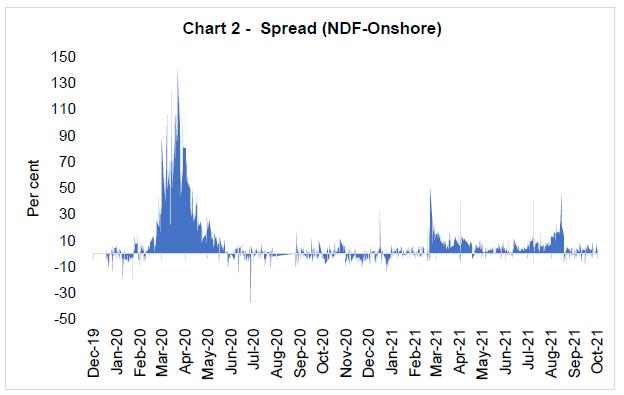
c. A key aspect of currency convertibility is integration of financial markets. Over time, it is essential that two markets – onshore and offshore - for domestic currency or interest rates cannot exist with efficiency. With increased convertibility, these markets need to be linked. An effort has already commenced in the interest rate derivative segment. Allowing Indian banks access to NDF markets for the Rupee is also consistent with this objective. As G-secs get held by global custodians and traded abroad more and more non-residents get to hold Rupee assets and take Rupee exposure. These measures are already seeing the desired results - for instance, NDF-onshore spreads have substantially narrowed after allowing Indian banks into the NDF space (Chart 2, see Annex). We need to now consider whether India is ready to allow such non-residents to hold Rupee accounts. This will be an important early step in internationalization of the Rupee and, therefore, needs to be carefully considered. Further, there is a need to consider a proper mechanism for information flow so that exchange and interest rate management can continue to be effective in an environment of larger offshore transactions.

d. As onshore and offshore financial markets get integrated, it should be ensured that price discovery in the domestic markets is efficient lest flows move to the offshore segment. Take the case of the Rupee exchange rate. It is market determined with fairly tight bid-ask spreads in the interbank market. Major corporates also seem to benefit from tight pricing. Yet many entities, especially SMEs, small exporters, individuals, etc., are prone to over-pricing. Do processing charges and market risk for warehousing odd lot positions justify these spreads? An effective way is to shift price discovery for the retail forex users to a platform. While such a platform (FX Retail) has been developed, it appears that banks do not find it in their interest to navigate customers to use that platform. In this age of technology, it may not really be possible to shun superior technology for any length of time. There should be a debate on the use of the platform and banks should make an effort to give it a fair trial.

Conclusion

18. India has come a long way in achieving increasing levels of convertibility on the capital account. It has broadly achieved the desired outcome for the policy choices it has made, in terms of achieving a stable composition of foreign capital inflow. At the same time, India is on the cusp of some fundamental shifts in this space with increased market integration in the offing and freer non-resident access to debt on the table. The rate of change in capital convertibility will only increase with each of these and similar measures. With that comes the responsibility to ensure that such flows are managed effectively with the right combination of capital flow measures, macro-prudential measures and market intervention. All of us need to consider deeply the issues I have highlighted above and arrive at effective solutions. Market participants, particularly banks, will have to prepare themselves to manage the business process changes and the global risks associated with capital convertibility. The regulator’s job is somewhat different. As someone once said, the job of a regulator is like the gas regulator in the kitchen - it cannot ensure the quality of the dish, but it can prevent the kitchen from blowing up. The quality of the dish – that is, the efficiency with which investment needs of the country are met - is up to how well Authorized Dealers and other intermediaries adjust to the increasingly fuller capital account convertibility.

Annex - Charts
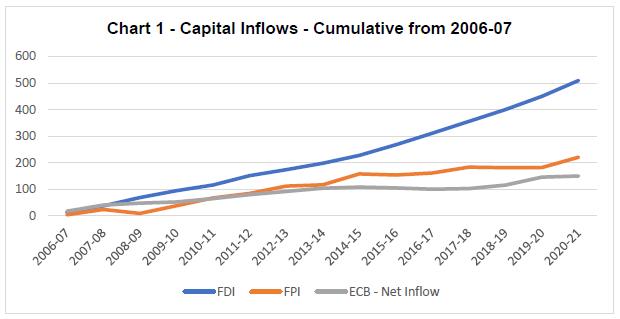
Chart 1

Chart 2

----

1 Speech delivered by Deputy Governor Shri T Rabi Sankar on the Fifth Foreign Exchange Dealers’ Association of India (FEDAI) Annual Day on October 14th, 2021. It was delivered via virtual platform.

2 OECD (2017), Open and Orderly Capital Movements: Interventions from the 2016 OECD High-Level Seminar.

3 Kaminsky Graciela Laura and Sergio L. Schmukler: Short-Run Pain, Long-Run Gain: Financial Liberalization and Stock Market Cycles, review of Finance, 2008

4 Fratzscher, Marcel: Capital Controls and Foreign Exchange Policy, Working Paper Series, European Central bank, February 2012.

5 FPI flows into equity over the 15-year period (2006-07 to 2020-21) accounts for 73% of total FPI inflows, while flows into debt account for the remaining 27%.

Topics

Acts Income Tax