Loading...

Top
Help
×

By creating an account you can:

Logo TaxTMI
Call Us / Help / Feedback

Contact Us At :

E-mail: [email protected]

Call / WhatsApp at: +91 99117 96707

For more information, Check Contact Us

FAQs :

To know Frequently Asked Questions, Check FAQs

Most Asked Video Tutorials :

For more tutorials, Check Video Tutorials

Submit Feedback/Suggestion :

Email :
Please provide your email address so we can follow up on your feedback.
Category :
Description :
Min 15 characters 0/2000
Make Most of Text Search
  1. Checkout this video tutorial: How to search effectively on TaxTMI.
  2. Put words in double quotes for exact word search, eg: "income tax"
  3. Avoid noise words such as : 'and, of, the, a'
  4. Sort by Relevance to get the most relevant document.
  5. Press Enter to add multiple terms/multiple phrases, and then click on Search to Search.
  6. Text Search
  7. The system will try to fetch results that contains ALL your words.
  8. Once you add keywords, you'll see a new 'Search In' filter that makes your results even more precise.
  9. Text Search
Add to...
You have not created any category. Kindly create one to bookmark this item!
Create New Category
Hide
Title :
Description :
❮❮ Hide
Default View
Expand ❯❯
Close ✕
🔎 News - Adv. Search
TEXT SEARCH:

Press 'Enter' to add multiple search terms. Rules for Better Search

Search In:
Main Text + AI Text
  • Main Text
  • Main Text + AI Text
  • AI Text
Category: ?
Categorized by AI
---- All Categories ----
  • ---- All Categories ----
  • Income Tax
  • GST
  • Customs, DGFT & SEZ
  • FEMA & RBI
  • Corp. Laws, SEBI & IBC
  • PMLA, Black Money & ED
  • Budget
  • News and Press Release
  • PTI News
Month:
---- All Months ----
  • ---- All Months ----
  • January
  • February
  • March
  • April
  • May
  • June
  • July
  • August
  • September
  • October
  • November
  • December
Year:
---- All Years ----
  • ---- All Years ----
  • 2026
  • 2025
  • 2024
  • 2023
  • 2022
  • 2021
  • 2020
  • 2019
  • 2018
  • 2017
  • 2016
  • 2015
  • 2014
  • 2013
  • 2012
  • 2011
Sort By: ?
In Sort By 'Default', exact matches for text search are shown at the top, followed by the remaining results in their regular order.
Relevance Default Date
    Additional Information related to GDP Estimates Received After Release of Q1 Estimates of FY 2026-27
    Union Minister of Commerce & Industry Shri Piyush Goyal Chairs CEO Roundtable on Ease of Doing Business for Scaling India’s Data Centre Ecosystem
    India–Afghanistan Joint Working Group on Trade Holds Virtual Meeting; Reviews Measures to Strengthen Bilateral Trade and Economic Cooperation
    PM Surya Ghar Yojana 2026: How to Get Rs 78,000 Solar Subsidy & Cut Your Electricity Bill
    Japan's JCR upgrades India's sovereign rating to 'A-', cites solid growth, improved financial system
    In personal insolvency case before NCLAT, Subhash Chandra opposes formation of 5-member NCLT bench
    GoCredit Launches Free Loan App Checker to Verify If a Lending App Is Real, Fake or RBI Registered
    Rupee falls 2 paise to 94.97 against US dollar in early trade
    Senior bureaucrats attend IICA’s ‘weekend wisdom’ program initiave
    NLMC to Facilitate E-Auction of 459 RINL Land Parcels in Visakhapatnam
    CCI approves acquisition of Aseem Infrastructure Finance Limited by TPG Nicobar SG Pte. Ltd. and related transactions
    CCI approves acquisition of up to 100% equity shareholding of Apollo Fertility Centre (AFCPL) and Apollo Specialty Hospitals (ASHPL) by Kids Clinic In...
    ED arrests businessman in DMF-linked money laundering case
    Rupee gains 27 paise to close at 94.95 against US dollar
    India's CAD widens to USD 4.2 bn in Q1 amid West Asia conflict: RBI data
    Andhra commercial tax collections rise by 11 per cent in August to Rs 4,983 cr
    Govt hikes windfall gains tax on petrol, diesel exports; cuts levy on ATF
    DGFT Enables Automated Issuance of Free Sale and Commerce Certificates to Promote Ease of Doing Business
    Bank unions to go on nationwide strike on Sep 11 over 5-day banking, other issues
    Stock markets close marginally lower amid higher oil prices, fresh US-Iran tensions
❯❯
Maximize Maximize Maximize
0 / 200
Expand Note
Add to Folder

No Folders have been created

+

Are you sure you want to delete "My most important" ?

NOTE:

News
Showing Results for :
Reset Filters
Results Found:
Show All Summaries Hide All Summaries
September 2, 2026
Show AI Summary
Double deflation explains negative manufacturing GVA deflators when input prices rise faster than output prices.
Double deflation in manufacturing separately deflates gross output and intermediate consumption, with real GVA derived from their difference. Where input prices rise faster than output prices, nominal GVA may grow more slowly than real GVA, producing a negative implicit GVA deflator despite rising output and input prices. A negative manufacturing GVA deflator therefore does not establish a fall in manufactured-product prices or lower real growth. The implicit GDP deflator is a derived ratio between current-price and constant-price GDP and differs from CPI and WPI because of their distinct coverage, weights, and price concepts.
September 2, 2026
Show AI Summary
Data centre ease-of-doing-business reforms target reliable power, prepared land, streamlined approvals and building standards for faster infrastructure deployment.
Ease-of-doing-business reforms for India's data-centre ecosystem focus on faster and sustainable infrastructure deployment through reliable power, ready-to-use land, streamlined approvals and suitable building regulations. Proposed power measures include cluster-based transmission planning, first-day sanctioned load, dual feeders and cross-border renewable-energy procurement. Data-centre-ready land banks and power-ready parcels are intended to reduce development timelines. The National Building Code 2026 recognises data centres under Group E and contains a dedicated annex on fire-risk assessment and data-centre-specific performance indicators.
September 2, 2026
Show AI Summary
Trade facilitation and customs cooperation drive follow-up action on connectivity, regulatory coordination, investment promotion and bilateral commercial engagement.
India-Afghanistan bilateral trade and economic cooperation is being advanced through institutional engagement on trade facilitation, customs cooperation, connectivity, investment and commercial exchange. Priority areas include customs and data-sharing cooperation, visa facilitation for traders, banking and financial cooperation, pharmaceutical and agricultural trade, energy cooperation, tariff concessions, cargo connectivity and port-related matters. Follow-up action covers regulatory cooperation, improved connectivity, investment promotion and business-to-business engagement.
September 2, 2026
Show AI Summary
Residential rooftop solar subsidy requires eligibility, prior approval, registered installation, net metering, commissioning, and verified bank details for direct transfer.
PM Surya Ghar Muft Bijli Yojana provides central financial assistance for eligible grid-connected residential rooftop solar systems, capped at Rs. 78,000 for systems of three kilowatts or more. Applicants must be Indian citizens who own a suitable house, hold a valid electricity connection, and have not received an earlier solar-panel subsidy. Applications require portal registration, distribution-company feasibility approval, installation through a registered vendor, net metering, inspection, commissioning and submission of bank details. Assistance is transferred directly after verification. State-specific net-metering procedures, approvals and additional incentives may apply.
September 2, 2026
Show AI Summary
Sovereign credit rating upgrade reflects solid growth, stronger financial systems, and improving fiscal and external resilience.
JCR upgrades India's foreign-currency and local-currency long-term issuer ratings to A- with a stable outlook, citing sustained economic growth, productivity-oriented policies and improved financial-system soundness. Fiscal constraints include elevated deficits, intergovernmental fiscal transfers, electoral-cycle sensitivity, and high combined government debt and interest burdens. Greater emphasis on infrastructure capital expenditure has improved the quality of fiscal spending. External resilience is supported by a contained current account deficit, services surplus and foreign-exchange reserves exceeding short-term external debt.
September 2, 2026
Show AI Summary
Personal insolvency bench constitution and repayment-plan eligibility remain contested where a larger tribunal bench stays a third-member order.
Personal insolvency proceedings raised a challenge to the National Company Law Tribunal's authority to constitute a five-member bench after a split verdict. The challenge contended that the mechanism for differing views permits reference to another member or members, but does not authorise a five-member bench. The larger bench stayed the third member's order, restricted asset alienation, and suspended an order permitting settlement of personal-guarantee claims. The dispute concerned the validity of that bench, the split-verdict reference procedure, repayment-plan eligibility, and pending creditor appeals.
September 2, 2026
Show AI Summary
Digital lending app verification enables borrowers to identify regulated lenders, grievance channels, and warning signs before accepting loans.
GoCredit's Loan App Checker allows borrowers to search lending apps against the public Digital Lending App directory and identify the regulated lender, grievance contact and RBI Ombudsman escalation route where a match exists. Regulatory reporting by regulated entities enables app-level verification, while borrowers should also check the lender named in app disclosures and loan agreements. A directory listing is a regulated-entity disclosure, not RBI approval or endorsement. Unmatched apps should be assessed through verification steps and reported through official channels where appropriate.
September 2, 2026
Show AI Summary
Rupee depreciation in early trade reflected oil-price pressures, risk aversion, higher Treasury yields and broad dollar strength.
Early foreign-exchange trading saw the rupee weaken against the US dollar amid renewed US-Iran tensions, risk aversion, higher Brent crude prices, and a stronger dollar. Safe-haven demand, inflation concerns linked to potential oil-supply disruption, expectations of a September Federal Reserve rate increase, and higher US Treasury yields supported the broad dollar rally. RBI monitoring of the rupee's decline was noted.
September 2, 2026
Show AI Summary
Responsible AI governance requires ethical safeguards, privacy protection, accountability and adaptive oversight to build lasting corporate stakeholder trust.
Responsible artificial intelligence governance requires continuous innovation, inclusive development, responsible deployment and trust-based governance. AI systems should be ethical, safe, transparent, fair and human-centric, with safeguards for privacy, bias, security and accountability. Proportionate and adaptive regulation should provide clear accountability, standards, monitoring, auditability and grievance redressal. Good governance, cybersecurity, personal data protection and responsible AI together strengthen organisational resilience, stakeholder trust, transparency and sustainable innovation.
September 2, 2026
Show AI Summary
E-auction of surplus public land enables transparent outright sale of RINL parcels through registered, KYC-verified bidding.
National Land Monetization Corporation will facilitate the e-auction and outright sale of 459 encumbrance-free RINL land parcels, including residential plots and parcels suited for commercial and logistics use. Competitive bidding will occur through the RailTel E-Nivida e-procurement platform. Participation requires online registration, KYC verification, and plot-wise submission of an earnest money deposit within prescribed timelines. The process supports transparent monetisation of surplus land and non-core public assets.
September 2, 2026
Show AI Summary
Competition approval for infrastructure finance restructuring covers acquisition, minority transfer, investment divestment, and merger of regulated NBFCs.
Competition Commission of India approval applies to the acquisition of Aseem Infrastructure Finance Limited by TPG Nicobar SG Pte. Ltd., a subsequent minority share acquisition by ICICI Bank Limited, and Aseem's divestment of its shareholding in NIIF Infrastructure Finance Limited to National Investment and Infrastructure Fund II. Following the acquisition, Climate Finance India Private Limited is intended to merge into Aseem as the surviving entity. The entities involved include RBI-registered non-deposit taking NBFCs operating in infrastructure finance, investment and credit, and infrastructure debt financing.
September 2, 2026
Show AI Summary
Healthcare merger approval enables KCIL to acquire fertility and specialty hospital businesses alongside related equity issuances and investment.
Competition Commission approval covers KCIL's acquisition of up to 100% equity shareholding in AFCPL and 100% equity shareholding in ASHPL. The combination includes KCIL issuing equity shares and optionally convertible debentures to AHLL, representing 9.9% fully diluted shareholding as partial consideration, together with a further KCIL equity investment by Arvon Investments Pte. Ltd. KCIL operates mother and baby care hospitals, while AFCPL provides assisted reproductive treatment and reproductive-medicine services.
September 1, 2026
Show AI Summary
Money-laundering investigation into alleged District Mineral Fund diversion examines purported liaison activity and asset acquisition through proceeds of crime.
Money-laundering proceedings under the Prevention of Money Laundering Act concern alleged diversion of District Mineral Fund resources through the Chhattisgarh Seed Corporation. The investigation alleges siphoning of public funds by contractors in collusion with government officials and political executives. A businessman was identified as an alleged liaisoner and financial coordinator between public servants, district authorities and private vendors. Allegations also include receipt of commissions, acquisition of immovable assets from purported proceeds of crime, non-production of records, and contradictory statements during questioning.
September 1, 2026
Show AI Summary
Foreign exchange market dynamics: rupee appreciation reflected portfolio inflows, domestic growth, and possible central-bank intervention amid external pressures.
The rupee appreciated against the US dollar, supported by domestic growth, controlled fiscal slippage, portfolio-related inflows and possible Reserve Bank of India intervention. Its gains were limited by weak equity markets, rising crude oil prices and a stronger dollar. External geopolitical tensions and hawkish US monetary signals remained potential pressures. Domestic indicators showed strong economic activity, while the current account deficit widened because of a higher merchandise trade deficit. Foreign portfolio inflows continued despite investors remaining net sellers during the year.
September 1, 2026
Show AI Summary
Current account deficit widened as merchandise trade deficit increased, notwithstanding stronger services receipts, remittances, and foreign direct investment inflows.
India's current account deficit widened in the first quarter of 2026-27 as the merchandise trade deficit increased. Higher net services receipts, increased personal transfer receipts and lower net primary-income outgo partly supported the external account. Financial-account movements included higher net foreign direct investment inflows, a shift in foreign portfolio investment from net inflow to net outflow, and lower net inflows through non-resident deposits and external commercial borrowings. Foreign exchange reserves declined on a balance-of-payments basis during the quarter.
September 1, 2026
Show AI Summary
Technology-enabled tax compliance and enforcement supported higher commercial tax collections, while GST rate reductions moderated sectoral net GST growth.
Technology-enabled tax administration supported commercial tax and net GST collection growth in Andhra Pradesh during August 2026 and the cumulative period through August. AI-based analytics and scrutiny, IGST reversals, UPI-based enforcement, registration verification, Aadhaar authentication, digital payment enablement, predictive analytics and data sharing strengthened compliance, scrutiny and revenue mobilisation. Petroleum VAT, professional tax, liquor VAT and IGST settlement also increased, while GST rate reductions moderated net GST performance in specified product sectors.
September 1, 2026
Show AI Summary
Windfall gains tax on petroleum exports rises for petrol and diesel while aviation turbine fuel levy is reduced.
Special additional excise duty and road and infrastructure cess on petroleum-product exports are revised with effect from 1 September 2026. The export duty on diesel is increased, the levy on aviation turbine fuel is marginally reduced, and a duty is imposed on petrol exports. Existing duty rates for petrol and diesel cleared for domestic consumption remain unchanged. The windfall-tax framework seeks to support domestic fuel availability and deter exporters from benefiting from domestic and international price differences.
September 1, 2026
Show AI Summary
Automated Free Sale and Commerce Certificate issuance reduces manual scrutiny while preserving risk-based review for eligible exporters.
DGFT has enabled automated issuance of Free Sale and Commerce Certificates through its portal for eligible exporters of items not covered by the Drugs & Cosmetics Act, 1940. Applications satisfying prevailing framework and automated processing parameters may be issued without manual scrutiny. Applications requiring verification or not meeting those parameters may be routed for manual processing, while auto-approved applications may be flagged later for risk-based review. The mechanism seeks faster, more transparent and predictable processing while retaining necessary oversight.
September 1, 2026
Show AI Summary
Five-day banking and equitable performance incentives drive planned nationwide bank union strike amid unresolved pension demands.
United Forum of Bank Unions has proposed nationwide strike action over delayed five-day banking, the performance-linked incentive framework, and unresolved pension demands. Five-day banking was agreed under the 12th Bipartite Settlement/9th Joint Note with extended Monday-to-Friday working hours, but remains pending for implementation. Unions challenge the incentive scheme for departing from a uniform, bank-performance-linked approach and for disproportionately benefiting senior officers. The dispute is under conciliation and pending before the Delhi High Court, while pension updation, a uniform dearness allowance formula, and an old pension scheme option remain unresolved.
September 1, 2026
Show AI Summary
Equity market volatility intensified as higher crude prices, geopolitical tensions and tighter monetary expectations weakened domestic investor sentiment.
Indian equity markets closed marginally lower as higher crude oil prices, US-Iran tensions, and expectations of prolonged tight United States monetary policy weakened risk appetite. The phased Closing Auction Session contributed to a late recovery in the benchmark index. Rising crude prices and global bond yields triggered broad-based selling across several domestic sectors, while foreign institutional equity sales and weakness in overseas markets added to pressure despite stronger-than-expected domestic economic growth.

News

Back

All News

Showing Results for :
Reset Filters
No Records Found

News

Showing Results for : Reset Filters

Pradhan Mantri Jan-Dhan Yojana (PMJDY) - National Mission for Financial Inclusion, completes seven years of successful implementation

August 28, 2021

Contents
Summary
Note

Note

-

Bookmark

Print

Print

Pradhan Mantri Jan-Dhan Yojana (PMJDY) - National Mission for Financial Inclusion, completes seven years of successful implementation

More than 43.04 crore beneficiaries banked under PMJDY since inception, amounting to ₹ 146,231 crore

“The journey of PMJDY led interventions undertaken over a short span of 7 years has in effect, produced both transformational as well as directional change thereby making the emerging FI ecosystem capable of delivering financial services to the last person of the society-the poorest of the poor”– Minister of Finance & Corporate Affairs, Smt. Nirmala Sitharaman

“Financial Inclusion is among top-most priorities of the Government as it is an enabler for inclusive growth.”- MoS Finance, Dr. Bhagwat Karad

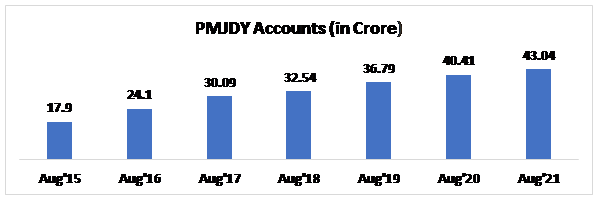
PMJDY Accounts have grown three-fold from 14.72 Crore in Mar’15 to 43.04 Crore as on 18-08-2021

55% Jan-Dhan account holders are women and 67% Jan Dhan accounts are in rural and semi-urban areas

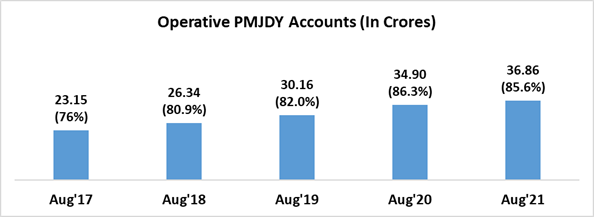
Out of total 43.04 crore PMJDY accounts, 36.86 crore (86%) are operative

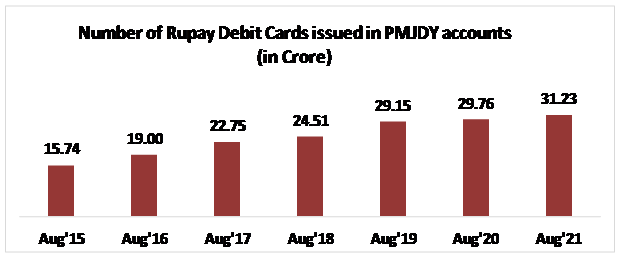
Total RuPay cards issued to PMJDY accountholders: 31.23 Crore

Under PM Garib Kalyan Yojana, a total of ₹ 30,945 crore have been credited in accounts of women PMJDY account holders during Covid lockdown

About 5.1 crore PMJDY accountholders receive direct benefit transfer (DBT) from the Government under various schemes

Ministry of Finance is committed to provide financial inclusiveness and support to the marginalized and hitherto socio-economically neglected classes. Financial Inclusion is a national priority of the Government as it is an enabler for inclusive growth. It is important as it provides an avenue to the poor for bringing their savings into the formal financial system, an avenue to remit money to their families in villages besides taking them out of the clutches of the usurious money lenders. A key initiative towards this commitment is the Pradhan Mantri Jan Dhan Yojna (PMJDY), which is one of the biggest financial inclusion initiatives in the world.

PMJDY was announced by Prime Minister, Shri Narendra Modi in his Independence Day address on 15th August 2014. While launching the programme on 28th August, the Prime Minister had described the occasion as a festival to celebrate the liberation of the poor from a vicious cycle.

On the 7th Anniversary of PMJDY, Finance Minister Smt. Nirmala Sitharaman reiterated the importance of this Scheme “The journey of PMJDY led interventions undertaken over a short span of 7 years has in effect, produced both transformational as well as directional change thereby making the emerging FI ecosystem capable of delivering financial services to the last person of the society-the poorest of the poor. The underlying pillars of PMJDY, namely, Banking the Unbanked, Securing the Unsecured and Funding the Unfunded has made it possible to adopt multi-stakeholders’ collaborative approach while leveraging technology for serving the unserved and underserved areas as well.” she said

Minister of State for Finance, Dr. Bhagwat Karad also expressed his thoughts for PMJDY on this occasion. He said “Pradhan Mantri Jan Dhan Yojana (PMJDY) has been one of the most far reaching initiatives towards Financial Inclusion not only in India but in the world. Financial Inclusion is among top-most priorities of the Government as it is an enabler for inclusive growth. It provides an avenue to the poor for bringing their savings into the formal financial system, an avenue to remit money to their families besides taking them out of the clutches of the usurious money lenders.”

As we complete 7 years of successful implementation of this Scheme, we take a look at the major aspects and achievements of this Scheme so far.

Background

Pradhan Mantri Jan-Dhan Yojana (PMJDY) is National Mission for Financial Inclusion to ensure access to financial services, namely, Banking/ Savings & Deposit Accounts, Remittance, Credit, Insurance, Pension in an affordable manner.

  1. Objectives:
    • Ensure access of financial products & services at an affordable cost
    • Use of technology to lower cost & widen reach
  2. Basic tenets of the scheme
    • Banking the unbanked - Opening of basic savings bank deposit (BSBD) account with minimal paperwork, relaxed KYC, e-KYC, account opening in camp mode, zero balance & zero charges
    • Securing the unsecured - Issuance of Indigenous Debit cards for cash withdrawals & payments at merchant locations, with free accident insurance coverage of ₹ 2 lakh
    • Funding the unfunded - Other financial products like micro-insurance, overdraft for consumption, micro-pension & micro-credit
  3. Initial Features

The scheme was launched based upon the following 6 pillars:

  • Universal access to banking services  – Branch and BC
  • Basic savings bank accounts with overdraft facility of ₹ 10,000/- to every eligible adult
  • Financial Literacy Program– Promoting savings, use of ATMs, getting ready for credit, availing insurance and pensions, using basic mobile phones for banking
  • Creation of Credit Guarantee Fund – To provide banks some guarantee against defaults
  • Insurance – Accident cover up to ₹ 1,00,000 and life cover of   ₹ 30,000 on account opened between 15 Aug 2014 to 31 January 2015
  • Pension scheme for Unorganized sector
  1. Important approach adopted in PMJDY based on past experience:
  • Accounts opened are online accounts in core banking system of banks, in place of earlier method of offline accounts opening with technology lock-in with the vendor
  • Inter-operability through RuPay debit card or Aadhaar enabled Payment System (AePS)
  • Fixed-point Business Correspondents
  • Simplified KYC / e-KYC in place of cumbersome KYC formalities
  1. Extension of PMJDY with New features – The Government decided to extend the comprehensive PMJDY program beyond 28.8.2018 with some modifications
  • Focus shift from ‘Every Household’ to Every Unbanked Adult’
  • RuPay Card Insurance - Free accidental insurance cover on RuPay cards increased from ₹ 1 lakh to ₹ 2 lakh for PMJDY accounts opened after 28.8.2018.
  • Enhancement in overdraft facilities -
  • OD limit doubled from ₹ 5,000/- to ₹ 10,000/-;  OD upto ₹ 2,000/- (without conditions).
  • Increase in upper age limit for OD from 60 to 65 years
  1. Impact of PMJDY

PMJDY has been the foundation stone for people-centric economic initiatives. Whether it is direct benefit transfers, COVID-19 financial assistance, PM-KISAN, increased wages under MGNREGA, life and health insurance cover, the first step of all these initiatives is to provide every adult with a bank account, which PMJDY has nearly completed. 

One in 2 accounts opened between Mar’14 to Mar’20 was a PMJDY account. Within 10 days of nationwide lockdown more than about 20 crore women PMJDY accounts were credited with ex-gratia.

Jandhan provides an avenue to the poor for bringing their savings into the formal financial system, an avenue to remit money to their families in villages besides taking them out of the clutches of the usurious money lenders. PMJDY has brought the unbanked into the banking system, expanded the financial architecture of India and brought financial inclusion to almost every adult.

In today's COVID-19 times, we have witnessed the remarkable swiftness and seamlessness with which Direct Benefit Transfer (DBTs) have empowered and provided financial security to the vulnerable sections of society. An important aspect is that DBTs via PM Jan Dhan accounts have ensured every rupee reaches its intended beneficiary and preventing systemic leakage. 
  1. Achievements under PMJDY- As on 18th August’21:
  1. PMJDY Accounts

  • As on 18th August ’21 number of total PMJDY Accounts: 43.04 Crore; 55.47% (23.87 crore) Jan-Dhan account holders are women and 66.69% (28.70 crore) Jan Dhan accounts are in rural and semi-urban areas
  • During first year of scheme 17.90 crore PMJDY accounts were opened
  • Continuous increase in no of accounts under PMJDY
  • PMJDY Accounts have grown three-fold from 14.72 Crore in Mar’15 to 43.04 Crore as on 18-08-2021. Undoubtedly a remarkable journey for the Financial Inclusion Program.
  1. Operative PMJDY Accounts –

  • As per extant RBI guidelines, a PMJDY account is treated as inoperative if there are no customer induced transactions in the account for over a period of two years
  • In August’21, out of total 43.04 crore PMJDY accounts, 36.86 crore (85.6%) are operative
  • Continuous increase in % of operative accounts is an indication that more an more of these accounts are being used by customers on a regular basis
  • Only 8.2% PMJDY accounts are zero balance accounts
  1. Deposits under PMJDY accounts -

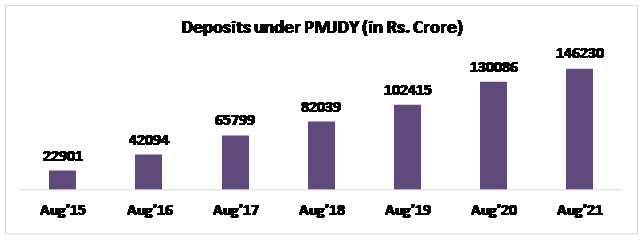
  • Total deposit balances under PMJDY Accounts stand at ₹ 1,46,230 crore
  • Deposits have increased about 6.38 times with increase in accounts 2.4 times (Aug’21 / Aug’15)
  1. Average Deposit per PMJDY account -

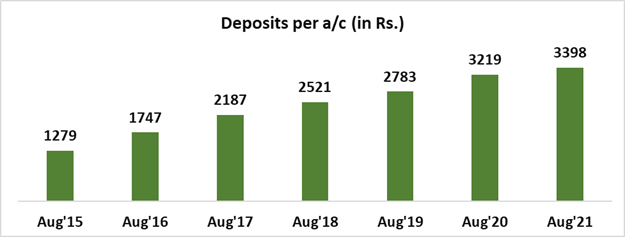
  • Average deposit per account is ₹ 3,398
  • Avg. Deposit per account has increased over 2.7 times over Aug’15
  • Increase in average deposit is another indication of increased usage of accounts and inculcation of saving habit among account holders
  1. Rupay Card issued to PMJDY account holders

  • Total RuPay cards issued to PMJDY accountholders: 31.23 Crore
  • Number of RuPay cards & their usage has increased over time
  1. Jan Dhan Darshak App

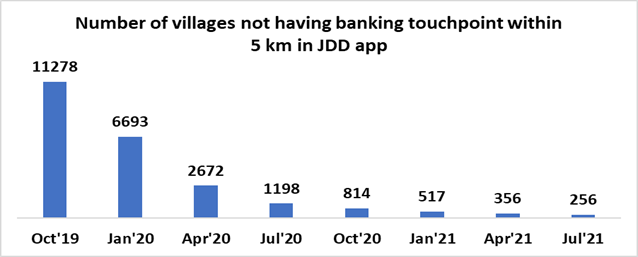
A mobile application, was launched to provide a citizen centric platform for locating banking touch points such as bank branches, ATMs, Bank Mitras, Post Offices, etc. in the country. Over 8 lakh banking touchpoints have been mapped on the GIS App. The facilities under Jan Dhan Darshak App could be availed as per the need and convenience of common people. The web version of this application could be accessed at the link http://findmybank.gov.in.

This app is also being used for identifying villages which are not served by banking touchpoints within 5 km. these identified villages are then allocated to various banks by concerned SLBCs for opening of banking outlets. The efforts have resulted in significant decrease in number of such villages.
  1. Pradhan Mantri Garib Kalyan Package (PMGKP) for PMJDY women beneficieries

As per announcement made by the Hon’ble Finance Minister on 26.3.2020, under PM Garib Kalyan Yojana, an amount of ₹ 500/- per month for three months (April’20 to June’20), was credited to the accounts of women account holders under Pradhan Mantri Jan Dhan Yojana (PMJDY). A total of ₹ 30,945 crore have been credited in accounts of women PMJDY account holders during Covid lockdown

  1. Towards ensuring smooth DBT transactions:

As informed by banks, about 5 crore PMJDY accountholders receive direct benefit transfer (DBT) from the Government under various schemes.To ensure that the eligible beneficiaries receive their DBT in time, the Department takes active role in identification of avoidable reasons for DBT failures in consultation with DBT Mission, NPCI, banks and various other Ministries. With close monitoring in this regard through regular VCs with banks and NPCI, the share of DBT failures due to avoidable reasons as a percentage of total DBT failures has decreased from 13.5%  (FY 19-20) to 5.7% (FY 20-21).

  1. The road ahead
  1. Endeavour to ensure coverage of PMJDY account holders under micro insurance schemes. Eligible PMJDY accountholders will be sought to be covered under PMJJBY and PMSBY. Banks have already been communicated about the same.
  2. Promotion of digital payments including RuPay debit card usage amongst PMJDY accountholders through creation of acceptance infrastructure across India
  3. Improving access of PMJDY account holders to Micro-credit and micro investment such as flexi-recurring deposit etc.

Topics

Acts Income Tax