Loading...

Top
Help
×

By creating an account you can:

Logo TaxTMI
Call Us / Help / Feedback

Contact Us At :

E-mail: [email protected]

Call / WhatsApp at: +91 99117 96707

For more information, Check Contact Us

FAQs :

To know Frequently Asked Questions, Check FAQs

Most Asked Video Tutorials :

For more tutorials, Check Video Tutorials

Submit Feedback/Suggestion :

Email :
Please provide your email address so we can follow up on your feedback.
Category :
Description :
Min 15 characters 0/2000
Make Most of Text Search
  1. Checkout this video tutorial: How to search effectively on TaxTMI.
  2. Put words in double quotes for exact word search, eg: "income tax"
  3. Avoid noise words such as : 'and, of, the, a'
  4. Sort by Relevance to get the most relevant document.
  5. Press Enter to add multiple terms/multiple phrases, and then click on Search to Search.
  6. Text Search
  7. The system will try to fetch results that contains ALL your words.
  8. Once you add keywords, you'll see a new 'Search In' filter that makes your results even more precise.
  9. Text Search
Add to...
You have not created any category. Kindly create one to bookmark this item!
Create New Category
Hide
Title :
Description :
❮❮ Hide
Default View
Expand ❯❯
Close ✕
🔎 News - Adv. Search
TEXT SEARCH:

Press 'Enter' to add multiple search terms. Rules for Better Search

Search In:
Main Text + AI Text
  • Main Text
  • Main Text + AI Text
  • AI Text
Category: ?
Categorized by AI
---- All Categories ----
  • ---- All Categories ----
  • Income Tax
  • GST
  • Customs, DGFT & SEZ
  • FEMA & RBI
  • Corp. Laws, SEBI & IBC
  • PMLA, Black Money & ED
  • Budget
  • News and Press Release
  • PTI News
Month:
---- All Months ----
  • ---- All Months ----
  • January
  • February
  • March
  • April
  • May
  • June
  • July
  • August
  • September
  • October
  • November
  • December
Year:
---- All Years ----
  • ---- All Years ----
  • 2026
  • 2025
  • 2024
  • 2023
  • 2022
  • 2021
  • 2020
  • 2019
  • 2018
  • 2017
  • 2016
  • 2015
  • 2014
  • 2013
  • 2012
  • 2011
Sort By: ?
In Sort By 'Default', exact matches for text search are shown at the top, followed by the remaining results in their regular order.
Relevance Default Date
    Enabling Filing of Appeals in Cases Involving NIL or Zero Demand Amount
    DGFT Introduces Open API Facility for Certificate of Origin on the Trade Connect e-Platform
    Amid global turmoil, India maintained momentum of its economic growth, says Amit Shah
    Zaggle Brings Cricket and Business Together in Hyderabad; Hosts Padma Bhushan Dr. Sunil Gavaskar
    AI may accelerate anti-competitive practices in digital markets: CCI chief
    Union Minister of Commerce and Industry Shri Piyush Goyal Calls for India to Emerge as a Global Medical and Healthcare Destination
    Union Minister of Commerce and Industry Shri Piyush Goyal Calls for Trained Caregivers and Wider Hospital Participation in Heal in India Gateway
    Rupee falls 7 paise to close at 94.50 against US dollar
    India Must Build Resilient, Globally Integrated Healthcare Supply Chains: Commerce and Industry Minister Shri Piyush Goyal at Bharat Health Global Exp...
    Rupee rises 4 paise to 94.39 against US dollar in early trade
    Jantar Mantar student stir, mass struggles could impact Assembly polls: MA Baby
    FDA awaiting response from restaurants at Mumbai Cricket Association premises: Mundhe
    India emerges as key diesel supplier to Europe as Russian, US flows falter
    Trump keeps heralding an economic boom, but even a solid jobs report is causing problems for him
    Telangana CM urges TCS'' HyperVault to launch its Hyderabad AI data centre by June 2028
    CBI FIR against Subhash Chandra for 'inflating' net worth to secure Rs 980 Cr in loans
    TCS subsidiary HyperVault to invest Rs 70,000 cr to develop Hyderabad AI data centre
    CBI FIR against Subhash Chandra for 'inflation' of net worth to secure nearly Rs 1,000-cr in loans
    Union Minister of Commerce & Industry Shri Piyush Goyal Calls for Nationwide FTA Utilisation Drive to Expand India’s Global Trade Footprint
    Union Minister of Commerce & Industry Shri Piyush Goyal Calls Upon Automotive Industry to Deepen Localisation, Expand Exports and Prepare to Serve Glo...
❯❯
Maximize Maximize Maximize
0 / 200
Expand Note
Add to Folder

No Folders have been created

+

Are you sure you want to delete "My most important" ?

NOTE:

News
Showing Results for :
Reset Filters
Results Found:
Show All Summaries Hide All Summaries
September 7, 2026
Show AI Summary
Appeals against NIL or Zero GST demand orders are enabled where taxpayers paid liabilities before issuance of the order.
GST Portal validation restricting appeals against demand orders showing NIL or Zero demand has been removed where a liability dispute exists and the taxpayer made payment before issuance of the demand order. Taxpayers may challenge such orders by filing an appeal in Form GST APL-01, and may raise a ticket with the GST Helpdesk if filing difficulties arise.
September 7, 2026
Show AI Summary
Certificate of origin API integration enables exporters to submit applications, receive certificates, verify issuance, and reduce repetitive data entry.
Open API integration for Certificates of Origin enables eligible exporters to connect ERP, accounting and other business software with the Trade Connect e-Platform for electronic application submission. The facility covers preferential and non-preferential certificates, provides authentication, file-submission and certificate-verification APIs, and maintains a transaction ledger for application tracking. Security measures include digital signatures, password hashing, IP whitelisting and time-limited access tokens. Relevant origin criteria, fields and validation rules are automatically applied according to the selected trade agreement or certification scheme.
September 7, 2026
Show AI Summary
Free trade agreements and strategic partnerships were identified as supporting India's trade engagement and economic growth amid geopolitical disruption.
India's international economic engagement through free trade agreements and strategic partnerships was identified as a means of sustaining economic growth amid geopolitical disruption. Economic cooperation was described as extending across defence, technology, energy, investment and trade. Nine free trade agreements were stated to have been concluded by 2026, with further trade arrangements proposed with other countries. Pursuit of free trade agreements was linked to increasing trade and to reported first-quarter GDP growth in the financial year 2026-27.
September 7, 2026
Show AI Summary
Leadership, talent recognition and legacy framed a discussion linking cricketing performance with entrepreneurship and organisational responsibility.
No FEMA or RBI regulatory measure, compliance obligation, legal interpretation, or adjudicatory determination is identified. The subject matter concerns leadership, performance and entrepreneurship, with emphasis on preparation, decision-making under pressure, teamwork, recognising potential and supporting talent. Corporate success is linked with creating opportunities, contributing to society and building a lasting legacy. Zaggle is described as providing enterprise spend management, card-based financial products through banking partnerships and software offerings for corporate customers.
September 7, 2026
Show AI Summary
AI-driven digital markets require competition scrutiny of autonomous pricing, self-preferencing, discriminatory pricing, tying, and market manipulation.
Artificial intelligence may accelerate anti-competitive conduct in digital markets through self-preferencing, discriminatory pricing, tying and market manipulation. Agentic AI may create particular concerns where it monitors competitors' prices and autonomously responds without direct human intervention. Competition law aims to prevent anti-competitive practices, promote competition, protect consumers and preserve freedom of trade, while allowing legitimate growth and innovation. Market dominance is not objectionable in itself; concern arises from abuse of dominance through exclusionary or exploitative practices.
September 7, 2026
Show AI Summary
Healthcare innovation and supply-chain self-reliance are prioritised through trade access, investment, research collaboration, testing infrastructure, and quality standards.
Healthcare-sector development priorities seek to expand medical devices, diagnostics, digital health, research, and pharmaceutical machinery through exports, import substitution, and services growth. Free trade agreements are presented as supporting preferential market access, services opportunities, and mobility. Sectoral growth is linked to startup incubation, intellectual-property capability, international research collaboration, technology transfer, and joint ventures. Healthcare self-reliance requires indigenous equipment, critical components, resilient supply chains, shared testing and certification infrastructure, and uncompromising quality standards.
September 7, 2026
Show AI Summary
Medical value tourism quality standards prioritise verified hospitals, ethical treatment, transparent pricing, and seamless international patient care.
Medical value tourism is proposed to expand through trained caregivers, transparent treatment packages, ethical hospital practices, seamless reimbursement and cashless-payment systems, telemedicine, and verified hospital participation. International patients are intended to receive care through accredited quality systems, supported by interpreters, global outreach, and coordinated healthcare networks. Expansion beyond metropolitan areas must maintain equivalent high-quality care for domestic and foreign patients without discrimination. Certification systems are expected to remain professionally independent and free from unethical influence.
September 7, 2026
Show AI Summary
Foreign exchange market pressures from rising crude oil and weak domestic equities constrained rupee support from foreign inflows.
Foreign exchange market conditions caused the rupee to depreciate against the US dollar despite support from FCNR dollar inflows and a softer dollar. Rising crude oil prices, weak domestic equities and global headwinds constrained gains. The outlook remained dependent on foreign inflows, dollar movements, crude prices, market sentiment and inflation data, with geopolitical tensions capable of increasing pressure on the currency.
September 7, 2026
Show AI Summary
Healthcare supply-chain resilience requires diversified sourcing, global investment, domestic innovation, and stronger medical-device production supported by enabling infrastructure.
Healthcare supply-chain resilience requires diversified sourcing, restoration of domestic capacity in Active Pharmaceutical Ingredients and Key Starting Materials, and continued imports where necessary through multiple suppliers and geographies. Pharmaceutical industry growth should move beyond generics towards research, development, patented products, new molecules, biosimilars and biotechnology. Regulatory convergence should support clinical trials, patenting and new-product introduction. Government support is contemplated for medical value travel, healthcare infrastructure, bulk drug parks, plug-and-play facilities, medical-device component production and scientific validation of Ayush products.
September 7, 2026
Show AI Summary
Foreign exchange market pressures offset rupee support from FCNR inflows amid higher crude oil and dollar demand.
The rupee gained marginally against the US dollar, supported by FCNR-related dollar inflows and robust liquidity. Elevated Brent crude prices, safe-haven dollar demand and geopolitical tensions constrained this support. Higher oil prices may enlarge India's import bill, increase dollar demand and pressure the rupee, although rising foreign-exchange reserves indicated external-sector strength.
September 6, 2026
Show AI Summary
Census data privacy and electoral integrity concerns emerge alongside calls to repeal insolvency law and protect political dissent.
CPI(M) called for repeal of the Insolvency and Bankruptcy Code, alleging that insolvency processes enabled diversion of public resources. It questioned economic growth figures against agricultural weakness, mining contraction, higher input costs, inflation, unemployment and malnutrition. The party also raised Census data privacy concerns over caste-data collection, potential linkage with government databases, and possible implications for citizenship, electoral rolls and future delimitation.
September 6, 2026
Show AI Summary
Food business licensing: Third-party restaurant operators require their own licences and cannot operate under another entity's registration.
Food Business Operator licensing requires the entity holding a food licence or registration to itself conduct the licensed food business at the specified premises. A third-party operator cannot operate under another entity's licence or registration and must obtain its own licence or registration. Regulatory notices concerning such arrangements may also address hygiene lapses and structural violations, followed by consideration of the operators' responses.
September 6, 2026
Show AI Summary
European diesel supply dependence on alternative refiners grows amid constrained exports, weakening transatlantic flows, and restricted shipping routes.
European diesel supply is becoming increasingly dependent on Indian refining capacity as Russian diesel and gasoil exports remain constrained by export restrictions, refinery disruptions and port outages, while US shipments to Europe have weakened. Alternative supply routes offer limited additional clean-product volumes because reduced tanker crossings and lower ship-to-ship transfers offshore Oman constrain flows through the Strait of Hormuz. Low diesel inventories, seasonal demand and planned refinery maintenance increase exposure to supply disruptions.
September 5, 2026
Show AI Summary
Tariff-driven inflation and elevated borrowing costs constrain growth, while durable deficit reduction may require spending restraint and tax increases.
Persistent inflation, elevated interest rates and rising public debt constrain economic growth policy. Tariffs and oil shortages are identified as contributing to inflationary pressures, while lower interest rates could increase money flows and worsen inflation. Tariffs, tax cuts, artificial intelligence productivity gains and anti-fraud measures are advanced as mechanisms to support growth, investment and domestic employment. Fiscal sustainability, however, cannot be achieved through growth alone where social security and healthcare costs exceed revenue growth; deficit reduction may require slower spending, spending reductions and tax increases.
September 5, 2026
Show AI Summary
AI data centre development receives state support for a high-capacity campus and accelerated commissioning timetable.
HyperVault's proposed artificial-intelligence data-centre campus in Hyderabad is planned on 264 acres, with investment projected at up to Rs 70,000 crore and capacity of up to 1 GW. The campus is intended to provide high-density, liquid-cooled computing infrastructure for frontier AI companies and hyperscalers. Telangana's Chief Minister sought inauguration by June 2, 2028, while assuring required governmental sanctions and support. The project is estimated to create 7,000 jobs.
September 5, 2026
Show AI Summary
Inflated net-worth certificates allegedly enabled secured lending, triggering fraud, breach-of-trust and asset-stripping allegations after default.
Alleged inflation of net-worth certificates is said to have induced approval and disbursal of two corporate loan facilities aggregating Rs 980 crore, each secured by continuing personal guarantees. The facilities subsequently defaulted. The FIR alleges that materially higher net-worth representations made in 2018 were later contradicted during insolvency proceedings, and attributes the lending to collusion among the guarantor, borrower entities and their officers. Allegations include cheating, creation of false documents, misappropriation and misapplication of loan funds, breach of trust, and asset stripping intended to frustrate recovery.
September 5, 2026
Show AI Summary
AI data centre infrastructure investment enables phased deployment of high-density, liquid-cooled computing capacity using green and water-neutral design.
HyperVault plans to develop an artificial intelligence data-centre campus on 264 acres in Hyderabad, with capacity of up to 1 GW and investment by HyperVault and its partners of up to Rs 70,000 crore. The facility is intended to provide high-density, liquid-cooled computing infrastructure for frontier AI companies and hyperscalers. Development will proceed in phases according to customer demand and technology requirements, incorporating green-energy use and water-neutral design principles.
September 5, 2026
Show AI Summary
Alleged inflation of personal net worth underpins fraud and breach-of-trust accusations over secured corporate lending.
CBI registration of an FIR concerns allegations that inflated personal net-worth certificates were used to secure corporate loan facilities from Life Insurance Corporation Housing Finance Ltd. The lender alleges that the certificates influenced lending decisions, the facilities subsequently defaulted, and later insolvency proceedings disclosed inconsistency between the represented and asserted net-worth figures. Allegations include collusion with borrower entities, false documentation, cheating, misappropriation of loan funds, and breach of lender trust.
September 5, 2026
Show AI Summary
Free trade agreement utilisation requires district-level exporter support, rules-of-origin assistance, standards compliance, and coordinated market-access outreach nationwide.
Free Trade Agreement utilisation is to be advanced through coordinated action by central and state governments, sectoral ministries, Export Promotion Councils, industry associations and local export-support institutions. Preferential treatment is assessed against tariff rates faced by competing countries, while export competitiveness depends on scale, quality, customer trust and timely delivery. The Export Promotion Mission supports export credit, digitised compliance and FTA documentation, including rules-of-origin certification. District-level identification of products, clusters, new exporters and practical constraints, supported by workshops and rapid online facilitation, is intended to deepen market access.
September 5, 2026
Show AI Summary
Automotive localisation and export competitiveness are prioritised through global-standard manufacturing, technology partnerships, sustainable mobility, and government infrastructure support.
Automotive-sector localisation, export expansion and global-standard manufacturing are prioritised to strengthen India's role in global production and trade. Companies are urged to invest in technology, innovation, research and development, use domestic scale for overseas markets, and avoid supplying inferior products domestically. Trade agreements are positioned as channels for market access, technology absorption and exports. Greater indigenisation is encouraged through component localisation, technology collaborations and expanded exports, supported by critical minerals, batteries, indigenous energy sources, research funding, plug-and-play infrastructure and industrial ecosystems.

News

Back

All News

Showing Results for :
Reset Filters
No Records Found

News

Showing Results for : Reset Filters

Pradhan Mantri Jan-Dhan Yojana (PMJDY) - National Mission for Financial Inclusion, completes seven years of successful implementation

August 28, 2021

Contents
Summary
Note

Note

-

Bookmark

Print

Print

Pradhan Mantri Jan-Dhan Yojana (PMJDY) - National Mission for Financial Inclusion, completes seven years of successful implementation

More than 43.04 crore beneficiaries banked under PMJDY since inception, amounting to ₹ 146,231 crore

“The journey of PMJDY led interventions undertaken over a short span of 7 years has in effect, produced both transformational as well as directional change thereby making the emerging FI ecosystem capable of delivering financial services to the last person of the society-the poorest of the poor”– Minister of Finance & Corporate Affairs, Smt. Nirmala Sitharaman

“Financial Inclusion is among top-most priorities of the Government as it is an enabler for inclusive growth.”- MoS Finance, Dr. Bhagwat Karad

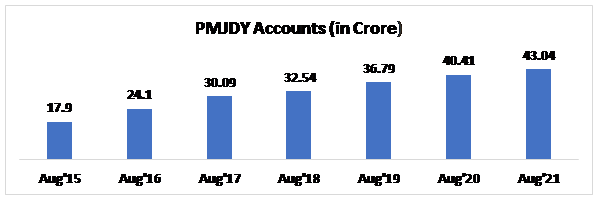
PMJDY Accounts have grown three-fold from 14.72 Crore in Mar’15 to 43.04 Crore as on 18-08-2021

55% Jan-Dhan account holders are women and 67% Jan Dhan accounts are in rural and semi-urban areas

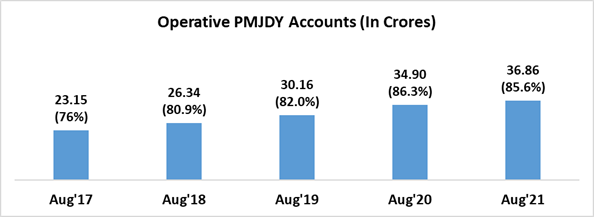
Out of total 43.04 crore PMJDY accounts, 36.86 crore (86%) are operative

Total RuPay cards issued to PMJDY accountholders: 31.23 Crore

Under PM Garib Kalyan Yojana, a total of ₹ 30,945 crore have been credited in accounts of women PMJDY account holders during Covid lockdown

About 5.1 crore PMJDY accountholders receive direct benefit transfer (DBT) from the Government under various schemes

Ministry of Finance is committed to provide financial inclusiveness and support to the marginalized and hitherto socio-economically neglected classes. Financial Inclusion is a national priority of the Government as it is an enabler for inclusive growth. It is important as it provides an avenue to the poor for bringing their savings into the formal financial system, an avenue to remit money to their families in villages besides taking them out of the clutches of the usurious money lenders. A key initiative towards this commitment is the Pradhan Mantri Jan Dhan Yojna (PMJDY), which is one of the biggest financial inclusion initiatives in the world.

PMJDY was announced by Prime Minister, Shri Narendra Modi in his Independence Day address on 15th August 2014. While launching the programme on 28th August, the Prime Minister had described the occasion as a festival to celebrate the liberation of the poor from a vicious cycle.

On the 7th Anniversary of PMJDY, Finance Minister Smt. Nirmala Sitharaman reiterated the importance of this Scheme “The journey of PMJDY led interventions undertaken over a short span of 7 years has in effect, produced both transformational as well as directional change thereby making the emerging FI ecosystem capable of delivering financial services to the last person of the society-the poorest of the poor. The underlying pillars of PMJDY, namely, Banking the Unbanked, Securing the Unsecured and Funding the Unfunded has made it possible to adopt multi-stakeholders’ collaborative approach while leveraging technology for serving the unserved and underserved areas as well.” she said

Minister of State for Finance, Dr. Bhagwat Karad also expressed his thoughts for PMJDY on this occasion. He said “Pradhan Mantri Jan Dhan Yojana (PMJDY) has been one of the most far reaching initiatives towards Financial Inclusion not only in India but in the world. Financial Inclusion is among top-most priorities of the Government as it is an enabler for inclusive growth. It provides an avenue to the poor for bringing their savings into the formal financial system, an avenue to remit money to their families besides taking them out of the clutches of the usurious money lenders.”

As we complete 7 years of successful implementation of this Scheme, we take a look at the major aspects and achievements of this Scheme so far.

Background

Pradhan Mantri Jan-Dhan Yojana (PMJDY) is National Mission for Financial Inclusion to ensure access to financial services, namely, Banking/ Savings & Deposit Accounts, Remittance, Credit, Insurance, Pension in an affordable manner.

  1. Objectives:
    • Ensure access of financial products & services at an affordable cost
    • Use of technology to lower cost & widen reach
  2. Basic tenets of the scheme
    • Banking the unbanked - Opening of basic savings bank deposit (BSBD) account with minimal paperwork, relaxed KYC, e-KYC, account opening in camp mode, zero balance & zero charges
    • Securing the unsecured - Issuance of Indigenous Debit cards for cash withdrawals & payments at merchant locations, with free accident insurance coverage of ₹ 2 lakh
    • Funding the unfunded - Other financial products like micro-insurance, overdraft for consumption, micro-pension & micro-credit
  3. Initial Features

The scheme was launched based upon the following 6 pillars:

  • Universal access to banking services  – Branch and BC
  • Basic savings bank accounts with overdraft facility of ₹ 10,000/- to every eligible adult
  • Financial Literacy Program– Promoting savings, use of ATMs, getting ready for credit, availing insurance and pensions, using basic mobile phones for banking
  • Creation of Credit Guarantee Fund – To provide banks some guarantee against defaults
  • Insurance – Accident cover up to ₹ 1,00,000 and life cover of   ₹ 30,000 on account opened between 15 Aug 2014 to 31 January 2015
  • Pension scheme for Unorganized sector
  1. Important approach adopted in PMJDY based on past experience:
  • Accounts opened are online accounts in core banking system of banks, in place of earlier method of offline accounts opening with technology lock-in with the vendor
  • Inter-operability through RuPay debit card or Aadhaar enabled Payment System (AePS)
  • Fixed-point Business Correspondents
  • Simplified KYC / e-KYC in place of cumbersome KYC formalities
  1. Extension of PMJDY with New features – The Government decided to extend the comprehensive PMJDY program beyond 28.8.2018 with some modifications
  • Focus shift from ‘Every Household’ to Every Unbanked Adult’
  • RuPay Card Insurance - Free accidental insurance cover on RuPay cards increased from ₹ 1 lakh to ₹ 2 lakh for PMJDY accounts opened after 28.8.2018.
  • Enhancement in overdraft facilities -
  • OD limit doubled from ₹ 5,000/- to ₹ 10,000/-;  OD upto ₹ 2,000/- (without conditions).
  • Increase in upper age limit for OD from 60 to 65 years
  1. Impact of PMJDY

PMJDY has been the foundation stone for people-centric economic initiatives. Whether it is direct benefit transfers, COVID-19 financial assistance, PM-KISAN, increased wages under MGNREGA, life and health insurance cover, the first step of all these initiatives is to provide every adult with a bank account, which PMJDY has nearly completed. 

One in 2 accounts opened between Mar’14 to Mar’20 was a PMJDY account. Within 10 days of nationwide lockdown more than about 20 crore women PMJDY accounts were credited with ex-gratia.

Jandhan provides an avenue to the poor for bringing their savings into the formal financial system, an avenue to remit money to their families in villages besides taking them out of the clutches of the usurious money lenders. PMJDY has brought the unbanked into the banking system, expanded the financial architecture of India and brought financial inclusion to almost every adult.

In today's COVID-19 times, we have witnessed the remarkable swiftness and seamlessness with which Direct Benefit Transfer (DBTs) have empowered and provided financial security to the vulnerable sections of society. An important aspect is that DBTs via PM Jan Dhan accounts have ensured every rupee reaches its intended beneficiary and preventing systemic leakage. 
  1. Achievements under PMJDY- As on 18th August’21:
  1. PMJDY Accounts

  • As on 18th August ’21 number of total PMJDY Accounts: 43.04 Crore; 55.47% (23.87 crore) Jan-Dhan account holders are women and 66.69% (28.70 crore) Jan Dhan accounts are in rural and semi-urban areas
  • During first year of scheme 17.90 crore PMJDY accounts were opened
  • Continuous increase in no of accounts under PMJDY
  • PMJDY Accounts have grown three-fold from 14.72 Crore in Mar’15 to 43.04 Crore as on 18-08-2021. Undoubtedly a remarkable journey for the Financial Inclusion Program.
  1. Operative PMJDY Accounts –

  • As per extant RBI guidelines, a PMJDY account is treated as inoperative if there are no customer induced transactions in the account for over a period of two years
  • In August’21, out of total 43.04 crore PMJDY accounts, 36.86 crore (85.6%) are operative
  • Continuous increase in % of operative accounts is an indication that more an more of these accounts are being used by customers on a regular basis
  • Only 8.2% PMJDY accounts are zero balance accounts
  1. Deposits under PMJDY accounts -

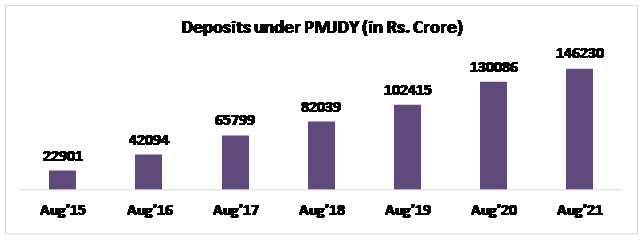
  • Total deposit balances under PMJDY Accounts stand at ₹ 1,46,230 crore
  • Deposits have increased about 6.38 times with increase in accounts 2.4 times (Aug’21 / Aug’15)
  1. Average Deposit per PMJDY account -

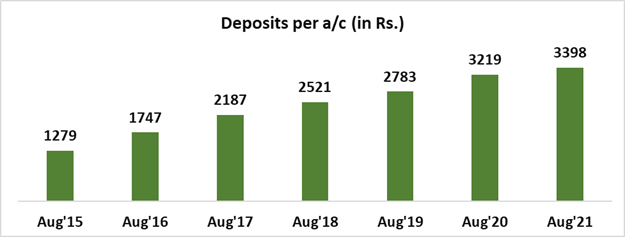
  • Average deposit per account is ₹ 3,398
  • Avg. Deposit per account has increased over 2.7 times over Aug’15
  • Increase in average deposit is another indication of increased usage of accounts and inculcation of saving habit among account holders
  1. Rupay Card issued to PMJDY account holders

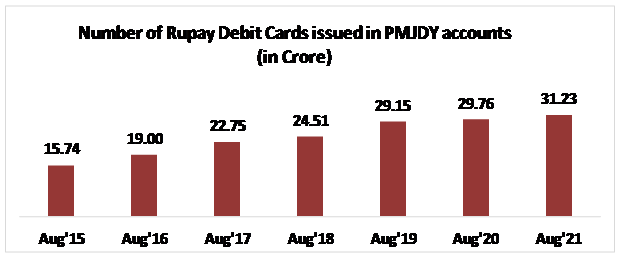
  • Total RuPay cards issued to PMJDY accountholders: 31.23 Crore
  • Number of RuPay cards & their usage has increased over time
  1. Jan Dhan Darshak App

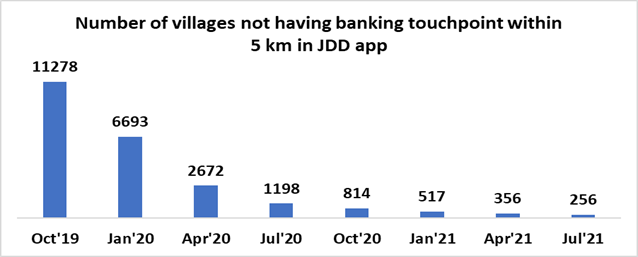
A mobile application, was launched to provide a citizen centric platform for locating banking touch points such as bank branches, ATMs, Bank Mitras, Post Offices, etc. in the country. Over 8 lakh banking touchpoints have been mapped on the GIS App. The facilities under Jan Dhan Darshak App could be availed as per the need and convenience of common people. The web version of this application could be accessed at the link http://findmybank.gov.in.

This app is also being used for identifying villages which are not served by banking touchpoints within 5 km. these identified villages are then allocated to various banks by concerned SLBCs for opening of banking outlets. The efforts have resulted in significant decrease in number of such villages.
  1. Pradhan Mantri Garib Kalyan Package (PMGKP) for PMJDY women beneficieries

As per announcement made by the Hon’ble Finance Minister on 26.3.2020, under PM Garib Kalyan Yojana, an amount of ₹ 500/- per month for three months (April’20 to June’20), was credited to the accounts of women account holders under Pradhan Mantri Jan Dhan Yojana (PMJDY). A total of ₹ 30,945 crore have been credited in accounts of women PMJDY account holders during Covid lockdown

  1. Towards ensuring smooth DBT transactions:

As informed by banks, about 5 crore PMJDY accountholders receive direct benefit transfer (DBT) from the Government under various schemes.To ensure that the eligible beneficiaries receive their DBT in time, the Department takes active role in identification of avoidable reasons for DBT failures in consultation with DBT Mission, NPCI, banks and various other Ministries. With close monitoring in this regard through regular VCs with banks and NPCI, the share of DBT failures due to avoidable reasons as a percentage of total DBT failures has decreased from 13.5%  (FY 19-20) to 5.7% (FY 20-21).

  1. The road ahead
  1. Endeavour to ensure coverage of PMJDY account holders under micro insurance schemes. Eligible PMJDY accountholders will be sought to be covered under PMJJBY and PMSBY. Banks have already been communicated about the same.
  2. Promotion of digital payments including RuPay debit card usage amongst PMJDY accountholders through creation of acceptance infrastructure across India
  3. Improving access of PMJDY account holders to Micro-credit and micro investment such as flexi-recurring deposit etc.

Topics

Acts Income Tax