
Just a moment...

Top
Help
×

By creating an account you can:

Logo TaxTMI
Call Us / Help / Feedback

Contact Us At :

E-mail: [email protected]

Call / WhatsApp at: +91 99117 96707

For more information, Check Contact Us

FAQs :

To know Frequently Asked Questions, Check FAQs

Most Asked Video Tutorials :

For more tutorials, Check Video Tutorials

Submit Feedback/Suggestion :

Email :
Please provide your email address so we can follow up on your feedback.
Category :
Description :
Min 15 characters0/2000
Make Most of Text Search
  1. Checkout this video tutorial: How to search effectively on TaxTMI.
  2. Put words in double quotes for exact word search, eg: "income tax"
  3. Avoid noise words such as : 'and, of, the, a'
  4. Sort by Relevance to get the most relevant document.
  5. Press Enter to add multiple terms/multiple phrases, and then click on Search to Search.
  6. Text Search
  7. The system will try to fetch results that contains ALL your words.
  8. Once you add keywords, you'll see a new 'Search In' filter that makes your results even more precise.
  9. Text Search
Add to...
You have not created any category. Kindly create one to bookmark this item!
Create New Category
Hide
Title :
Description :
❮❮ Hide
Default View
Expand ❯❯
Close ✕
🔎 News - Adv. Search
TEXT SEARCH:

Press 'Enter' to add multiple search terms. Rules for Better Search

Search In:
Main Text + AI Text
  • Main Text
  • Main Text + AI Text
  • AI Text
Category: ?
Categorized by AI
---- All Categories ----
  • ---- All Categories ----
  • Income Tax
  • GST
  • Customs, DGFT & SEZ
  • FEMA & RBI
  • Corp. Laws, SEBI & IBC
  • PMLA, Black Money & ED
  • Budget
  • News and Press Release
  • PTI News
Month:
---- All Months ----
  • ---- All Months ----
  • January
  • February
  • March
  • April
  • May
  • June
  • July
  • August
  • September
  • October
  • November
  • December
Year:
---- All Years ----
  • ---- All Years ----
  • 2026
  • 2025
  • 2024
  • 2023
  • 2022
  • 2021
  • 2020
  • 2019
  • 2018
  • 2017
  • 2016
  • 2015
  • 2014
  • 2013
  • 2012
  • 2011
Sort By: ?
In Sort By 'Default', exact matches for text search are shown at the top, followed by the remaining results in their regular order.
RelevanceDefaultDate
    Kerala to stop welfare pension delivery through cooperative banks, shifts to DBT
    China's exports slow slightly in July despite robust demand for high-tech products
    India successfully concludes the Tenth BRICS Industry Ministers' Meeting in Jaipur under its BRICS Chairship 2026
    APEDA Organises BIOFACH INDIA 2026 to Promote India's Certified Organic Products and Expand Global Market Access
    RBI bars banks from disabling mobile devices of defaulting borrowers
    Par panel for early conclusion of India-US trade pact, tariff exemptions on key goods
    No commitments relating to ethanol import from US for fuel blending under FTA talks: Govt
    No concession or commitment on import of Ethanol for fuel blending from the United States
    Office of the Controller General of Patents, Designs and Trade Marks Announces Tentative Schedule for Patent and Trade Marks Agent Examinations 2027 a...
    RBI invites comments on the draft “Reserve Bank of India (Non-Banking Financial Companies – Credit Facilities) Amendment Directions, 2026”
    West Bengal seeks 100pc foodgrain, 40pc sugar jute packaging quota at SAC meeting
    RBI clasifies Tata Sons, 16 others as large NBFCs
    Sensex climbs 374 points on buying in Reliance, ICICI Bank; Nifty ends flat
    Insurance Division, DFS Secures 3rd Rank in Group A Category of Grievance Redressal Assessment & Index (GRAI) for June 2026
    VKDL Group’s NPA Bazaar Strengthens India’s Distressed Asset Resolution Ecosystem Under the Leadership of V K Dubey
    Lok Sabha passes bill to authorise govt to permit banks to levy charges on UPI transactions
    Monetary Policy Statement, 2026-27 Resolution of the Monetary Policy Committee August 3 to 5, 2026
    Stock markets edged higher in early trade amid lower crude oil prices, buying in Reliance Industries
    Monthly review of accounts of Government of India upto June 2026 (FY 2026-27)
    DRI busts illegal drug manufacturing unit in Satara district in Maharashtra; two arrested
❯❯
MaximizeMaximizeMaximize
0 / 200
Expand Note
Add to Folder

No Folders have been created

    +

    Are you sure you want to delete "My most important" ?

    NOTE:

    News
    Showing Results for :
    Reset Filters
    Results Found:
    Show All SummariesHide All Summaries
    August 7, 2026
    Show AI Summary
    Direct Benefit Transfer for welfare pensions replaces doorstep cooperative-bank delivery, while home delivery remains for bedridden beneficiaries.
    Direct Benefit Transfer of social security and welfare pensions is to be made mandatory through Aadhaar-linked bank accounts, replacing cooperative-bank doorstep distribution. Home delivery continues for completely bedridden beneficiaries and others who cannot be excluded. The change addresses delays in remitting undistributed amounts, record-update and reconciliation deficiencies, duplicate payments linked to incomplete Aadhaar-based payments, delivery incentive costs, and the need to comply with Direct Benefit Transfer norms to avoid loss of central financial assistance.
    August 7, 2026
    Show AI Summary
    Customs trade data show moderating July growth while high-technology exports, vehicles and advanced manufacturing supplies remain strongly supported.
    Customs and trade data showed that China's July export and import growth moderated and its trade surplus narrowed from the preceding month. Typhoon-related port disruptions affected trade flows, but demand for electronics and green technology products supported elevated values. High-technology items, vehicles, electronics and machinery recorded strong January-July export growth, while trade performance varied among the United States, the European Union and Southeast Asia.
    August 7, 2026
    Show AI Summary
    BRICS industrial cooperation advances MSME, photovoltaic, startup and logistics frameworks alongside resilient trade and digital services collaboration.
    BRICS industrial cooperation under PartNIR was strengthened through a Joint Declaration and institutional measures addressing MSMEs, photovoltaics, startup-led innovation, and resilient transport and logistics. The measures include an SME cooperation framework, Terms of Reference and an Action Plan for photovoltaic industry cooperation, and a startup innovation action plan. Trade discussions focused on the multilateral trading system, MSME participation in international trade, resilient global value chains, and cross-border digitally delivered services within a rules-based trading framework.
    August 7, 2026
    Show AI Summary
    Certified organic export promotion: BIOFACH INDIA facilitates buyer-seller engagement, certification awareness, traceability discussions and international market access.
    BIOFACH INDIA 2026 promotes certified organic exports by providing a platform for Indian organic enterprises to showcase diverse certified products and engage with overseas buyers through structured Buyer-Seller Meets. Technical sessions address organic certification, traceability, sustainability, quality standards, international regulatory requirements and export-market expectations. The initiative supports quality assurance, international market access, export linkages and sustainable agricultural practices across the organic value chain.
    August 6, 2026
    Show AI Summary
    Device-based loan recovery restrictions protect essential mobile functions while permitting gradual locking only for lender-financed devices.
    Technology-based recovery mechanisms cannot restrict or disable a borrower's mobile device unless the bank financed acquisition of that device. Where permitted, banks must adopt a gradual approach and preserve essential functions, including incoming calls, SMS access, and emergency SOS features. Regulated entities and service providers must obtain manufacturer or operating-system certification for device-locking technology. Disclosure of borrower or guarantor information to recovery personnel must be limited to what is necessary for loan-recovery duties.
    August 6, 2026
    Show AI Summary
    Bilateral trade agreement negotiations should secure tariff certainty, protect key exports, strengthen supply chains, and support vulnerable small industries.
    An early Bilateral Trade Agreement is proposed to protect Indian interests, secure tariff exemptions for key exports, reduce barriers affecting industrial products, and create predictable trade conditions. Recommended measures include financial and export-credit support for small industries, real-time monitoring of customs requirements, documentation assistance, and timely policy support against tariff and non-tariff barriers. Export strategy should develop knowledge services and critical supply-chain integration, while a National Fund should assist suppliers with redesign, tooling, certification and entry into new global supply chains.
    August 6, 2026
    Show AI Summary
    Ethanol imports for fuel blending remain excluded from trade commitments, with domestic producers continuing to supply the blending programme.
    Ethanol imports for fuel blending remain outside concessions or commitments in India-US trade discussions. Under the Ethanol Blended with Petrol Programme, ethanol procurement is governed solely by domestic policy requirements and is sourced entirely from domestic producers. Claims of existing or intended large-scale ethanol imports from the United States for fuel blending, or of a policy change permitting them, are stated to be baseless.
    August 6, 2026
    Show AI Summary
    Domestic ethanol sourcing for fuel blending continues unchanged, with no import commitments or concessions involving United States ethanol.
    Ethanol used for fuel blending under the Ethanol Blended with Petrol Programme is sourced entirely from domestic producers, with no imports from the United States for that purpose. No concessions or commitments on importing United States ethanol for fuel blending have been made in trade discussions. Fuel blending and ethanol procurement continue to be governed solely by domestic policy requirements, and claims of a policy change allowing large-scale imports are incorrect.
    August 6, 2026
    Show AI Summary
    Patent and trade marks agent qualification examinations require written-paper minimums, aggregate passing scores, and viva voce assessment for registration.
    Patent and trade marks agent examinations comprise an objective Paper I, a descriptive Paper II and a viva voce assessing suitability to practise before the Intellectual Property Office. Candidates must secure the stipulated minimum marks in each written paper and the required aggregate score to pass. Registration in the relevant Register of Patent Agents or Register of Trade Marks Agents is available only to candidates who satisfy all prescribed eligibility conditions and qualify the examination.
    August 6, 2026
    Show AI Summary
    Draft NBFC credit-facilities amendments open for stakeholder consultation through designated online and email feedback channels.
    Draft amendments to the Non-Banking Financial Companies credit-facilities framework have been released for public consultation. Regulated entities and other interested stakeholders may submit comments or feedback through the 'Connect 2 Regulate' platform or by email using the specified subject line.
    August 6, 2026
    Show AI Summary
    Mandatory jute packaging reservations were urged to protect cultivators, mill workers, crop absorption, and environmentally sustainable packaging.
    Mandatory jute packaging reservations were sought to be retained at full coverage for foodgrains and increased for sugar packaging for the forthcoming Jute Year. The submission before the Standing Advisory Committee emphasised absorption of bumper jute output, remunerative prices for cultivators, uninterrupted mill operations, and protection of farm and worker livelihoods. It also stressed that biodegradable jute bags offer an environmentally friendly alternative to HDPE and polypropylene woven sacks, and that dilution of compulsory packaging could undermine plastic-pollution reduction efforts.
    August 6, 2026
    Show AI Summary
    NBFC Upper Layer classification imposes enhanced regulation and listing obligations, while de-registration applications remain under examination.
    NBFC Upper Layer classification subjects identified large non-banking financial companies to enhanced regulatory requirements for at least five years and requires stock-exchange listing within three years of identification. The framework divides NBFCs into Base, Middle, Upper and Top Layers. Seventeen large NBFCs were included in the Upper Layer list, while Tata Sons' classification remains subject to the pending examination of its de-registration application.
    August 6, 2026
    Show AI Summary
    Closing auction price discovery may affect benchmark levels differently based on constituent liquidity and concentrated institutional order flow.
    The Closing Auction Session in the equity cash segment uses an auction-based method to determine closing prices of eligible shares with futures and options contracts, aiming to strengthen transparent and robust price discovery. Its effect on benchmark closing levels may differ according to constituent liquidity and institutional order flow. The Reserve Bank of India retained the policy repo rate and neutral stance, indicating that future policy decisions will be data-dependent and influenced by assessment of energy-cost effects on inflation.
    August 6, 2026
    Show AI Summary
    Public grievance redressal strengthens through monitoring, senior review, workshops, stakeholder coordination, and customer-centric service delivery improvements.
    Public grievance redressal is assessed through the Grievance Redressal Assessment and Index, which analyses grievance categories and disposal. The Department of Financial Services' Insurance and Banking Divisions received third and sixth ranks respectively in the June 2026 assessment. Its framework includes disposal of grievances, random reviews by senior officials, and workshops on effective grievance redressal, supporting best practices, stakeholder coordination, technology use, customer-centric service, and accountable public service delivery.
    August 6, 2026
    Show AI Summary
    Distressed asset resolution integrates restructuring, insolvency advisory, funding facilitation and digital marketplaces for transparent financial recovery transactions.
    The platform provides integrated advisory, management and transaction-facilitation services for Non-Performing Assets, stressed assets and distressed assets. Its services include NPA resolution, debt restructuring, One-Time Settlements, funding assistance, insolvency and bankruptcy advisory, asset reconstruction, financial restructuring and capital raising. Digital and offline marketplaces facilitate transactions involving distressed assets, receivables and related movable or immovable properties, supported by collaborations with banks, Non-Banking Financial Companies, Asset Reconstruction Companies, corporates and investors.
    August 6, 2026
    Show AI Summary
    Merchant discount rate framework may permit charges on notified UPI and digital payments through a government notification mechanism.
    The proposed amendment to Section 10A of the Payment and Settlement Systems Act, 2007 replaces the existing income-tax-linked reference with a Central Government notification-based mechanism for electronic payment modes. It removes the current statutory restriction preventing banks and payment service providers from charging Merchant Discount Rate on notified modes, enabling the Government to permit charges for UPI and other digital payments. The policy rationale is to support funding for payment infrastructure and a sustainable revenue model for service providers.
    August 6, 2026
    Show AI Summary
    Neutral monetary policy stance continues as resilient growth and food-fuel inflation risks require close macroeconomic monitoring.
    The Monetary Policy Committee retained the policy repo rate and continued the neutral monetary policy stance, citing the need to assess evolving growth-inflation conditions. Domestic activity was assessed as resilient, supported by consumption, investment, credit, manufacturing, services and exports, although global uncertainty, energy prices, supply-chain pressures, geopolitical developments and monsoon conditions remain risks. CPI inflation increased mainly because of food and fuel pressures, while underlying inflation remained moderate. The Committee considered that price pressures were not yet generalised and reaffirmed its commitment to align inflation with the target.
    August 6, 2026
    Show AI Summary
    Closing auction price discovery and a neutral monetary policy stance shaped equity market conditions amid lower crude prices.
    The Closing Auction Session in the equity cash segment introduced an auction-based mechanism for determining closing prices of eligible shares with futures and options contracts, intended to make price discovery more transparent and robust. The Reserve Bank of India retained its neutral stance and left the benchmark policy rate unchanged, pending greater clarity on the inflationary effects of higher energy costs. Future policy decisions were stated to be data dependent.
    August 6, 2026
    Show AI Summary
    Monthly public accounts review records receipts, expenditure, tax devolution, interest payments, subsidies, and capital spending through June.
    Consolidated monthly accounts up to June 2026 report total receipts of Rs.10,49,243 crore, comprising net tax revenue, non-tax revenue and non-debt capital receipts. Tax devolution transfers to State Governments total Rs.2,63,336 crore. Total expenditure is Rs.13,57,076 crore, including revenue expenditure of Rs.10,16,818 crore and capital expenditure of Rs.3,40,258 crore. Revenue expenditure includes interest payments and major subsidies.
    August 6, 2026
    Show AI Summary
    Illicit psychotropic drug manufacture triggered seizure, apprehensions, and investigation into planned trafficking under narcotics control law.
    Illicit manufacture and trafficking of Alprazolam and Diazepam, psychotropic substances regulated under the Narcotic Drugs and Psychotropic Substances Act, 1985, were detected at a clandestine facility. Searches recovered finished and intermediary substances, together with raw materials and reaction mixtures used in manufacture, and the goods were seized under the Act. The manufacturer and an intended buyer were apprehended, with material indicating a proposed transaction for further illicit trafficking. Preliminary investigation indicated prior involvement in illegal drug production and trafficking.

    News

    Back

    All News

    Showing Results for :
    Reset Filters
      No Records Found

      News

      Back

      All News

      whatsappJoin Channel
      Showing Results for : Reset Filters
      Customs, DGFT & SEZ

      Year End Review- 2020 for Department for Promotion of Industry & Internal Trade

      December 31, 2020

      Contents
      Summary
      Note

      Note

      -

      Bookmark

      Print

      Print

      Year End Review-  2020 for Department for Promotion of Industry & Internal Trade

      Production-Linked Incentive Scheme for 13 sectors

      Investment Clearance Cell -a one-stop digital platform to provide facilitation and support to businesses, is being set up

      Industrial Information System to help investors identify their preferred location for investment launched

      One District One Product for AatmaNirbhar Bharat

      FDI inflow increased by 11% from USD 42.06 billion to US$ 46.82 billion

      The major highlights of the Department for Promotion of Industry & Internal Trade during the year 2020 are as follows:

      EASE OF DOING BUSINESS

      Doing Business Report,2020: To improve Ease of Doing Business in the country, the emphasis has been on simplification and rationalization of the existing rules and introduction of information technology to make governance more efficient and effective. As per the Doing Business Report (DBR) ,2020 of the  World Bank’s released  on 24th October, 2019, India’s rank has moved upwards at  63rd position amongst 190 countries from its rank at  77nd  position  in  2019. India has improved its rank in 7 out of 10 indicators and has moved closer to international best practices. The DBR, 2020 acknowledges India as one of the top 10 improvers, third time in a row, with an improvement of 67 ranks in three years. It is also the highest jump by any large country since 2011. India's progress in EoDB rankings since 2009 and the comparative position on the 10 indicators in DBR 2019 and 2020 are shown in the graphs below: 

      India’s ranking in World Bank Doing Business Reports
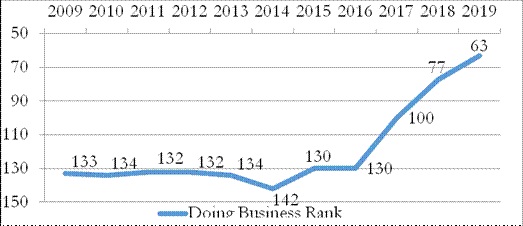
       

      India’s progress in Ease of Doing Business
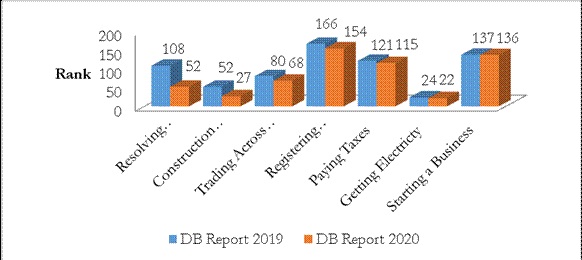
      State Reform Action Plan

      Since 2014 to track the implementation of business reforms at the State level, DPIIT in partnership with the World Bank, has been annually ranking all States and UTs based on the assessments of reforms in the specified areas of ease of doing business. A 301-point State Reforms Action Plan, 2020 was shared with States/UTs on 25th August, 2020 for its implementation by 31st December, 2020. The Action Plan is spread across 24 reform areas and seeks to promote sector-specific approach so as to create an enabling business environment across various sectors in the country. The various sectors include Trade License, Healthcare, Legal Metrology, Fire License/NOC, Cinema Halls, Hospitality, Telecom, Movie Shooting and Tourism.

      District Reform Action Plan

      District level functionaries are key touch points for an entrepreneur and hence a district level reform exercise is the next logical step in the reform agenda. DPIIT has prepared and shared a 213-point District Reform Action Plan, 2020 with States/UTs on 25.08.2020. The Action Plan covers 8 reform areas with States & UTs. The District Plan covers 43 NOCs/Permissions/ Registrations/ Certificates which will ease regulations for sectors like retail, education, health, food and beverages, real estate, gems and jewellery mining and entertainment. 

      1. INVESTMENT PROMOTION

      Production-Linked Incentive Scheme

      To provide a major boost to manufacturing, the government has launched Production-Linked Incentive (PLI) Scheme for 13 sectors, 3 sectors in March 2020    and 10 sectors in November 2020 with an outlay of ₹ 1.97 lakh crore over the next five years. The sectors are  (i) Automobiles and Auto Components, (ii) Pharmaceuticals Drugs, (iii) Specialty Steel, (iv) Telecom & Networking Products, (v) Electronic/Technology Products, (vi) White Goods (ACs and LEDs), (vii) Food Products, (viii) Textile Products: MMF segment and technical textiles, (ix) High efficiency solar PV modules, and (x) Advanced Chemistry Cell (ACC) Battery (xi) Medical devices (xii) Large scale electronics manufacturing  including mobile phones (xiii)  Critical Key Starting materials /Drug intermediaries and APIs. The PLI schemes will be implemented by the concerned ministries/departments and will be within the overall financial limits prescribed. The largest financial outlay has been given to the PLIs on Automobile and Auto Components and on Advanced Chemistry Cells (ACC).

      Empowered Group of Secretaries and Project Development Cells

       In the midst of COVID-19 pandemic, with a view to support, facilitate and provide investor friendly ecosystem to investors investing in India, an Empowered Group of Secretaries (EGoS), and Project Development Cells (PDCs) in Ministries/Departments have been set up. These institutions are meant to fast-track investments in coordination between the Central Government and State Governments and thereby grow the pipeline of investible projects in India to increase domestic investments and FDI inflow.

      PDCs have now been established in 29 Ministries/Departments of the Government of India, headed by respective Joint Secretary-level nodal officers. All PDCs have assumed a smooth functioning, executing clearly defined investor engagement strategies, which includes identification of prospective investors; multi-level engagements with investors that have shown interest; active engagement with a wide range of stakeholders to resolve existing investors’ issues, to develop new projects/proposals and to promote existing investment opportunities. 

      Investment Clearance Cell

      Following the Hon'ble FM’s budget announcement, an Investment Clearance Cell (ICC) to provide facilitation and support to businesses through a one-stop digital platform – the central Single Window System (SWS) is being set up and the platform is planned for launch with select states by 15 April, 2021. This national portal will integrate the existing clearance systems of the various Ministries/Departments of Govt. of India and State Governments without disruption to the existing IT portals of Ministries. 

      Industrial Information System

      DPIIT has developed an Industrial Information System (IIS) which provides a GIS-enabled database of industrial areas including clusters, parks, nodes, zones, etc. across the country to help investors identify their preferred location for investment. 3390 industrial parks/estates/SEZs in 4.76 lakh hectares have been mapped on Industrial Information System (IIS) along with net land area availability. A national level land bank is being developed by integrating IIS with State industrial GIS systems. A GIS Land Bank was launched by Hon’ble Minister of Commerce & Industry on 27 August 2020 for 6 states [Gujarat, UP, Odisha, Telangana, Goa, Haryana]; and now 7 more states [Maharashtra, Karnataka, Punjab, Himachal Pradesh, Uttarakhand, Andhra Pradesh and Jharkhand] have been on-boarded, which brings total number of states on-boarded to 13. This will enable the investors to see plot level data and availability of updated land related information in real time. A mobile app is also available for easy viewing by users. 

      Industrial Park Rating System

      Industrial Park Rating System (IPRS) is an exercise which recognizes best performing parks, identifying interventions and serving as a decision support system for investors and policy makers in being undertaken by DPIIT, under the technical guidance of ADB. DPIIT now aims to develop the first annual ‘Industrial Park Rating System 2.0’ that shall widen its coverage and aim to bring in qualitative assessment further to the pilot phase. Under IPRS 2.0, the assessment of Industrial Parks including private industrial parkswith introduction of qualitative indicators for assessing these parks will be undertaken this year. IPRS 2.0 will include the introduction of tenant feedback mechanism which will help in assessment of the developer’s responses and also engage directly with the ultimate beneficiaries of this exercise. The exercise of assessment of the Industrial Park will conclude with releasing of report on Industrial Park Rating System 2.0 by March-2021.

      Focus Sub-Sectors

      DPIIT is working closely with 24 sub-sectors which have been chosen keeping in mind the Indian industries strengths and competitive edge, need for import substitution, potential for export and increased employability. These 24 subsectors are – furniture, air-conditioners, leather and footwear, ready to eat, fisheries, agri-produce, auto components, aluminium, electronics, agrochemicals, steel, textiles, EV components and integrated circuits, ethanol, ceramics, set top boxes, robotics, televisions, close circuit cameras, toys, drones, medical devices, sporting goods, gym equipment. Efforts are on to boost the growth of the sub-sectors in a holistic and coordinated manner 

      One District One Product (ODOP)

      The Hon’ble PM’s clarion call of ‘Atmanirbhar’ to the nation in his address on the 74th Independence Day – August 15, 2020 explicitly emphasized that we as a nation must move on the path of value addition to our natural as well as human resources. DPIIT is working on the initiative of One District One Product to take this vision forward. OODP has been envisaged to be a transformational step forward realizing the true potential of a district, fuel economic growth and generate employment and rural entrepreneurship. ODOP has already been implemented in some of the States (for example, UP). By scaling it up as a national movement, we can look at creating a pool of 739 products from 739 districts in India that can be regulated.

      To begin with, 103 districts have been identified with specific products having manufacturing / export potential. 68 products out of the 106 products are available on big ecommerce platforms. With a view to promote manufacturing and exports, an analysis of specific interventions such as marketing, technology, design, etc. is underway along with identification of the agency responsible for the same. Merger of the two initiatives “ODOP” and “District as Export Hub” as a common initiative to be led by Department of Commerce and supported by DPIIT.

      1. INTELLECTUAL PROPERTY RIGHTS

      The IPR regime in India has transformed in the past two decades. The changes have been effected in infrastructure upgradation, manpower augmentation, regulatory reforms and IT enablement resulting in speedy disposal of IP applications. Electronic filing systems are in place for filing of applications for Patents, Trademarks, Designs and Geographical Indications. The Copyright Office, also has advanced facilities for online filing for registration of copyrights. Real time dissemination of information, in respect of IP applications, positions India’s IP Offices at par with its peers globally. 

      The major achievements in 2020 are explained below.

      a) In order to simplify the process and reduce compliance burden, amendments have been made through Patent Amendment Rules 2020, related to the working of Patented Invention in India as required under section 8 in Form 27. Additionally, filing of a statement on the commercial working of a patent within 6 months instead of 3 months as prescribed earlier and only one form may be filled in respect of multiple related patents assigned to common patentee.

      b) To give a boost to the registration of Authorised users of a Geographical Indications product, Geographical Indications of Goods (Registration and Protection) (Amendment) Rules, 2020 were notified in the Gazette on August 26, 2020. The amendment has reduced the fees to be paid for the GI registration process and eased the procedure for registration of an authorized user of a registered GI.

      c) Scheme for facilitating Startups Intellectual Property Protection (SIPP) launched for encouraging innovation and creativity of startups has now been extended up to 31stMarch, 2023. 

       No. of Patent and Trademark applications filed by Startups under Startups Intellectual Property Protection

      Year

      Patents

      Trademarks


      Filed

      Granted

      Filed

      Registered

      2019-20

      1841

      106

      4130

      2248

      2020-21 (till November 2020)

      1262

      9

      4104

      89

      d) To encourage Small and Medium Enterprises (SMEs) to seek protection for their innovations processing fees for patent applications by small entities has been further reduced by 80% (from the existing 50% provided in May 16, 2016) as compared to large entities. As a result, the patent filing and processing fees for small entities is now at par with the fees for individual applicants and start-ups.

      e) Last year, India and Japan had signed a bilateral "Patent Prosecution Highway". The first year of a three year’s Pilot PPH Program with Japan was a successful drive whereby 100 patent applications were received, which allowed 100 applications from Japan in a year.

      f) International Collaborations - India has signed MoUs with various countries so as to lay the foundation for a technical cooperation between the two countries with the aim of strengthening the protection of intellectual property rights for the benefit of innovation and sustainable economic growth. Building on this foundation, India this year signed MoUs with the United States of America, Denmark and Portugal. Subsequently, various IPR awareness drives were carried out in collaboration with Denmark.

      g)  Adapting to the COVID-19 pandemic, a shift to the digital space for carrying forward the objective of creating IPR awareness was observed and organised 224 webinars for different stakeholders such as FICCI/CII/INTA/Atal Tinkering Labs. Additionally, a specific initiative related to sensitization of IPR enforcement agencies was also carried out in collaboration with State Judicial Academies.

      S. No.

      Particulars

      IPR Awareness workshops/ seminars

      1.  

      Academic Institutions (including school/colleges/ universities)

      117

      1.  

      IP training and sensitization programs for enforcement agencies and judiciary.

      16

      1.  

      Industries including Ministry of Micro, Small & Medium Enterprises (MSME)/Startups/Young entrepreneurs

      97

      h) Keeping with the trend, several social media campaigns related to IPR awareness were executed, such as “Quiz Time with CIPAM”, and “Defeat Counterfeit”. Further, a campaign “Gift a GI” for promotion and marketing of GI products was also launched, especially during festive seasons. In the spirit of ‘vocal for local’ theme, another campaign talking about success stories of indigenous technologies and startupshas been recently launched in collaboration with AGNII. 

      Figures of IPR filings and registered in 2020-21

      IP

      CUMULATIVE STATISTICS: FY 2020-21 (Till November 30, 2020)

      Filing

      Grants/Registration

      Patents

      37660

      17148

      Trademarks

      278023

      135289

      Copyrights

      13861

      9221

      Designs

      7403

      5425

      Geographical Indications

      33

      5

      1. STARTUP INDIA

      With over 40,000 recognized startups, India has transformed into the third largest startup ecosystem supplementing employability as well as enhancing our self-reliance. Startup India’s role has been vital in nurturing entrepreneurship beyond Tier 1 cities. The regional growth through the efforts of States and Union Territories (UTs) has created a national ecosystem to thrust our economic goals

      With the launch of the Startup India campaign, recognized startups have now spread across 586 districts with a total of 29 States and UTs with Startup Policies in place, creating more than 4.2 lakh jobs. Entrepreneurs now have options to avail benefits across a range of laws, regulations, fiscal and infrastructural support. Startup India has also played a pivotal role in strengthening the key pillars identified for our startup economy.

      Salient features of the schemes provided by Startup India are:

      • An INR 10294.27 crore Startup Fund of Funds has been launched by the Ministry of Commerce and Industry to promote availability of risk capital in the Indian economy. As of 13th November 2020, the Fund of Funds has committed INR 4326.95 crore to 60 private venture funds.
      • Startup India has facilitated procurement from startups on the Government E-Marketplace (GeM) portal. Presently, 7438 startups have serviced orders worth over INR 1800 crores on GeM portal.
      • A number of ‘Startup Grand Challenges’ with Government bodies and corporates have been organized to channelize them to work with startups and incorporate the spirit of innovation and entrepreneurship.
      • To further bridge the Indian Startup ecosystem with the Global ecosystem, engagement models with 11 countries including Korea, UK, Netherlands, Sweden, Portugal, etc. have been built.
      • Startup India launched the StartupYatra in 2017 which took the momentum to rural and non-metro regions, reaching the grass root level of the states.
      • DPIIT launched the first edition of States’ Startup Ranking Framework 2018 in February 2018 and second edition in May 2019. State Startup Ranking is an effort to identify key actions undertaken by various States to help and scale up Startups. It is also an opportunity to recognize and acknowledge relevant departments of the States and UTs that have worked consistently in this mission to make India a thriving Startup nation. The results for SRF 2.0 were declared in September 2020. To facilitate continuity in the exercise that has led to immense growth of startup ecosystem on in the states, the State Ranking Framework 2020 is being planned and will be undertaken in the coming months. To further this endeavour, the next framework delves deeper into policies and incentives to make India one of the best startup nations in the world.
      • Actions taken by the Startup India initiative have resulted in a culture of innovation and entrepreneurship in the country. The results are visible across all fields of human endeavour and all sectors of the economy. The ‘National Startup Awards’ have been conceptualized to further strengthen the Indian startup ecosystem. These awards seek to recognize and reward outstanding Startups and ecosystem enablers (incubators and accelerators) that are building innovative products or solutions and scalable enterprises, with high potential of employment generation or wealth creation, demonstrating measurable social impact. The first edition of the awards was launched in November 2019 across 12 Sectors and 3 Special Categories, successfully receiving 1,682 applications. The Winners were announced on the 6th of October 2020 for the first edition. The 2nd National Startup Awards are in the planning stage and will be open for applications in the coming months.
      • The Atal Innovation Mission (AIM) under the Atal Incubation Centres (AICs) scheme has selected 102 incubators across the country to provide financial support, with grants worth INR 201.1 crores being disbursed to 68 incubators. This fund has supported incubation of more than 1,250 startups, created over 13,800 jobs and has led to over 2,000 events and 700 trainings being conducted.
      • Atal Tinkering Labs (ATL)by the Atal Innovation Mission (AIM) aims to inculcate entrepreneurial skills in school students. Over 14,000 schools have been selected to set up Atal Tinkering Labs (ATL) with 5068 ATLs having received INR 12 lakhs grants each and are operational. 
      1. FOREIGN DIRECT INVESTMENT

      Foreign Direct Investment has played an important role in this process of Globalization and is a major driver of economic growth and a source of non-debt finance for the economic development of India. It has been the endeavour of the Government to put in place an enabling and investor friendly FDI policy. Government on its part has undertaken a number of reforms in different areas of economy. In the last one years, to liberalise and simplify FDI policy for providing Ease of doing business and attract investments, following reforms have been undertaken by the Government across sectors:

      Insurance Intermediaries

      Vide Press Note 1(2020) 100% FDI has been permitted in Intermediaries or Insurance Intermediaries including insurance brokers, re-insurance brokers, insurance consultants, corporate agents, third party administrator, Surveyors and Loss Assessors and such other entities, as may be notified by the Insurance Regulatory and Development Authority from time to time.

      Civil Aviation

      In order to permit Foreign Investment up to 100% by those NRIs, who are Indian Nationals, in case of M/s Air India Ltd., vide Press Note 2(2020); Government amended the extant FDI Policy to permit Foreign Investment(s) in M/s Air India Ltd. by NRIs, who are Indian Nationals, up to 100% under automatic route.

      Curbing opportunistic takeovers/acquisitions of Indian companies due to the COVID-19 pandemic

      In order to curbing opportunistic takeovers/acquisitions of Indian companies due to the COVID-19 pandemic, vide Press Note 3(2020) dt. 17.04.2020, Government amended the FDI policy according to which an entity of a country, which shares land border with India or where the beneficial owner of an investment into India is situated in or is a citizen of any such country, can invest only under the Government route. Further, in the event of the transfer of ownership of any existing or future FDI in an entity in India, directly or indirectly, resulting in the beneficial ownership falling within the restriction/purview of the said policy amendment, such subsequent change in beneficial ownership will also require Government approval.

      Defence Sector

      Now, FDI in the defence sector is allowed up to 74% through automatic route (from earlier 49%) for companies seeking new industrial licenses. FDI beyond 74% and up to 100% will be permitted under Government route. For existing FDI approved holders/defence licensees, infusion of fresh foreign investment up to 49% resulting in change in equity/ shareholding pattern can be done by making declaration within 30 days (earlier Government approval was required). Now, foreign investments in the defence sector shall be subject to scrutiny on grounds of National Security.

      Consolidated FDI Policy Circular 2020

      This Department has released 'Consolidated FDI Policy Circular 2020' and the same is uploaded on this Department's website for reference of various stakeholders including Ministries/Departments and prospective investors.

      Standard Operating Procedure (SOP)

      SOP has been amended for ease of processing FDI proposals and is uploaded on
      Foreign Investment Facilitation Portal for reference of various stakeholders including Ministries/Departments and prospective investors.

      FDI applications disposed of in 2020

       26 FDI applications marked to DPIIT have been disposed of in 2020.

      FDI Statistics

      During the first seven months of F.Y. 2020-21, total FDI inflow increased by 11% from USD 42.06 billion (April, 2019 to October, 2019) to US$ 46.82 billion (April, 2020 to October, 2020). FDI equity inflow increased by 21% to US$ 35.33 billion (April, 2020 to October, 2020) from US$ 29.31 billion reported in the same period of previous financial year.

      1. PUBLIC PROCUREMENT

      To promote “Manufacturing Investment” in India, usage of made in India products is being encouraged in government procurement. Keeping above perspective, DPIIT has revised its Public Procurement (Preference to Make in India) Order on 16.09.2020 with the following important changes:

      a) For purchases with estimated value less than ₹ 200 crore, Global tender enquiry shall not be issued.

      b) Suppliers offering items with minimum 50% domestic value addition will get purchase preference over other suppliers in government procurement.

      c) Suppliers offering items with less than 20% domestic value addition can’t participate in domestic/national bidding process.

      d) Nodal Ministries/ Departments have been authorized to notify higher minimum local content requirement for Class-I/ Class-II local suppliers i.e. higher than 50/20%. 

      Amendment has been done in GFR/PPP-MII to keep check on entities operating from countries sharing land border with India from participating in Government procurement/tenders –Applications received are being forwarded to MHA & MEA for security and political clearance. It is expected that usage of made in India products will promote local manufacturing thereby enhancing income and job opportunities for local people. 

      1. TECHNICAL REGULATIONS/QUALITY CONTROL ORDERS

      One of the instruments for attracting investment in post COVID economy is adoption of Technical Regulations- a WTO compliant instrument. Technical regulations/Quality Control Orders (QCOs) are issued by DPIIT for industries falling under its domain to provide safe reliable quality goods; minimizing health hazards to consumers; promoting exports, promoting import substitutes and restricting imports of sub-standard products. DPIIT as per its mandate has been issuing QCOs since 1987. QCOs for 100 products (e.g. Air conditioner, Toys, Footwears, Pressure cooker, Microwave oven etc.) under BIS Act, 1986/2016 as well as 15 products under Indian Explosives Act, 1884 (Gas Cylinders, Valves and Regulators) have been issued. 71 HSN Codes as identified by Department of Commerce (DoC) based on import surge have been examined by DPIIT. Out of which QCOs notified for 22; additional 13 are under consideration; on the rest 36 HS lines QCO not feasible. DPIIT is continuously engaged with BIS and relevant stakeholders for notification of QCOs. 

      1. INDUSTRIAL CORRIDORS

      National Industrial Corridor Development Programme is India's most ambitious infrastructure programme aiming to develop new industrial cities as "Smart Cities" and converging next generation technologies across infrastructure sectors. The National Industrial Corridor Programme includes the following Industrial Corridors:

      • Delhi Mumbai Industrial Corridor (DMIC)
      • Amritsar Kolkata Industrial Corridor (AKIC)
      • Chennai Bengaluru Industrial Corridor (CBIC) with extension to Kochi via Coimbatore
      • East Coast Economic Corridor (ECEC) with Vizag Chennai Industrial Corridor (VCIC) as Phase 1
      • Bengaluru Mumbai Industrial Corridor (BMIC)

      The objective is to expand India's Manufacturing & Services base and develop National Industrial Corridors as a "Global Manufacturing and Trading Hub". The programme will provide a major impetus to planned urbanization in India with manufacturing as the key driver. In addition to new Industrial Cities, the programme envisages development of infrastructure linkages like power plants, assured water supply, high capacity transportation and logistics facilities as well as softer interventions like skill development programme for employment of the local populace.

      A National Master Plan for providing multimodal connectivity infrastructure depicting the economic zones as fulcrums of economic development interconnected with a network of multimodal connectivity infrastructure for seamless movement of people, goods & services has been prepared and is under consideration for approval of CCEA. As part of the National Master Plan, 11 (Eleven) Industrial Corridors have been identified with 32 nodes/projects proposed to be developed in 04 phases until 2024-25”.

      Major achievements in 2020 are given below.

      Completion of Trunk Infrastructure Components

      • Trunk infrastructure activities completed at Integrated Industrial Township (IITGN) at Greater Noida (747 acres), Uttar Pradesh and Integrated Industrial Township (IITVUL) at VikramUdyogpuri (1100 acres), Ujjain in Madhya Pradesh.
      • Trunk infrastructure activities nearing completion at Dholera Special Investment Region (DSIR) (22.5 sq. kms), Gujarat and ShendraBidkin Industrial Area (AURIC) (19 sq. kms), Aurangabad, Maharashtra. 

      Land allotted and investment secured

      • A total of 84 plots admeasuring nearly 554.73 acres have been allotted to companies with investment to the tune of more than ₹ 16,100 crore including investors like HYOSUNG (South Korea), NLMK (Russia), HAIER (China), TATA Chemicals & AMUL so far. Further, 09 companies have also started their commercial production.
      • During the year, 09 plots (industrial and residential) admeasuring 53 acres allotted in Shendra Industrial City and 02 plots admeasuring 10 acres awarded in Integrated Township at VikramUdyogpuri.
      • part from the above allotted plots, developed land parcels are available for immediate allotment as per details below:

      S. No

      Name of the Node/City

      Land available for allotment (industrial + other uses)

      (acres)

      1

      ShendraBidkin Industrial Area (MH), 4583 acres

      1100

      1700

      2

      Dholera Special Investment Region (GJ), 5,560 acres

      2900

      3

      Integrated Industrial Township Project, Greater Noida (UP), 747 acres

      270

      4

      Integrated Industrial Township ‘VikramUdyogpuri’ Project (MP), 1100 acres

      650

      Total

      6,620

      Logistics Data Bank (LDB) project is currently operational across 28 ports in India covering approximately 150+ Container Freight Stations/Inland Container Depots and 60+ Toll plazas. More than 30 million EXIM containers have been tracked till date. During the year, the services have been expanded till Nepal and Bangladesh. 

      1. DEVELOPMENT OF BACKWARD REGIONS

      One of the principal objectives of the Government of India’s industrial strategy is to promote balanced industrial development throughout the country. For stimulating industrial development of hilly States, the Union Government has been supplementing the efforts of State Governments through various policies / schemes / packages of incentives. Region specific incentives schemes for the States of J&K, Uttarakhand, Himachal Pradesh and Northern-Eastern Regions are being implemented by DPIIT.

      1. PETROLEUM AND EXPLOSIVES SAFETY ORGANIZATION (PESO)

                 Petroleum and Explosives Safety Organization (PESO) functioning as a subordinate organization under Department for Promotion of Industry & Internal Trade (DPIIT), Ministry of Commerce and Industry has undertaken various initiatives for ease of doing business and assisting the stake holders. Some important initiatives undertaken are as follows: 

      Launch of paperless licensing systemWith an aim of eliminating human interface, to revamp the functioning of PESO and to enhance efficiency and transparency, paperless application and approval / grant / renewal of licenses have been launched by PESO with effect from 16/01/2020. The paperless application for grant / renewal of licenses will save precious time, stationery/postage and physical storage space. Forgery & misuse of licenses will be completely eradicated as the licenses will be issued through a secure system.

      The authenticity of the license can be verified through PESO’s website (https://online.peso.gov.in/PublicDomain/). As a step ahead and to promote the digital payment initiative of the Government of India, PESO has introduced online fee payments in the application module. Fees can be submitted through credit card, debit card and net banking. With effect from 20/11/2019, receipt of fees through demand drafts has been completely stopped and fees is being received through Non Tax Receipt Portal (Bharat Kosh).

      Out of the 47 licenses issued by PESO, 28 have been made paperless and remaining will be available online by 31st March 2021. More than 80% of the licenses issued by PESO are covered under the Paperless Application and Approval. The breakup of all the licenses covered under paperless application, approval & renewal is as follows:

      Licenses issued under rules

      Total modules

      Modules covered under online system

      Modules not covered under online system

      Petroleum Rules

      14

      11

      3

      SMPV (U) Rules

      7

      6

      1

      Gas Cylinders Rules

      8

      5

      3

      Explosives Rules

      12

      3

      9

      Ammonium Nitrate Rules

      5

      2

      3

      Calcium Carbide Rules

      1

      1

      0

      Total Premises

      47

      28

      19

      Petroleum, Gas & Explosives Industry will be immensely benefitted by this initiative of PESO, as they are committed towards transparent and efficient public service. 

      Increasing the number of Competent Persons

      With an aim to increase the number of Competent Persons, PESO proposes to increase the existing strength of the recognized Competent Persons. As on date, there are 349 competent persons recognized under the Petroleum Rules, 2002 and 297 competent persons are recognized under the SMPV (U) Rules, 2016. As an additional step, PESO proposes to add additional educational qualifications as well as relax the existing educational qualifications and relevant work experience of the candidates. Age limit is proposed to be introduced for ensuring physical and medical fitness of the Competent Persons. Draft rules for making necessary amendments in the Rules are under examination.

       Third-Party Inspection

      In order to speed up the process of inspections mandated under the statutes administered by PESO and Rules framed therein, PESO is evaluating to enlarge the scope of the third-party inspection wherever feasible. DPIIT is already working in this regard and consultations were held on 25.11.2020 with stakeholders Ministries/Departments viz. Ministry of Petroleum & Natural Gas, Ministry of Consumer Affairs, Bureau of Indian Standards and Ministry of Environment, Forests and Climate Change. A committee of Officers of PESO has been constituted to examine the views/ideas given by stakeholders, hold detailed consultations with them and submit a report by December, 2020. 

      1.  INTERVENTIONS DURING COVID

      COVID-19 has been unambiguously one of the worst events that happened to mankind. The outbreak of the pandemic has given an unprecedented shock to the global economy and the ripples felt in the Indian economy as well. With the prolonged country-wide lockdown, the global economic downturn, and associated disruption of demand and supply chains, the economy faced a protracted period of slowdown.

      In these tough times, the Department for Promotion of Industry and Internal Trade (DPIIT) along with other Central Ministries and regulatory bodies undertook several measures to support and protect domestic industry. The idea behind these initiatives was to support the post-COVID 19 industrial ecosystem. The sections below summarize the key initiatives undertaken for managing India’s industrial growth. 

      1. Setting up a ‘Control Room’ to monitor the real-time status of manufacturing & logistics of essential goods and commodities
        • DPIIT  set-up a ‘Control Room’ to monitor the real-time status of transportation & logistics. The control room was operational during the entire period of the national lockdown. The team monitored the issues of internal trade, manufacturing, delivery & logistics of essential commodities. They also responded to the difficulties faced by stakeholders in the resource mobilization.
        • The control room played a key role in resolving on-ground difficulties by facilitating feedback to State Governments and other agencies and if required, provided submissions on clarifications and further steps that were needed to be taken to resolve the issues
        • In the event of any manufacturer, transporter, distributor, wholesaler, or e-commerce companies facing any ground-level difficulties, it was informed to the department through the helpline number and email
        • After registering complaints, DPIIT submitted the same to the respective concerned state government/ department(s) to take quick actions and ensure that the delivery of essential commodities isn’t impacted.
        • To monitor actual resolution on-ground, daily feedback calls were made to understand pendency and response. The control room’s proactive response and real-time feedback monitoring ensured a resolution rate of 73% for all queries logged in at the Control Room. Out of the total number of 2500 (Approx.) queries reported, about 1880 were successfully addressed by the team.
      1. Managing and facilitating Pan-India medical oxygen supply

      DPIIT and its subordinate office, the Petroleum & Explosives Safety Organization (PESO), have taken various measures to mitigate the problems of license holders and to meet the challenge of supply of sufficient quantity of medical oxygen to hospitals all over the country without any interruption during the present COVID pandemic.

      Various challenges arose and these were tackled in a consultative manner, with the support of quick decision making from the DPIIT and the Empowered Group of Secretaries (EG2) of the Government of India. Some of the important decisions undertaken are mentioned below:

        1. An institutional mechanism was put in place through the nomination of nodal officers to review and monitor medical oxygen supply in all States and UTs of India. A control room was formed with the Nodal officers to ensure every State and UT had a mechanism to represent oxygen-related matters and get a quick resolution
        2. Government issued a letter confirming that all Medical Oxygen Manufacturing units remain functional during the lockdown. A multi-disciplinary Oxygen monitoring committee (with senior government officials) was formed to ensure adequate availability of Oxygen.
        3. An important decision to allow industrial oxygen for medical use was also facilitated which proved beneficial during the times when the oxygen requirement was at the peak in the country
        4. Government facilitated the decision to allow manufacturing units of Medical Oxygen Gas Cylinders, Liquid Oxygen Cylinders, and other related accessories to operate during the lockdown. The order allowed cross border movement of vehicles carrying the said products across the States.
        5. The number of medical oxygen gas cylinder available in the country went up from 4.35 lakhs in April 2020 to 10.76 lakhs in Nov 2020, as per PESO reports, with majority of these manufactured in India.
        6. Additionally, Oxygen carrying vehicles were also exempted from State-specific permits across States in India; thereby easing the movement of cryogenic tankers
        7. To ease the shortage of tankers to move liquid medical oxygen to distant places (and to facilitate safe & fast movement of liquid oxygen), PESO allowed cryogenic ISO tanks (of 20 MT each) for domestic movement
        8. Daily monitoring of medical oxygen supply and storage (state-wise) is being undertaken to plan the oxygen supply as per projections of the COVID-19 cases by the Ministry of Health and Family Welfare.
        9. Additionally, regular assessment of cryogenic storage facilities in hospitals is also done, leading to enhancement of storage capacities in the hospitals for liquid medical oxygen thereby, making them self-sufficient for the assured supply of medical oxygen. Storage capacity for Liquid Medical Oxygen in the hospitals in the country went up from 5959 MTs in April 2020 to 8000 MTs plus by Nov end 2020.
        10. Oxygen production capacity enhanced from 5,913 MT (on April 2020) to 6,862 MT in September 2020. 7,014 MT by the end of October 2020, through additional capacities created.
      1. Setting up of the ‘Business Immunity Platform’, the dynamic platform for business issue redressal during the lockdown
        • Invest India, India’s national Investment Promotion & Facilitation Agency, under the Ministry of Commerce and Industry launched Business Immunity Platform (BIP) on 21st March 2020. Its objective was to become a knowledge base bringing together key stakeholders including logistics providers to fill demand-supply shortages required to combat COVID-19. The team worked with government stakeholders to simplify lockdown notifications, developed a strategy for national systems, and refined central advisories and notifications proactively.
        • This dynamic and constantly updating platform also kept a regular track of developments concerning the virus, provided the latest information on various central and state government initiatives, & resolved queries through emails and WhatsApp. BIP became an active platform for business issue redressal, operating 24/7, with a team of dedicated sector experts and responding to queries at the earliest
        • It also included frequently asked questions on important aspects like locations of COVID-19 testing, special permissions, and assisting businesses focusing on essential services to attain approvals. The portal mapped and highlighted the response mechanism in place to mitigate lockdown issues.


      1. Extending license renewal and compliance timelines

      PESO, under DPIIT, is the nodal organization charged with ensuring and implementing safety requirements in the manufacturing, storage, transport, and use of explosives and petroleum in the country. With the movement restriction and vehicular traffic disruption due to nationwide lockdown, undertaking inspections and other routine work was a challenge for the organization.

      So, to address these issues faced by Petroleum, Explosives, Fireworks, and Industrial Gas industries, the following steps were undertaken:

        • The validity of the renewal of a license under Rule 112 (1) of Explosives Rules, 2008 was extended from 13.03.2020 to 30.09.2020
        • Submission of one-year late fee for applications submitted up to 30.09.2020 to the organization for renewal of the license, after the date of expiry, exempted under Rule 112 (6) of Explosives Rules, 2008
        • 31.03.2020 under Rule 35 of Gas Cylinders Rules, 2016 shall be deemed to be due for testing on a later date as of 30.06.2020.
        • The validity of License Form LS-2 under Rule 55 of SMPV (U) Rules, 2016 expiring on 31.03.2020 extended up to 30.06.2020.
        • The validity of certificates issued under Rule 18 & 19 of SMPV (U) Rules, 2016 regarding Safety Release Valve (SRV) and hydro test of pressure vessel due for testing between 15.03.2020 to 30.06.2020 extended up to 30.06.2020 
      1. Proactive Industry Consultations

      With the lockdown imposed on 24th March 2020, the government took a proactive approach to organize industry consultations to understand the on-ground issues being faced by the businesses. The first meeting in this regard was held on 28th March 2020, under the chairpersonship of Hon’ble Commerce & Industry Minister, and the participants in these meetings were leading national chambers (such as CII, FICCI), regional chambers (such as Indian Chamber of Commerce, PHDCCI), MSME associations (such as FISME, LUB), sectoral chambers (such as NASSCOM, ACMA). Seven such meetings have been conducted till November 2020 to discuss and deliberate on the impact of COVID19 and the possible measures and facilitation to be undertaken by the Government to address the current industrial scenario. The outcome of these interactions with the participating industry associations was analysed by the government regularly and sent to the corresponding empowered group for consideration.

      A booklet on the achievements of the Ministry of Commerce and Industry is available at https://dipp.gov.in/whats-new/achievements-ministry-commerce-and-industry. 

      Topics

      ActsIncome Tax
