
Just a moment...

Top
Help
×

By creating an account you can:

Logo TaxTMI
>
Call Us / Help / Feedback

Contact Us At :

E-mail: [email protected]

Call / WhatsApp at: +91 99117 96707

For more information, Check Contact Us

FAQs :

To know Frequently Asked Questions, Check FAQs

Most Asked Video Tutorials :

For more tutorials, Check Video Tutorials

Submit Feedback/Suggestion :

Email :
Please provide your email address so we can follow up on your feedback.
Category :
Description :
Min 15 characters0/2000
Add to...
You have not created any category. Kindly create one to bookmark this item!
Create New Category
Hide
Title :
Description :
❮❮ Hide
Default View
Expand ❯❯
Close ✕
🔎 News - Adv. Search
TEXT SEARCH:

Press 'Enter' to add multiple search terms. Rules for Better Search

Search In:
Main Text + AI Text
  • Main Text
  • Main Text + AI Text
  • AI Text
Category: ?
Categorized by AI
---- All Categories ----
  • ---- All Categories ----
  • Income Tax
  • GST
  • Customs, DGFT & SEZ
  • FEMA & RBI
  • Corp. Laws, SEBI & IBC
  • PMLA, Black Money & ED
  • Budget
  • News and Press Release
  • PTI News
Month:
---- All Months ----
  • ---- All Months ----
  • January
  • February
  • March
  • April
  • May
  • June
  • July
  • August
  • September
  • October
  • November
  • December
Year:
---- All Years ----
  • ---- All Years ----
  • 2026
  • 2025
  • 2024
  • 2023
  • 2022
  • 2021
  • 2020
  • 2019
  • 2018
  • 2017
  • 2016
  • 2015
  • 2014
  • 2013
  • 2012
  • 2011
Sort By: ?
In Sort By 'Default', exact matches for text search are shown at the top, followed by the remaining results in their regular order.
RelevanceDefaultDate
    ITC Q1 profit declines 15.6 pc to Rs 4,508.79 cr; non-cigarette FMCG posts robust growth
    Punjab extends deadline of one-time scheme for settling tax dues of pre-GST period till Sept 30
    PM Modi speaks to UK counterpart Burnham
    Bank credit to industry records robust growth of 19.2 pc in June: RBI data
    Delhi protesters' fingerprints collected from stones for identification via Aadhaar: BJP minister
    Cabinet approves Rs 84,084-cr offshore exploration scheme; govt to fund up to Rs 650 cr per well
    India's forex reserves jump USD 6.12 bn to USD 682.35 bn
    Jharkhand signs pact with CSC eStore to make SHG products made by women available online
    APEDA Facilitates First-Ever Air Shipment of Karnataka's Neelam and Totapuri Mangoes to the Maldives
    Favara-UPI Cross-Border Payment Corridor Goes Live Between Maldives and India
    SC upholds NCLAT order setting aside CCI's Rs 301.6-cr penalty on Grasim Industries
    China's factory activity unexpectedly slips into contraction in July
    PM Modi to inaugurate Bhogapuram Airport on Aug 1 in Andhra Pradesh
    Rupee rises 20 paise to 95.30 against US dollar in early trade
    APEDA Facilitates First-Ever Sea Shipment of Value-Added Flavoured Makhana from Bihar to Canada
    Indian envoy meets Chinese commerce ministry official; Calls for enhanced market access
    ED attaches Rs 94 crore in foreign bank account in fraud case against Delhi-based rice firm
    Ensure uniform deposit rates across all branches: RBI tells banks
    PM takes stock of geo-political situation, safety of seafarers, supply chain constraints
    Delhi govt to provide property Aadhaar cards; bring Land Records Bill: CM Rekha Gupta
❯❯
MaximizeMaximizeMaximize
0 / 200
Expand Note
Add to Folder

No Folders have been created

    +

    Are you sure you want to delete "My most important" ?

    NOTE:

    News
    Showing Results for :
    Reset Filters
    Results Found:
    Show All SummariesHide All Summaries
    July 31, 2026
    Show AI Summary
    Excise duty increases on cigarettes pressured profitability, while calibrated pricing and FMCG growth supported market resilience.
    Excise duty increases on cigarettes affected consolidated profitability, prompting calibrated pricing and portfolio measures to protect market share and limit migration to illicit trade. The cigarette portfolio was re-architected across price points through value-accretive offerings and staggered pricing actions. Non-cigarette FMCG growth was supported by demand for packaged foods, dairy and personal-care products. Input-cost inflation was mitigated through inventory cover, commodity hedging and price-volume rebalancing amid crude-price volatility, supply-chain disruption and imported inflation concerns.
    July 31, 2026
    Show AI Summary
    One-Time Settlement Scheme offers final pre-GST tax dispute resolution relief before stricter recovery action against defaulters begins.
    The One-Time Settlement Scheme 2025 for pre-GST tax dues has been extended until September 30. Eligible taxpayers may resolve pending legacy tax disputes with full waiver of interest and penalties and slab-wise relief in principal tax. After the deadline, recovery action may be intensified under applicable tax laws and the Punjab Land Revenue Act, including property attachment, auction and freezing of bank accounts. The department also supports amicable settlement of tax disputes through the SAMADHAN initiative.
    July 31, 2026
    Show AI Summary
    Bilateral trade agreement implementation supports expanded trade, investment and strategic cooperation through technology, security, clean energy and community links.
    The India-UK Comprehensive Economic and Trade Agreement was identified as a framework for expanding bilateral trade and investment opportunities following its operationalisation. The two governments proposed closer cooperation to use the agreement for shared prosperity, while advancing their comprehensive strategic partnership through technology, innovation, defence, security, clean energy, education and people-to-people links.
    July 31, 2026
    Show AI Summary
    Sectoral bank credit growth reflects broad-based expansion across industry, services, agriculture and personal loans, with slower credit-card growth.
    Sectoral bank credit growth accelerated across non-food lending, agriculture, industry, services and personal loans. Industrial credit expanded across micro and small, medium and large enterprises, with strong lending to infrastructure, engineering, food processing, textiles, construction, metals, petroleum-related products and chemical products. Services lending was supported by non-banking financial companies, commercial real estate and trade. Vehicle and housing loans maintained double-digit growth, while credit-card outstanding growth decelerated.
    July 31, 2026
    Show AI Summary
    Biometric identification of protesters through alleged fingerprint-Aadhaar linkage was described alongside criminal-background profiling and database creation.
    Biometric identification of protesters through fingerprints recovered from alleged stone-pelting evidence was publicly described as a proposed investigative method. A minister stated that fingerprints allegedly found on stones would be linked with Aadhaar numbers to identify participants and examine their prior records. The account also referred to analysis and categorisation of detained protesters' criminal backgrounds, creation of a separate database, and proposed action against participants described as anti-social elements or persons with criminal records.
    July 31, 2026
    Show AI Summary
    Offshore hydrocarbon exploration support funds high-risk deepwater drilling, shared infrastructure and data acquisition to strengthen domestic energy production.
    The National Offshore Exploration Scheme provides public support for deepwater and ultra-deepwater oil and gas exploration, including seismic and offshore data acquisition, exploratory drilling in frontier basins, and common production and evacuation infrastructure. It addresses the high cost and geological uncertainty of offshore drilling and includes technology adoption, digital programme management, capacity building and collaboration measures. The scheme seeks to expand domestic hydrocarbon discoveries and production, attract investment across the exploration and production value chain, and reduce reliance on imported oil and gas.
    July 31, 2026
    Show AI Summary
    Foreign exchange reserves increased as foreign currency assets and gold holdings rose, alongside measures to attract forex inflows.
    India's foreign exchange reserves increased during the reporting week, principally because foreign currency assets and gold reserves rose. Foreign currency assets, expressed in United States dollar terms, include valuation effects from movements in currencies such as the euro, pound and yen. Special Drawing Rights and the reserve position with the International Monetary Fund declined. Measures including the FCNR(B) measure were reported as efforts to attract foreign-exchange inflows following rupee pressure and dollar-sales intervention.
    July 31, 2026
    Show AI Summary
    Digital marketplace access for women's self-help group products expands e-commerce opportunities while panchayat-level citizen services are strengthened.
    Digital marketplace access for women's self-help group products is proposed through a memorandum of understanding between CSC eStore and the Jharkhand State Livelihood Promotion Society. Products marketed under the 'Palash' and 'Adiva' brands are intended to be offered through an e-commerce network to widen market access, support rural women's income and entrepreneurship, and strengthen the rural economy. Digital panchayat services are also being expanded through Common Service Centres, including banking, e-governance and Aadhaar-related services.
    July 31, 2026
    Show AI Summary
    Agricultural export facilitation expands market access for late-season mangoes through farmer aggregation and direct global market linkages.
    Agricultural export facilitation enabled an air shipment of late-season Neelam and Totapuri mangoes to an international market, expanding market access and extending the mango export season. Direct sourcing through a Farmer Producer Company supported organised aggregation, quality produce, and export-oriented supply chains. Direct procurement and export market linkages enabled participating farmers to realise higher returns than conventional market channels while promoting horticultural export diversification.
    July 31, 2026
    Show AI Summary
    Cross-border digital payment integration enables real-time Favara transfers from Maldives mobile banking applications to UPI-enabled accounts in India.
    Cross-border digital payment integration between Favara and UPI enables individuals in the Maldives to make real-time person-to-person transfers to UPI-enabled bank accounts in India through mobile banking applications. Transfers are initiated in Maldivian Rufiyaa and credited in Indian Rupees. The initial service is available through participating Maldivian banks. Permitted remittances include family-maintenance transfers under foreign inward and outward remittance categories, and gift-related transfers under foreign outward remittance. Future phases are intended to introduce QR-based merchant payments and other digital payment services.
    July 31, 2026
    Show AI Summary
    Procedural Fair Hearing in competition inquiries requires notice when the Commission departs from investigative findings before imposing action.
    Competition law procedure requires the Competition Commission to notify and hear an opposite party when departing from the Director General's findings. The penalty order concerning alleged abuse of dominance in viscose staple fibre supply was set aside because Grasim Industries was not given an opportunity to respond to the Commission's disagreement with the investigative findings. The matter was remanded for fresh, time-bound consideration without a finding on the merits.
    July 31, 2026
    Show AI Summary
    Manufacturing contraction highlights weak domestic demand, property-sector pressure and continued reliance on technology-related exports for economic growth.
    Manufacturing activity in China contracted in July, as the official purchasing managers' index fell below the expansion threshold and new orders and production declined. Weak domestic demand, lower building activity and possible typhoon-related disruptions contributed to the slowdown. Consumer spending, investment and property-sector weakness continue to affect confidence, while technology-related exports support growth. Policy commitments include strengthening domestic consumption amid continued reliance on exports.
    July 31, 2026
    Show AI Summary
    Public-private partnership airport development strengthens aviation, cargo logistics, export infrastructure and sustainable connectivity through an integrated international airport project.
    The Bhogapuram airport project is being implemented under a Public-Private Partnership through the Design, Build, Finance, Operate and Transfer framework. It has obtained required aerodrome, safety, fire and environmental clearances and includes infrastructure for domestic and international aviation, passenger processing and airport security. Cargo and cold-chain facilities are intended to support exports and logistics integration, while recycled-water use and LEED Platinum standards form part of the project's sustainability features.
    July 31, 2026
    Show AI Summary
    Rupee appreciation against the US dollar continued as foreign inflows and lower crude prices supported domestic currency markets.
    Rupee appreciation against the US dollar continued in early trading, supported by foreign capital inflows and lower global crude oil prices. A stronger US dollar constrained further appreciation, while expectations of continued Reserve Bank of India intervention were cited as supporting the rupee. Declining Brent crude prices, gains in domestic equity indices and net foreign institutional investment in equities were also identified as relevant market factors.
    July 31, 2026
    Show AI Summary
    Value-added Makhana exports expand international market access, support quality compliance, and improve farmer returns through processing and branding.
    Agricultural export facilitation supported the first sea shipment of value-added flavoured Makhana from Bihar to Canada. Processed and packaged to international quality and food-safety standards, the export demonstrates the role of processing, value addition and export-oriented manufacturing in expanding overseas market access. The initiative is stated to improve farmer returns through value addition, while capacity building, export infrastructure, quality compliance, market linkages and stakeholder collaboration support the agri-export ecosystem.
    July 30, 2026
    Show AI Summary
    Market access for Indian pharmaceuticals remains central to bilateral efforts to promote sustainable trade and economic cooperation.
    Enhanced market access for Indian products, particularly pharmaceuticals, was raised in discussions aimed at strengthening bilateral trade and economic ties. The discussions addressed sustainable trade, and the sides agreed to increase mutual cooperation and communication. India continues to seek greater access to China's information technology, pharmaceutical and agricultural sectors, while pursuing increased pharmaceutical exports and Chinese investment. Bilateral trade increased, but India's trade deficit widened, reflecting an ongoing imbalance in trade flows.
    July 30, 2026
    Show AI Summary
    Money laundering asset attachment targets overseas bank deposits linked to alleged loan fraud and fugitive economic offenders.
    Provisional attachment under the Prevention of Money Laundering Act was reported against Singapore bank deposits held by a company promoter and associated entities in an alleged loan-fraud and money-laundering investigation. The underlying case arises from allegations of fraud, criminal misappropriation, criminal breach of trust and cheating affecting a consortium of lending banks. Service of the attachment order was reported through mutual legal-assistance arrangements, and the promoters had reportedly been declared fugitive economic offenders.
    July 30, 2026
    Show AI Summary
    Deposit interest rate uniformity requires equal rates for similar deposits, while allowing risk-based differentiation for bulk deposits.
    Banks must apply uniform deposit interest rates across branches and customers for similar deposit amounts accepted on the same date, without discrimination. Rates payable, including for bulk deposits, must strictly follow schedules disclosed in advance on bank websites. Bulk deposit rates must be published each business day at 10:00 am, subject to a short permitted delay. Differentiated bulk-deposit rates may be offered based on applicable differential run-off rates under the Liquidity Coverage Ratio framework.
    July 30, 2026
    Show AI Summary
    Supply-chain continuity measures prioritise energy, fertiliser and seafarer protection amid conflict-driven disruptions across critical maritime transit routes.
    Supply-chain continuity and energy security measures were reviewed in response to geopolitical conflicts disrupting maritime transit routes and imports. Measures included diversification of LPG procurement, maintenance of petroleum stocks, expansion of PNG, gas-grid, LNG and city-gas infrastructure, and pipeline connectivity approvals. Fertiliser requirements and alternative procurement sources were considered to ensure uninterrupted supply. A unified monitoring mechanism and support arrangements for seafarers, including timely information, emergency assistance and counselling, were directed to protect citizens, economic interests and the Indian diaspora.
    July 30, 2026
    Show AI Summary
    Property digital identity framework proposed through comprehensive surveys, floor-level records, and unique cards to improve ownership verification.
    The proposed Delhi Land Records Bill, 2026 contemplates a digital land-records framework requiring scientific surveys of every property, comprehensive authenticated digital records and a unique Property Aadhaar Card. The proposed system would cover rural and urban residential, commercial and other properties, including floor-level records for buildings. It is intended to improve ownership verification, property transactions, inheritance, loan access, building-plan approvals and transparency in land records.

    News

    Back

    All News

    Showing Results for :
    Reset Filters
      No Records Found

      News

      Back

      All News

      whatsappJoin Channel
      Showing Results for : Reset Filters
      PMLA, Black Money & ED

      NBFC Regulation- Looking ahead (Shri M. Rajeshwar Rao, Deputy Governor, Reserve Bank of India - November 6, 2020 - at the ‘National E-Summit on Non-Banking Finance Companies’ organized by ASSOCHAM)

      November 6, 2020

      Contents
      Summary
      Note

      Note

      -

      Bookmark

      Print

      Print

      Dr. Charan Singh, Shri Deepak Sood, Shri Ramesh Iyer, Shri Vineet Agarwal, Shri S. Ramann, Shri Sunil Kanoria, Shri Raman Agarwal, Ladies and Gentlemen,

      I thank the Associated Chambers of Commerce and Industry of India for this very kind invitation to address the ‘National E-Summit on Non-Banking Finance Companies’- with the theme “Stability and sustainability of Financial Sector”.

      2. At this juncture, NBFC sector is passing through a critical phase. Recent failures of certain large Non-Banking Financial Companies (NBFCs), severe liquidity strain confronting the sector and the consequent financial stability concerns have brought NBFC regulations back into focus. I thought that the time is opportune to talk a little bit on the innovative transformations taking place in the NBFC sector and the regulatory response from the Reserve Bank. It would be contextual to take stock of the direction in which regulatory focus has moved and what could be the future shape of NBFC regulations. This is intended as an analysis to evoke discussion and debate on the subject.

      Growth of NBFC sector and the need for prudence

      3. NBFCs have come a long way in terms of their scale and diversity of operations. They now play a critical role in financial intermediation and promoting inclusive growth by providing last-mile access of financial services to meet the diversified financial needs of less-banked customers. Over the years, the segment has grown rapidly, with a few of the large NBFCs becoming comparable in size to some of the private sector banks. The sector has also seen advent of many non-traditional players leveraging technology to adopt tech-based innovative business models.

      4. Between March 31, 2009 and March 31, 2019, the total assets2 of NBFCs grew at a compounded annual growth rate (CAGR) of 18.6 per cent, while the balance sheets of scheduled commercial banks (SCBs) grew at a CAGR of 10.7 per cent. Consequently, the aggregate balance sheet size of NBFCs increased from 9.3 per cent to 18.6 per cent of the aggregate balance sheet size of SCBs during the corresponding period. In absolute terms, the asset size of NBFC sector (including HFCs), as on March 31, 2020, is ₹ 51.47 lakh crore3. As at end-March 2020, NBFCs have been the largest net borrowers of funds from the financial system4, of which, more than half of the funds were from SCBs, followed by Asset Management Companies-Mutual Funds (AMC-MFs) and Insurance Companies. As the financial intermediation has shifted, so has interconnectedness. Many NBFCs now rely on banking system for funds and emergency liquidity needs. Therefore, it is not enough to understand and confront the vulnerabilities of the banking sector alone. The need of the hour is to understand vulnerabilities in the NBFC sector and how shocks are transmitted to or from the sector.
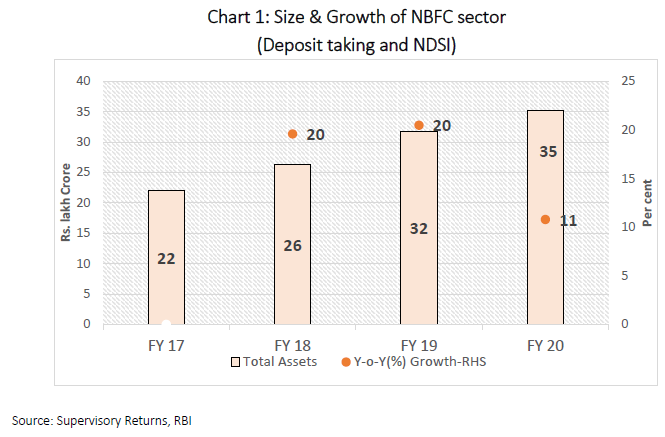
      Chart 1

      5. There is an increasingly complex web of inter-linkages of the sector with the banking sector, capital market and other financial sector entities, on both sides of the balance sheet. As such NBFCs, like other financial intermediaries, are increasingly exposed to counterparty, funding, market and asset concentration risks, even before the COVID-19 pandemic impacted financial markets and our lives.

      The Pandemic Effect

      6. In the aftermath of liquidity stress post IL&FS and DHFL events, the market funding conditions turned difficult for NBFCs. While NBFCs with better governance standards and better operating practices did well, others bore the brunt of the market forces. Smaller NBFCs and Microfinance Institutions (MFIs), who were contributing significantly to the last mile credit delivery, also got impacted as their funding sources got further squeezed. The Reserve Bank acted in a swift and proactive manner to improve access to funding and liquidity by its monetary policy and liquidity measures and resultantly, the cost of funds for NBFCs and HFCs has reduced substantially for all rating categories (Chart-2).
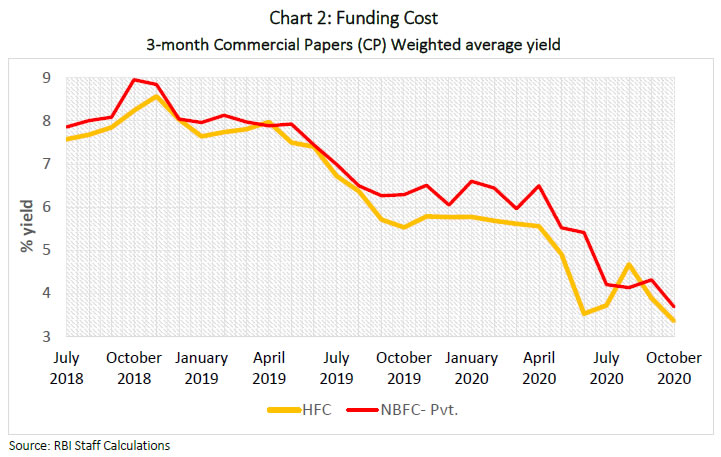
      Chart 2

      7. It is important to recognize that challenges faced by some of the NBFCs were reflective of inherent fragilities. As financial markets started differentiating between strong/well managed NBFCs and those having perceptible weaknesses, market discipline started to play out - entities with asset-liability mismatches or asset quality concerns faced constraints on market access. RBI, in response, took several calibrated steps to channel credit flow into the NBFC sector and improve the sector’s long-term resilience.

      8. As the sector was slowly inching towards normalcy (as can be seen from Table-1 below), the outbreak of COVID-19 and disruptions in economic activity due to lockdowns led to building up of huge stress in the financial system. While the entire financial system was affected, the impact was significantly greater on NBFCs due to their underlying business models, thereby straining their profitability.

      Table 1: Profitability of NBFC Sector (Deposit Taking and NDSI)
      (Amount in Rs. Crore)
      Profitability ParametersMarch 2017March 2018March 2019March 2020
      Net profit (Rs. Crore)31,92342,43417,46041,257
      Annualised RoA (%)1.51.60.61.2
      Annualised RoE (%)6.36.82.45.1
      Data source- Supervisory Returns, RBI

      The regulatory approach

      9. The regulatory approach of the Reserve Bank has adapted to the increase in complexity of the entities within the NBFC sector as well as the growing significance of NBFCs within the financial sector. The core principles of NBFCs regulation, however, has remained intact, i.e., - a) protection of depositors (in case of deposit-accepting companies) and customers; and, b) preserving financial stability. The varying emphasis on these objectives at different points in time has led RBI to deploy different policy tools as appropriate. We must recognise that NBFC regulation has undergone certain fundamental changes in recent years.

      10. Let me outline five of these most significant changes in brief -

      (i). First and foremost, in line with RBI’s emphasis on ownership-neutral regulations, Government owned NBFCs have been brought under the purview of prudential regulation since May 2018. Considering that Government owned NBFCs account for more than one-third of the sector, predominantly in infrastructure financing, this is a significant change.

      (ii). Second, considering the recent turmoil some NBFCs had to face because of liquidity stress, the criticality of sound liquidity risk management by NBFCs has been reinforced with the introduction of the liquidity risk management framework for NBFCs with asset size above ₹ 100 crore. All NBFCs, irrespective of size are encouraged to follow the framework. The guidelines emphasize the ‘Principles of Sound Liquidity Risk Management and Supervision’ published by Basel Committee on Banking Supervision. The framework expects the Boards of NBFCs to take an active role in the management of liquidity risk and deploy internal monitoring tools suitable to their business profile. More importantly, the regulations have devised a simplified and tailored Liquidity Coverage Ratio (LCR) meant for large NBFCs. It would prepare large NBFCs to effectively meet cash outflows even under severe liquidity stress scenarios over a 30-day horizon. No doubt, maintaining adequate high-quality liquidity assets would have repercussion on the overall yields of NBFCs, but the regulation is commensurate with the need to mitigate risks associated with maturity/liquidity transformation the NBFCs engage in.

      (iii). The third important development is in connection with FinTech based product delivery. It is now well recognised that non-banking financial sector would be a fertile ground for technology-based experimentation in financial products and services. Regulations have sought to create a conducive environment in this regard. For example, the timely introduction of guidelines for P2P lending platforms has ensured orderly growth of the segment anchored in high standards of prudence. Those have made lending platforms a neutral meeting place for lenders and borrowers and keeping them insulated from handling of funds involved in the underlying transactions. Regulations have brought down risks while creating the right environment for legitimate expansion of business opportunities. The ecosystem created under the Account Aggregator (AA) framework is yet another example of proactive regulation in the technology-intense activities. The AA framework has ushered in the required framework for safe, secure and consent-based sharing of information on financial assets of a customer. The critical regulatory aspect to be noted here is that the Account Aggregator does not store or view the data passing through it, thereby leaving no scope for any perverse incentive to abuse/ misuse the financial data. Let me also emphasize that the RBI has been flexible in according registered NBFCs to be completely app-based in financial intermediation.

      (iv). The RBI revised the regulatory framework under the principles of proportionality for Core Investment Companies (CICs) with transparency and disclosures being the focus of the revised regulations. The learnings from failure of a large NBFC - a Core Investment Company prompted this regulatory renovation. Large aggregate leverage at the group level aided by complex, multi-layered ownership structures were found to be nurturing the seeds of financial instability and vulnerability. Further, the aggregate risk view was missing at the holding company level. The revised regulatory framework tries to plug regulatory gaps in critical areas in respect of CICs.

      (v). Taking over the regulation of Housing Finance Companies (HFCs) is yet another significant move. Changes in the regulatory framework of HFCs have been issued after wide public consultations. The idea is to treat HFCs as a category of NBFC and bring about harmonisation of regulations while allowing HFCs to maintain their unique characteristics and allow them to transition to the revised regulations over a period of time, that is in a gradual manner, to make it least disruptive for the rest of the financial sector.

      11. With the growth in size and interconnectedness, NBFCs have increasingly become systemically significant and the prudential regulations for NBFC sector have evolved to give greater focus to the theme of financial stability. However, let’s not forget that regulation-light structure of NBFCs has enabled the flexibility enjoyed by them. This flexibility is the primary advantage of NBFCs over banks, enabling them to serve the last mile of financial intermediation. Therefore, it is imperative to strike a balance between regulating the NBFCs more tightly and the need to provide them the required flexibility. This will remain the cornerstone while we imagine the future of regulation for NBFCs.

      The Future

      Principle of Proportionality

      12. There is a view that any regulatory framework would ideally be designed according to the principle of proportionality. By extension, the spill-over of risks from a systematically important NBFC capable of transmitting perceptible impact on financial stability, must be dealt with in a proportionate manner. So, NBFCs with significant externalities and which contribute substantially to systemic risks must be identified and subjected to a higher degree of regulation. One can also argue that the design of prudential regulatory framework for such NBFCs can be comparable with banks so that beyond a point of criticality to systemic risks, such NBFC should have incentives either to convert into a commercial bank or scale down their network externalities within the financial system. This would make the financial sector sound and resilient while allowing a majority of NBFCs to continue under the regulation-light structure.

      13. Within the proportionality paradigm, one must deal with entities which neither belong to the critical ones in terms of systemic risk nor are they too small in their scale and complexity. These NBFCs currently enjoy great degree of regulatory arbitrage vis-à-vis banks. As a group, these entities can contribute to build-up of systemic risks because of the regulatory arbitrage enjoyed by them; hence there is a need to recalibrate the regulations.

      14. While dealing with proportionality principle, let me also touch upon the regulation of microfinance sector as well. We all are aware of the circumstances under which the regulatory framework for NBFC-MFIs was framed. Much water has flown under the bridge since then. Several large MFIs have converted into Small Finance Banks. The share of NBFC-MFIs in the overall microfinance sector has come down to a little over 30 per cent. Today we are in a situation, where the regulatory rigour is applicable only to a small part of the microfinance sector. There is a need to re-prioritise the regulatory tools in the microfinance sector so that our regulations are activity-based rather than entity-based. After all, the core of microfinance regulation lies in customer/consumer protection.

      15. We need to strike the right balance between the degree of regulation and the need for flexibility – a critical issue I alluded to a while ago. We could perhaps consider a graded regulatory framework for NBFCs calibrated in relation to their contribution to systemic significance.

      Regulating the FinTech

      16. Let me shift focus to another contemporary area of interest. Although significant regulatory steps have been taken already in the FinTech, the dynamic nature of the FinTech focused NBFCs keeps throwing up new challenges. The NBFC sector has been in the forefront in adopting innovative fintech-led delivery of products and services which are transforming the way one can imagine access to and interaction with these services. The advance technological solutions such as Big Data Analytics and Artificial Intelligence are being adopted by a large number of players to extend credit in an efficient manner over digital platforms. The Reserve Bank has been on the forefront of creating an enabling environment for growth of digital technology for new financial products and services. In fact, in the non-banking space, the RBI has been ahead of the curve and has come out with regulations for new products and services when the industry itself was at nascent stage. Peer to peer (P2P) lending, Account Aggregator (AA), and credit intermediation over “only digital platform” are case in point where the regulations have helped the industry to grow in a systematic and robust manner. While making regulation for the future in FinTech area, orderly growth and customer protection and data security will remain the guiding principles for the RBI.

      Ensuring transparency and governance

      17. Ensuring good corporate governance in NBFCs is at the core of any regulatory change. This is not an easy objective to meet, as good governance is essentially an aspirational achievement for an entity and it can seldom be founded only on regulatory prescriptions. Good governance would be a natural outcome if promoters/owners and senior management are fundamentally ‘fit and proper’. It is extremely critical that appropriate filtering mechanisms are in place to allow only the genuine and able promoters to start the business of NBFCs. After all, by issuing Certificate of Registration to new NBFCs, we provide them with the regulatory mandate to access public funds multiple times their net worth. Besides, it is necessary that NBFCs do not become conduits in money laundering and terrorist financing in any manner. While the current mechanism within RBI focuses on the above objective for companies seeking registration, there is a need to extend similar rigour of due diligence whenever there is a change in ownership/ control in an existing NBFC.

      Consumer protection and fair conduct

      18. A consumer of financial services provided by any regulated entity, whether a bank or NBFC, nurtures similar expectation of fair treatment and avenues for grievance redressal. Extension of the scheme of ombudsman to the NBFC sector is certainly a move in this direction. A transparent and self-disciplining mechanism has to be imagined for the future where the changing business models and newer credit delivery mechanisms do not deviate from the objective of fair treatment of the customer.

      Conclusions

      19. The Global Financial Crisis was primarily attributed to feather-touch regulatory approach, ignoring of the liquidity risks by financial intermediaries and unabated financial innovation. Abundant Liquidity, light touch regulation and financial innovation has also aided the growth of the NBFCs. The financial system today is significantly different from what it was at the outset of the financial crisis more than a decade ago. Regulatory reforms implemented in response to that crisis in India and globally, changes in technology and, more importantly, the growth of NBFCs have contributed to this dynamic landscape. The NBFC sector has become extremely diverse. The business model, customer profile and nature of financial products vary substantially depending on the category of the NBFC. The uniqueness of this sector lies in the inherent diversity of activities carried out by different NBFCs and thus, there can be no ‘one-size-fits-all’ prescription in the regulatory approach for NBFCs. Perhaps a calibrated and graded regulatory framework, proportionate to the systemic significance of entities concerned is the way forward.

      20. While on the one hand technological innovation and FinTech based delivery of financial services and products further the objective of improving access of financial products to the members of public, on the other, they push the regulator to recalibrate regulatory interventions to achieve the objective of consumer protection and financial stability. The regulatory challenges in marrying these diverse and sometimes conflicting objectives are many, but clarity of purpose would help us make the right policy choices.

      As I conclude, I pray that all of you and your family members stay safe in this long-drawn battle against the pandemic. Let me also wish you a happy and safe Deepawali.

      Thank You.

      -----

      1 Shri M. Rajeshwar Rao, Deputy Governor, Reserve Bank of India - speech delivered at the ‘National E-Summit on Non-Banking Finance Companies’ organized by ASSOCHAM on November 6, 2020. The inputs provided by Shri Manoranjan Mishra, Shri Chandan Kumar and Shri Pradeep Kumar are gratefully acknowledged.

      2 Report on Trend and Progress of Banking in India, RBI (2010 & 2019)

      3 Asset size of NBFCs (deposit taking, NDSI, non NDSI) – ₹ 37,38,162 crore. Asset size of Housing Finance Companies (HFCs) – ₹ 14.09 lakh crore

      4 Financial Stability Report, RBI, July 2020

      Topics

      ActsIncome Tax
