
Just a moment...

Top
Help
×

By creating an account you can:

Logo TaxTMI
>
Call Us / Help / Feedback

Contact Us At :

E-mail: [email protected]

Call / WhatsApp at: +91 99117 96707

For more information, Check Contact Us

FAQs :

To know Frequently Asked Questions, Check FAQs

Most Asked Video Tutorials :

For more tutorials, Check Video Tutorials

Submit Feedback/Suggestion :

Email :
Please provide your email address so we can follow up on your feedback.
Category :
Description :
Min 15 characters0/2000
Add to...
You have not created any category. Kindly create one to bookmark this item!
Create New Category
Hide
Title :
Description :
❮❮ Hide
Default View
Expand ❯❯
Close ✕
🔎 News - Adv. Search
TEXT SEARCH:

Press 'Enter' to add multiple search terms. Rules for Better Search

Search In:
Main Text + AI Text
  • Main Text
  • Main Text + AI Text
  • AI Text
Category: ?
Categorized by AI
---- All Categories ----
  • ---- All Categories ----
  • Income Tax
  • GST
  • Customs, DGFT & SEZ
  • FEMA & RBI
  • Corp. Laws, SEBI & IBC
  • PMLA, Black Money & ED
  • Budget
  • News and Press Release
  • PTI News
Month:
---- All Months ----
  • ---- All Months ----
  • January
  • February
  • March
  • April
  • May
  • June
  • July
  • August
  • September
  • October
  • November
  • December
Year:
---- All Years ----
  • ---- All Years ----
  • 2026
  • 2025
  • 2024
  • 2023
  • 2022
  • 2021
  • 2020
  • 2019
  • 2018
  • 2017
  • 2016
  • 2015
  • 2014
  • 2013
  • 2012
  • 2011
Sort By: ?
In Sort By 'Default', exact matches for text search are shown at the top, followed by the remaining results in their regular order.
RelevanceDefaultDate
    DRI seizes quantities of gold; drugs, e-cigarettes and other contraband in pan-India Ops; 20 persons, including 5 foreign nationals, arrested
    Union Government releases tax devolution of ₹1,09,019 crore to State Governments, as one advance instalment to accelerate their capital and deve...
    Raymond Lifestyle Limited Delivered a stable Q1 FY27 Performance
    Rupee rises 31 paise to 95.12 against US dollar in early trade
    Customs seizes 8 kg gold worth over Rs 11 cr at Kerala airports in one week
    Drill, Baby, Drill: India to fund Rs 650 cr per well for 60 deepsea wells to break its oil import habit
    Punjab GST revenue rises 20 pc to Rs 10,447 crore in April-July: Cheema
    India-China trade through Shipli La resumes after six years
    Odisha's export can reach USD 50 billion by FY 2029-30: Study
    Andhra records 21 per cent growth in net GST collections till July
    J&K crime branch chargesheets accused in separate bank, insurance fraud cases
    MCD-facilitated PM Vishwakarma Scheme enrols over 41,000 artisans in Delhi
    Gross GST mop-up grows 15.4 pc to over Rs 2.11 lakh cr in July on higher imports, sales
    Gross and Net GST revenue collections for the month of July, 2026
    India and Rwanda Hold First Joint Trade Committee Meeting to Deepen Bilateral Trade and Investment Cooperation
    West Bengal GST collection rises 2 pc in July to Rs 5,564 crore
    Gross GST collection kitty swells 15.4 pc to over Rs 2.11 lakh cr in July
    RBI says USD 40.82 bn mobilised under forex swap facility till Jul 31
    Sebi bars ZEEL for 2 months, Subhash Chandra, Punit Goenka for 1 year in Hyderabad land pledge case
    Department of Commerce Holds Workshop on Trade and Sustainable Development Policy Landscape
❯❯
MaximizeMaximizeMaximize
0 / 200
Expand Note
Add to Folder

No Folders have been created

    +

    Are you sure you want to delete "My most important" ?

    NOTE:

    News
    Showing Results for :
    Reset Filters
    Results Found:
    Show All SummariesHide All Summaries
    August 3, 2026
    Show AI Summary
    Anti-smuggling enforcement targets concealed gold, narcotics, protected products, prohibited e-cigarettes and restricted imports through coordinated intelligence operations.
    Intelligence-led anti-smuggling operations resulted in seizures of foreign-origin gold, narcotic drugs, hydroponic weed, protected wildlife and forest products, prohibited electronic cigarettes, and restricted poppy seeds and areca nuts. The operations identified concealment through fabricated baggage cavities, false cargo declarations, misdeclaration of origin, forged documentation, and concealment in transport vehicles. Poppy seeds are restricted under the Foreign Trade Policy and may be imported only subject to conditions concerning legally cultivated produce from designated countries and registration of import contracts with the Narcotics Commissioner.
    August 3, 2026
    Show AI Summary
    Tax devolution advance instalment strengthens State finances for accelerated capital and developmental expenditure through distribution of Union tax proceeds.
    Tax devolution was released to State Governments as an additional advance instalment alongside the normal monthly devolution schedule. The fiscal transfer shares net proceeds of Union taxes and duties with States, with the stated purpose of strengthening State finances and supporting accelerated capital and developmental expenditure. The release includes a State-wise distribution of tax-devolution proceeds.
    August 3, 2026
    Show AI Summary
    Financial performance reporting highlights revenue and EBITDA growth, garmenting recovery, retail optimisation, ESG commitments, and forward-looking risk disclosures.
    Financial performance reflects growth in total income and EBITDA, with improved margin, reduced net working-capital days, and a net-cash position. Branded textiles and high-value cotton shirting reported lower revenue due to the prior-year base effect, while branded apparel grew but faced lower margin from channel mix. Garmenting improved through order-book execution, tariff rationalisation, and new global clients. ESG priorities include female representation, waste-management initiatives, renewable energy, emissions reduction, and workplace safety. Forward-looking statements remain subject to regulatory, political, economic, and technological risks.
    August 3, 2026
    Show AI Summary
    Foreign exchange market support strengthens the rupee as lower crude prices, portfolio inflows and reserve growth improve sentiment.
    Foreign exchange market conditions supported an early appreciation of the rupee against the US dollar, attributed to lower global crude oil prices, a weaker dollar, sustained foreign portfolio inflows, higher foreign exchange reserves, and Reserve Bank of India presence in the foreign exchange market. Domestic equity market gains and net foreign institutional equity purchases were also identified as supporting factors.
    August 2, 2026
    Show AI Summary
    Gold smuggling detection targets sophisticated concealment methods through strengthened passenger profiling, intelligence gathering and coordinated investigations into organised networks.
    Gold smuggling detection at Kerala airports led to multiple seizures, registration of cases and arrests in alleged smuggling attempts. Organised networks reportedly use gold in paste or compound forms concealed in clothing, body cavities, aircraft seats and other unconventional locations. Enforcement measures include strengthened passenger profiling, intelligence gathering and inter-agency coordination, while investigations continue to identify associated syndicates and financiers.
    August 2, 2026
    Show AI Summary
    Offshore exploration funding supports deepwater drilling, shared infrastructure and seismic data to strengthen domestic hydrocarbon production potential.
    The Samudra Manthan National Offshore Exploration Scheme provides direct budgetary support for high-risk deepwater and ultra-deepwater exploratory drilling, subject to cost-sharing and per-well limits. Support is available to eligible operators holding or securing exploration acreage. The scheme also funds offshore data acquisition and shared subsea, receipt and processing infrastructure through a Common Hub Infrastructure model. It is intended to promote risk exploration, improve commercialisation of offshore discoveries and strengthen domestic hydrocarbon production potential within the existing exploration and licensing framework.
    August 1, 2026
    Show AI Summary
    GST compliance enforcement combines taxpayer refunds, analytics-based fraud detection, cancellation of fake registrations, and recovery of outstanding VAT arrears.
    Punjab attributed increased GST collections to voluntary compliance, intelligence-based enforcement and technology-driven tax administration, while facilitating compliant taxpayers through timely GST refunds. Data analytics, risk profiling and field verification were used to identify tax evasion, bogus billing, fake input tax credit networks and misuse of the GST registration framework. Measures included penalties, cancellation of fraudulent registrations and recovery of long-pending VAT arrears through attachment and auction of defaulters' properties.
    August 1, 2026
    Show AI Summary
    Cross-border barter trade resumes through Shipki La, subject to permitted goods, time limits, and import-export compliance requirements.
    Cross-border barter trade through Shipki La between India and Tibet resumed after a six-year interruption. Traders may exchange specified goods under a barter arrangement and must return within 72 hours. Traders are required to comply strictly with import-export regulations prescribed by the Union Ministry of Commerce, emphasising transparency and regulatory compliance. Expansion of permitted goods may be pursued through prescribed governmental and external-affairs channels.
    August 1, 2026
    Show AI Summary
    Export growth projections outline pathways for Odisha to expand merchandise trade through export diversification, MSME support and financing initiatives.
    Export growth projections for Odisha set out base, optimistic and ambitious scenarios through FY 2029-30, based respectively on historical growth, envisaged national export growth, and a larger share of national exports. Odisha's export basket remains concentrated in metals and minerals, led by aluminium products, with China as the principal export destination. Odisha Vision 2047 identifies exports, including MSME contributions, as an economic transformation driver, while export-financing and risk-mitigation initiatives aim to address financing gaps for exporters and MSMEs.
    August 1, 2026
    Show AI Summary
    GST compliance enforcement through AI analytics supported sustained net GST collection growth despite rate rationalisation reforms and reduced compliance costs.
    GST revenue mobilisation in Andhra Pradesh showed year-on-year growth in net GST and total commercial tax collections through July 2026, despite rate-rationalisation reforms. Revenue growth was attributed to AI-based scrutiny and analytics, machine-learning risk scoring, AI-driven IGST reversals, UPI-based enforcement analytics, data sharing, predictive analytics, registration verification, and Aadhaar-integrated expansion of the professional-tax base. These measures were stated to strengthen compliance, curb wrongful input tax credit claims, broaden taxpayer coverage, and improve revenue mobilisation.
    August 1, 2026
    Show AI Summary
    Economic-offences fraud chargesheets address alleged fictitious loans, forged insurance surrender papers, and diversion of bank and policy funds.
    Economic-offences chargesheets were filed in separate alleged bank and insurance fraud matters. The bank investigation alleged fictitious loan sanctions and overdrafts beyond delegated authority, involving cheating, forgery, use of forged documents and criminal conspiracy. The insurance investigation alleged that duplicate policy records and forged surrender documents were used to open a fraudulent account in a policyholder's name and divert policy proceeds. Records, witness statements, documentary evidence and forensic examination were cited in support of the allegations.
    August 1, 2026
    Show AI Summary
    PM Vishwakarma Scheme implementation expands artisan enrolment, skills, credit, e-commerce access and export facilitation while addressing documentation barriers.
    PM Vishwakarma Scheme implementation in Delhi facilitated artisan enrolment, application processing, skill training, toolkit distribution, loan access, e-commerce onboarding and export-related support. Awareness workshops and tele-calling campaigns were used to promote participation and follow up on benefits. Key implementation challenges concerned outreach to informal clusters, digital literacy, delays in Aadhaar and IEC documentation, and additional support for Divyang artisans. Planned action includes expanding workshops, scaling e-commerce onboarding, strengthening export facilitation and coordination with implementing agencies.
    August 1, 2026
    Show AI Summary
    Goods and Services Tax collections rise on domestic consumption and imports, while elevated import revenue prompts assessment of underlying drivers.
    Goods and Services Tax collections for July increased over the corresponding prior-year period, supported by domestic sales and imports. Gross receipts included Central GST, State GST and Integrated GST, with net GST revenue calculated after adjusting refunds. For the April-July period, gross and net collections also increased. Commentary linked domestic GST growth to consumption, formalisation and industrial activity, while identifying elevated import GST collections as an area requiring assessment of import composition, currency effects and volumes.
    August 1, 2026
    Show AI Summary
    GST revenue collections show provisional gross, refund and net revenue trends, with State-wise settlement and domestic collection data.
    GST revenue collections for July 2026 are reported provisionally through gross domestic and import revenue, domestic and export-related refunds, and net GST revenue after refunds. The data also sets out SGST collections and the SGST share of IGST settled to States and Union Territories, both monthly and cumulatively. State-wise domestic GST growth excludes GST on imported goods, while jurisdiction-wise data allocates collections between central and State formations and identifies CGST, SGST and IGST components.
    August 1, 2026
    Show AI Summary
    Bilateral trade cooperation expands through a Joint Trade Committee covering investment, critical minerals, healthcare, digital technologies and market access.
    Bilateral trade and investment cooperation between India and Rwanda is to be advanced through a structured Joint Trade Committee mechanism for reviewing commerce, diversifying trade, promoting investment, facilitating business engagement and addressing market-access and logistical issues. Priority cooperation includes critical minerals, pharmaceuticals and healthcare, agriculture and agro-processing, standards harmonisation, digital public infrastructure, fintech, cybersecurity, green mobility and renewable energy. Investment focal points will support engagement, while capacity-building assistance and close monitoring of the Agreed Minutes are intended to support time-bound implementation.
    August 1, 2026
    Show AI Summary
    GST collection growth in West Bengal continued year-on-year in July but remained below the national growth trend.
    West Bengal's July GST collection increased year-on-year and over the preceding month, marking a second consecutive month of annual growth. Official data also indicated that the State's annual growth rate was below the national trend, while gross domestic GST revenue excluding imports and overall gross GST collections including import-related taxes rose nationally during July.
    August 1, 2026
    Show AI Summary
    GST collection growth reflects higher revenue mobilisation from domestic transactions and imports, with refunds adjusted in net revenue.
    Goods and Services Tax collections increased in July, driven by higher revenue from domestic transactions and imports. The gross collection comprised Central GST, State GST and Integrated GST components. Refunds also increased during the month, and net GST revenue was determined after adjustment of refund outflows from gross tax receipts.
    August 1, 2026
    Show AI Summary
    Concessional foreign-exchange swaps encourage bank deposits and foreign borrowings to strengthen balance-of-payments resilience and foreign-exchange liquidity.
    The Reserve Bank of India introduced a concessional foreign-exchange swap facility to encourage foreign-currency inflows, strengthen the balance of payments and support foreign-exchange liquidity. The facility applies to fresh Foreign Currency Non-Resident (Bank) deposits, Overseas Foreign Currency Borrowings and External Commercial Borrowings. Foreign Currency Non-Resident (Bank) deposits constitute the principal source of inflows mobilised under the arrangement. The facility is available for specified time-bound periods, with a later availability period for Overseas Foreign Currency Borrowings and External Commercial Borrowings.
    August 1, 2026
    Show AI Summary
    Unauthorised pledge of listed-company land triggered securities-market bars for disclosure failures and misuse of management authority.
    Unauthorised pledge of ZEEL's Hyderabad land as security for loans obtained by promoter-linked entities was treated as a related-party transaction lacking prior audit committee approval. ZEEL failed to disclose the land's deployment in its financial statements. Its Chairman Emeritus was stated to have transferred title deeds by falsely representing management approval and to have concealed the transaction's nature. Securities-market prohibitions and monetary penalties were imposed with immediate effect.
    August 1, 2026
    Show AI Summary
    Trade and sustainable development policy integrates carbon regulation, sustainability standards and domestic frameworks to strengthen trade competitiveness and preparedness.
    Trade and Sustainable Development policy was examined in relation to international trade disciplines, sustainability regulation and India's trade strategy. Discussions considered carbon markets, carbon pricing, carbon border adjustment measures, sustainability standards and regulatory cooperation, and their implications for trade and industrial competitiveness. Domestic mechanisms, including the Carbon Credit Trading Scheme, Indian Carbon Market, Extended Producer Responsibility framework, and accreditation and conformity assessment systems, were considered for strengthening preparedness for emerging sustainability-related trade disciplines.

    News

    Back

    All News

    Showing Results for :
    Reset Filters
      No Records Found

      News

      Back

      All News

      whatsappJoin Channel
      Showing Results for : Reset Filters
      PMLA, Black Money & ED

      NBFC Regulation- Looking ahead (Shri M. Rajeshwar Rao, Deputy Governor, Reserve Bank of India - November 6, 2020 - at the ‘National E-Summit on Non-Banking Finance Companies’ organized by ASSOCHAM)

      November 6, 2020

      Contents
      Summary
      Note

      Note

      -

      Bookmark

      Print

      Print

      Dr. Charan Singh, Shri Deepak Sood, Shri Ramesh Iyer, Shri Vineet Agarwal, Shri S. Ramann, Shri Sunil Kanoria, Shri Raman Agarwal, Ladies and Gentlemen,

      I thank the Associated Chambers of Commerce and Industry of India for this very kind invitation to address the ‘National E-Summit on Non-Banking Finance Companies’- with the theme “Stability and sustainability of Financial Sector”.

      2. At this juncture, NBFC sector is passing through a critical phase. Recent failures of certain large Non-Banking Financial Companies (NBFCs), severe liquidity strain confronting the sector and the consequent financial stability concerns have brought NBFC regulations back into focus. I thought that the time is opportune to talk a little bit on the innovative transformations taking place in the NBFC sector and the regulatory response from the Reserve Bank. It would be contextual to take stock of the direction in which regulatory focus has moved and what could be the future shape of NBFC regulations. This is intended as an analysis to evoke discussion and debate on the subject.

      Growth of NBFC sector and the need for prudence

      3. NBFCs have come a long way in terms of their scale and diversity of operations. They now play a critical role in financial intermediation and promoting inclusive growth by providing last-mile access of financial services to meet the diversified financial needs of less-banked customers. Over the years, the segment has grown rapidly, with a few of the large NBFCs becoming comparable in size to some of the private sector banks. The sector has also seen advent of many non-traditional players leveraging technology to adopt tech-based innovative business models.

      4. Between March 31, 2009 and March 31, 2019, the total assets2 of NBFCs grew at a compounded annual growth rate (CAGR) of 18.6 per cent, while the balance sheets of scheduled commercial banks (SCBs) grew at a CAGR of 10.7 per cent. Consequently, the aggregate balance sheet size of NBFCs increased from 9.3 per cent to 18.6 per cent of the aggregate balance sheet size of SCBs during the corresponding period. In absolute terms, the asset size of NBFC sector (including HFCs), as on March 31, 2020, is ₹ 51.47 lakh crore3. As at end-March 2020, NBFCs have been the largest net borrowers of funds from the financial system4, of which, more than half of the funds were from SCBs, followed by Asset Management Companies-Mutual Funds (AMC-MFs) and Insurance Companies. As the financial intermediation has shifted, so has interconnectedness. Many NBFCs now rely on banking system for funds and emergency liquidity needs. Therefore, it is not enough to understand and confront the vulnerabilities of the banking sector alone. The need of the hour is to understand vulnerabilities in the NBFC sector and how shocks are transmitted to or from the sector.
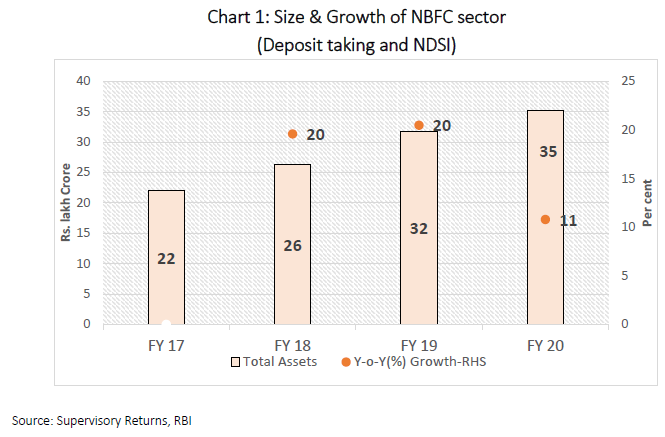
      Chart 1

      5. There is an increasingly complex web of inter-linkages of the sector with the banking sector, capital market and other financial sector entities, on both sides of the balance sheet. As such NBFCs, like other financial intermediaries, are increasingly exposed to counterparty, funding, market and asset concentration risks, even before the COVID-19 pandemic impacted financial markets and our lives.

      The Pandemic Effect

      6. In the aftermath of liquidity stress post IL&FS and DHFL events, the market funding conditions turned difficult for NBFCs. While NBFCs with better governance standards and better operating practices did well, others bore the brunt of the market forces. Smaller NBFCs and Microfinance Institutions (MFIs), who were contributing significantly to the last mile credit delivery, also got impacted as their funding sources got further squeezed. The Reserve Bank acted in a swift and proactive manner to improve access to funding and liquidity by its monetary policy and liquidity measures and resultantly, the cost of funds for NBFCs and HFCs has reduced substantially for all rating categories (Chart-2).
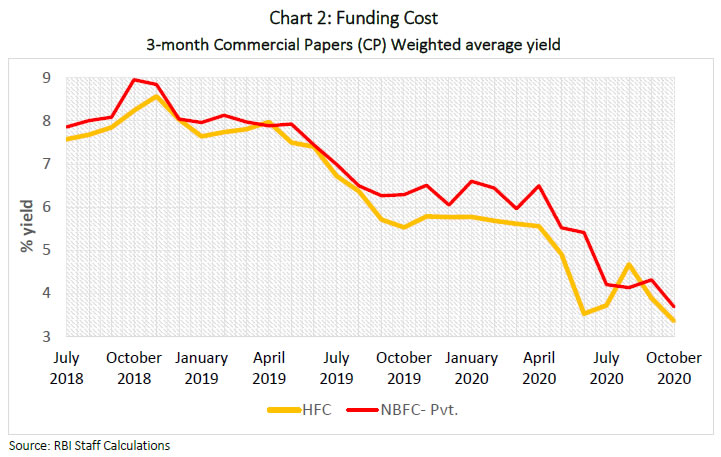
      Chart 2

      7. It is important to recognize that challenges faced by some of the NBFCs were reflective of inherent fragilities. As financial markets started differentiating between strong/well managed NBFCs and those having perceptible weaknesses, market discipline started to play out - entities with asset-liability mismatches or asset quality concerns faced constraints on market access. RBI, in response, took several calibrated steps to channel credit flow into the NBFC sector and improve the sector’s long-term resilience.

      8. As the sector was slowly inching towards normalcy (as can be seen from Table-1 below), the outbreak of COVID-19 and disruptions in economic activity due to lockdowns led to building up of huge stress in the financial system. While the entire financial system was affected, the impact was significantly greater on NBFCs due to their underlying business models, thereby straining their profitability.

      Table 1: Profitability of NBFC Sector (Deposit Taking and NDSI)
      (Amount in Rs. Crore)
      Profitability ParametersMarch 2017March 2018March 2019March 2020
      Net profit (Rs. Crore)31,92342,43417,46041,257
      Annualised RoA (%)1.51.60.61.2
      Annualised RoE (%)6.36.82.45.1
      Data source- Supervisory Returns, RBI

      The regulatory approach

      9. The regulatory approach of the Reserve Bank has adapted to the increase in complexity of the entities within the NBFC sector as well as the growing significance of NBFCs within the financial sector. The core principles of NBFCs regulation, however, has remained intact, i.e., - a) protection of depositors (in case of deposit-accepting companies) and customers; and, b) preserving financial stability. The varying emphasis on these objectives at different points in time has led RBI to deploy different policy tools as appropriate. We must recognise that NBFC regulation has undergone certain fundamental changes in recent years.

      10. Let me outline five of these most significant changes in brief -

      (i). First and foremost, in line with RBI’s emphasis on ownership-neutral regulations, Government owned NBFCs have been brought under the purview of prudential regulation since May 2018. Considering that Government owned NBFCs account for more than one-third of the sector, predominantly in infrastructure financing, this is a significant change.

      (ii). Second, considering the recent turmoil some NBFCs had to face because of liquidity stress, the criticality of sound liquidity risk management by NBFCs has been reinforced with the introduction of the liquidity risk management framework for NBFCs with asset size above ₹ 100 crore. All NBFCs, irrespective of size are encouraged to follow the framework. The guidelines emphasize the ‘Principles of Sound Liquidity Risk Management and Supervision’ published by Basel Committee on Banking Supervision. The framework expects the Boards of NBFCs to take an active role in the management of liquidity risk and deploy internal monitoring tools suitable to their business profile. More importantly, the regulations have devised a simplified and tailored Liquidity Coverage Ratio (LCR) meant for large NBFCs. It would prepare large NBFCs to effectively meet cash outflows even under severe liquidity stress scenarios over a 30-day horizon. No doubt, maintaining adequate high-quality liquidity assets would have repercussion on the overall yields of NBFCs, but the regulation is commensurate with the need to mitigate risks associated with maturity/liquidity transformation the NBFCs engage in.

      (iii). The third important development is in connection with FinTech based product delivery. It is now well recognised that non-banking financial sector would be a fertile ground for technology-based experimentation in financial products and services. Regulations have sought to create a conducive environment in this regard. For example, the timely introduction of guidelines for P2P lending platforms has ensured orderly growth of the segment anchored in high standards of prudence. Those have made lending platforms a neutral meeting place for lenders and borrowers and keeping them insulated from handling of funds involved in the underlying transactions. Regulations have brought down risks while creating the right environment for legitimate expansion of business opportunities. The ecosystem created under the Account Aggregator (AA) framework is yet another example of proactive regulation in the technology-intense activities. The AA framework has ushered in the required framework for safe, secure and consent-based sharing of information on financial assets of a customer. The critical regulatory aspect to be noted here is that the Account Aggregator does not store or view the data passing through it, thereby leaving no scope for any perverse incentive to abuse/ misuse the financial data. Let me also emphasize that the RBI has been flexible in according registered NBFCs to be completely app-based in financial intermediation.

      (iv). The RBI revised the regulatory framework under the principles of proportionality for Core Investment Companies (CICs) with transparency and disclosures being the focus of the revised regulations. The learnings from failure of a large NBFC - a Core Investment Company prompted this regulatory renovation. Large aggregate leverage at the group level aided by complex, multi-layered ownership structures were found to be nurturing the seeds of financial instability and vulnerability. Further, the aggregate risk view was missing at the holding company level. The revised regulatory framework tries to plug regulatory gaps in critical areas in respect of CICs.

      (v). Taking over the regulation of Housing Finance Companies (HFCs) is yet another significant move. Changes in the regulatory framework of HFCs have been issued after wide public consultations. The idea is to treat HFCs as a category of NBFC and bring about harmonisation of regulations while allowing HFCs to maintain their unique characteristics and allow them to transition to the revised regulations over a period of time, that is in a gradual manner, to make it least disruptive for the rest of the financial sector.

      11. With the growth in size and interconnectedness, NBFCs have increasingly become systemically significant and the prudential regulations for NBFC sector have evolved to give greater focus to the theme of financial stability. However, let’s not forget that regulation-light structure of NBFCs has enabled the flexibility enjoyed by them. This flexibility is the primary advantage of NBFCs over banks, enabling them to serve the last mile of financial intermediation. Therefore, it is imperative to strike a balance between regulating the NBFCs more tightly and the need to provide them the required flexibility. This will remain the cornerstone while we imagine the future of regulation for NBFCs.

      The Future

      Principle of Proportionality

      12. There is a view that any regulatory framework would ideally be designed according to the principle of proportionality. By extension, the spill-over of risks from a systematically important NBFC capable of transmitting perceptible impact on financial stability, must be dealt with in a proportionate manner. So, NBFCs with significant externalities and which contribute substantially to systemic risks must be identified and subjected to a higher degree of regulation. One can also argue that the design of prudential regulatory framework for such NBFCs can be comparable with banks so that beyond a point of criticality to systemic risks, such NBFC should have incentives either to convert into a commercial bank or scale down their network externalities within the financial system. This would make the financial sector sound and resilient while allowing a majority of NBFCs to continue under the regulation-light structure.

      13. Within the proportionality paradigm, one must deal with entities which neither belong to the critical ones in terms of systemic risk nor are they too small in their scale and complexity. These NBFCs currently enjoy great degree of regulatory arbitrage vis-à-vis banks. As a group, these entities can contribute to build-up of systemic risks because of the regulatory arbitrage enjoyed by them; hence there is a need to recalibrate the regulations.

      14. While dealing with proportionality principle, let me also touch upon the regulation of microfinance sector as well. We all are aware of the circumstances under which the regulatory framework for NBFC-MFIs was framed. Much water has flown under the bridge since then. Several large MFIs have converted into Small Finance Banks. The share of NBFC-MFIs in the overall microfinance sector has come down to a little over 30 per cent. Today we are in a situation, where the regulatory rigour is applicable only to a small part of the microfinance sector. There is a need to re-prioritise the regulatory tools in the microfinance sector so that our regulations are activity-based rather than entity-based. After all, the core of microfinance regulation lies in customer/consumer protection.

      15. We need to strike the right balance between the degree of regulation and the need for flexibility – a critical issue I alluded to a while ago. We could perhaps consider a graded regulatory framework for NBFCs calibrated in relation to their contribution to systemic significance.

      Regulating the FinTech

      16. Let me shift focus to another contemporary area of interest. Although significant regulatory steps have been taken already in the FinTech, the dynamic nature of the FinTech focused NBFCs keeps throwing up new challenges. The NBFC sector has been in the forefront in adopting innovative fintech-led delivery of products and services which are transforming the way one can imagine access to and interaction with these services. The advance technological solutions such as Big Data Analytics and Artificial Intelligence are being adopted by a large number of players to extend credit in an efficient manner over digital platforms. The Reserve Bank has been on the forefront of creating an enabling environment for growth of digital technology for new financial products and services. In fact, in the non-banking space, the RBI has been ahead of the curve and has come out with regulations for new products and services when the industry itself was at nascent stage. Peer to peer (P2P) lending, Account Aggregator (AA), and credit intermediation over “only digital platform” are case in point where the regulations have helped the industry to grow in a systematic and robust manner. While making regulation for the future in FinTech area, orderly growth and customer protection and data security will remain the guiding principles for the RBI.

      Ensuring transparency and governance

      17. Ensuring good corporate governance in NBFCs is at the core of any regulatory change. This is not an easy objective to meet, as good governance is essentially an aspirational achievement for an entity and it can seldom be founded only on regulatory prescriptions. Good governance would be a natural outcome if promoters/owners and senior management are fundamentally ‘fit and proper’. It is extremely critical that appropriate filtering mechanisms are in place to allow only the genuine and able promoters to start the business of NBFCs. After all, by issuing Certificate of Registration to new NBFCs, we provide them with the regulatory mandate to access public funds multiple times their net worth. Besides, it is necessary that NBFCs do not become conduits in money laundering and terrorist financing in any manner. While the current mechanism within RBI focuses on the above objective for companies seeking registration, there is a need to extend similar rigour of due diligence whenever there is a change in ownership/ control in an existing NBFC.

      Consumer protection and fair conduct

      18. A consumer of financial services provided by any regulated entity, whether a bank or NBFC, nurtures similar expectation of fair treatment and avenues for grievance redressal. Extension of the scheme of ombudsman to the NBFC sector is certainly a move in this direction. A transparent and self-disciplining mechanism has to be imagined for the future where the changing business models and newer credit delivery mechanisms do not deviate from the objective of fair treatment of the customer.

      Conclusions

      19. The Global Financial Crisis was primarily attributed to feather-touch regulatory approach, ignoring of the liquidity risks by financial intermediaries and unabated financial innovation. Abundant Liquidity, light touch regulation and financial innovation has also aided the growth of the NBFCs. The financial system today is significantly different from what it was at the outset of the financial crisis more than a decade ago. Regulatory reforms implemented in response to that crisis in India and globally, changes in technology and, more importantly, the growth of NBFCs have contributed to this dynamic landscape. The NBFC sector has become extremely diverse. The business model, customer profile and nature of financial products vary substantially depending on the category of the NBFC. The uniqueness of this sector lies in the inherent diversity of activities carried out by different NBFCs and thus, there can be no ‘one-size-fits-all’ prescription in the regulatory approach for NBFCs. Perhaps a calibrated and graded regulatory framework, proportionate to the systemic significance of entities concerned is the way forward.

      20. While on the one hand technological innovation and FinTech based delivery of financial services and products further the objective of improving access of financial products to the members of public, on the other, they push the regulator to recalibrate regulatory interventions to achieve the objective of consumer protection and financial stability. The regulatory challenges in marrying these diverse and sometimes conflicting objectives are many, but clarity of purpose would help us make the right policy choices.

      As I conclude, I pray that all of you and your family members stay safe in this long-drawn battle against the pandemic. Let me also wish you a happy and safe Deepawali.

      Thank You.

      -----

      1 Shri M. Rajeshwar Rao, Deputy Governor, Reserve Bank of India - speech delivered at the ‘National E-Summit on Non-Banking Finance Companies’ organized by ASSOCHAM on November 6, 2020. The inputs provided by Shri Manoranjan Mishra, Shri Chandan Kumar and Shri Pradeep Kumar are gratefully acknowledged.

      2 Report on Trend and Progress of Banking in India, RBI (2010 & 2019)

      3 Asset size of NBFCs (deposit taking, NDSI, non NDSI) – ₹ 37,38,162 crore. Asset size of Housing Finance Companies (HFCs) – ₹ 14.09 lakh crore

      4 Financial Stability Report, RBI, July 2020

      Topics

      ActsIncome Tax
