
Just a moment...

Top
Help
×

By creating an account you can:

Logo TaxTMI
Call Us / Help / Feedback

Contact Us At :

E-mail: [email protected]

Call / WhatsApp at: +91 99117 96707

For more information, Check Contact Us

FAQs :

To know Frequently Asked Questions, Check FAQs

Most Asked Video Tutorials :

For more tutorials, Check Video Tutorials

Submit Feedback/Suggestion :

Email :
Please provide your email address so we can follow up on your feedback.
Category :
Description :
Min 15 characters0/2000
Make Most of Text Search
  1. Checkout this video tutorial: How to search effectively on TaxTMI.
  2. Put words in double quotes for exact word search, eg: "income tax"
  3. Avoid noise words such as : 'and, of, the, a'
  4. Sort by Relevance to get the most relevant document.
  5. Press Enter to add multiple terms/multiple phrases, and then click on Search to Search.
  6. Text Search
  7. The system will try to fetch results that contains ALL your words.
  8. Once you add keywords, you'll see a new 'Search In' filter that makes your results even more precise.
  9. Text Search
Add to...
You have not created any category. Kindly create one to bookmark this item!
Create New Category
Hide
Title :
Description :
❮❮ Hide
Default View
Expand ❯❯
Close ✕
🔎 News - Adv. Search
TEXT SEARCH:

Press 'Enter' to add multiple search terms. Rules for Better Search

Search In:
Main Text + AI Text
  • Main Text
  • Main Text + AI Text
  • AI Text
Category: ?
Categorized by AI
---- All Categories ----
  • ---- All Categories ----
  • Income Tax
  • GST
  • Customs, DGFT & SEZ
  • FEMA & RBI
  • Corp. Laws, SEBI & IBC
  • PMLA, Black Money & ED
  • Budget
  • News and Press Release
  • PTI News
Month:
---- All Months ----
  • ---- All Months ----
  • January
  • February
  • March
  • April
  • May
  • June
  • July
  • August
  • September
  • October
  • November
  • December
Year:
---- All Years ----
  • ---- All Years ----
  • 2026
  • 2025
  • 2024
  • 2023
  • 2022
  • 2021
  • 2020
  • 2019
  • 2018
  • 2017
  • 2016
  • 2015
  • 2014
  • 2013
  • 2012
  • 2011
Sort By: ?
In Sort By 'Default', exact matches for text search are shown at the top, followed by the remaining results in their regular order.
RelevanceDefaultDate
    Invest Manchester: UK-India Free Trade Agreement Opens New Doors for APAC Manufacturers
    4 Chandigarh University Law Graduates Become Judicial Officers, 244 Secure Jobs at Corporate Law Firms
    ISTITUTO MARANGONI MUMBAI PRESENTS ITS 2026 STUDENT SHOWCASE — ‘ASTITVA’
    Rupee rises 5 paise to 96.48 against US dollar in early trade
    Ministry of Statistics and Programme Implementation has put in place well-defined mechanisms to ensure timely collection and publication of official s...
    Ministry of Statistics and Programme Implementation undertakes periodic methodological reviews of statistical framework to ensure official statis...
    ENERGY STATISTICS INDIA
    CCI approves acquisition of 100% of the equity share capital of NCR Atleos Corporation (Target) by The Brink's Company (Acquirer)
    US to unveil final action on Sec 301 investigation on Thursday: USTR Greer
    Lokayukta police unearth Rs 17 crore assets of power firm official, relatives
    Maharashtra govt releases 'representative' list of 533 beneficiaries of farm loan waiver scheme
    India exports 12.5 tons of Dashehari, Langra mangoes from UP to Dubai via sea route
    Finacle 10.2.25 software will make banking services faster and more transparent: Himachal CM
    Return of foreign investments shows revival of confidence in economy: RBI Bulletin
    India-US trade deal is almost complete: US State Department after Jaishankar-Rubio talks in Manila
    SC says legal error not sole ground to revoke liberty, flags growing trend of challenging bail
    Parliamentary joint committee on corporate laws amendment bill gets more time to submit report
    Archies Online Launches Pan-India Same-Day Cake, Flower & Gift Delivery Service
    DRI busts clandestine Mephedrone manufacturing facility in Ankleshwar, Gujarat and seizes Rs. 21 lakh; Three arrested
    SC rejects pleas of ED and state against grant of bail to Chaitanya Baghel in liquor scam cases
❯❯
MaximizeMaximizeMaximize
0 / 200
Expand Note
Add to Folder

No Folders have been created

    +

    Are you sure you want to delete "My most important" ?

    NOTE:

    News
    Showing Results for :
    Reset Filters
    Results Found:
    Show All SummariesHide All Summaries
    July 23, 2026
    Show AI Summary
    Free trade agreement tariff reductions create investment opportunities for Asia-Pacific manufacturers seeking UK and European market access.
    The UK-India Free Trade Agreement is presented as reducing tariffs on advanced machinery and manufacturing-related goods and creating trade and investment opportunities for Asia-Pacific manufacturers seeking UK and European market access. Manchester is promoted as an investment location through its advanced manufacturing cluster, skilled workforce, innovation infrastructure, international links, and available manufacturing and research space. Invest Manchester provides investor support and undertakes international engagement to develop trade, investment and innovation partnerships.
    July 23, 2026
    Show AI Summary
    Practical legal training and structured internships strengthen judicial examination preparation, professional skills, and career exposure for law students.
    Legal education employability initiatives combine curriculum alignment for judicial and competitive examinations with mentoring, legal drafting practice, research training, and professional interaction. Internships provide practical exposure to courts, judicial institutions, government bodies, law firms, advocates' chambers, corporate legal departments, and non-governmental organisations. Students in integrated and three-year law programmes complete prescribed minimum internship periods, with summer and winter placements commencing after the first year. Specialisation-based internships cover civil, criminal, corporate, cyber, intellectual property, arbitration, taxation, and government or non-governmental legal work.
    July 23, 2026
    Show AI Summary
    Student fashion showcase celebrates identity, personal storytelling, craft preservation and conscious creation through nine contemporary design collections.
    Student fashion showcase 'Astitva' presented nine contemporary collections exploring identity, belonging, transformation, memory, resilience, grief and cultural heritage through personal design narratives. The collections included a contemporary reinterpretation of Bhujodi weaving, Ajrakh block printing and Kumaoni hand-knitting, emphasising preservation of Indian craft traditions. Recognition included a designer award for the craft-revival collection and a sustainability award for a collection focused on craftsmanship, conscious creation, heirloom design and mindful luxury.
    July 23, 2026
    Show AI Summary
    Rupee exchange-rate movements face pressure from elevated crude prices and equity outflows, moderated by possible central-bank intervention.
    Rupee exchange-rate movement in early foreign-exchange trading reflected a modest appreciation against the US dollar after depreciation in the preceding session. Possible dollar sales by state-owned banks, widely viewed as central-bank intervention, and a weaker US dollar supported the currency. Elevated crude-oil prices, foreign institutional equity outflows, and negative domestic equity-market sentiment continued to create downside pressure, although expected central-bank support was considered likely to limit losses.
    July 23, 2026
    Show AI Summary
    Official statistics dissemination uses digital validation, release calendars, anonymised microdata and accessible platforms to strengthen timeliness and transparency.
    Official statistics collection and dissemination are supported through digital survey platforms with built-in validation, real-time monitoring and supervisory quality controls. Consumer Price Index, National Accounts Statistics and Index of Industrial Production data are collected, compiled or validated through specified quality and timeliness mechanisms. An Advance Release Calendar supports accountable publication, while anonymised survey microdata, stakeholder engagement and digital portals improve transparency, accessibility and use of official statistics.
    July 23, 2026
    Show AI Summary
    Official statistical modernization strengthens macroeconomic measurement through revised bases, digital surveys, validated data collection and district-level estimates.
    Official statistical methodology and National Sample Surveys are periodically reviewed to reflect changing economic conditions, emerging data needs and international standards. Base revisions for key macroeconomic indicators incorporate updated data, expanded coverage, revised weights, administrative sources and improved estimation of the unincorporated sector. Survey methods are updated through expert consultation, pilot studies and field testing. Digital collection platforms, validation checks, real-time monitoring, AI-enabled tools and multilingual interfaces support improved data quality, quicker releases, high-frequency surveys and district-level estimates.
    July 23, 2026
    Show AI Summary
    Energy statistics reporting expands with internationally aligned consumption data, energy-sector credit flows, and improved coal and electricity coverage.
    Energy Statistics India 2026 reports Total Primary Energy Supply and renewable energy potential, supporting energy policy and infrastructure planning. Its 33rd edition adds data on credit flow to the energy sector, the international energy scenario, and international marine and aviation bunker use. It aligns end-use consuming sectors for energy commodities with international standards and addresses data gaps in industry-wise coal and electricity consumption.
    July 23, 2026
    Show AI Summary
    Competition approval for full acquisition integrates cash replenishment, ATM hardware, software, managed services and maintenance operations.
    Competition approval has been granted for The Brink's Company's acquisition of the entire equity share capital of NCR Atleos Corporation, which will become wholly owned and controlled by the acquirer. The acquirer provides cash replenishment and ancillary first-line maintenance in India. The target's Indian activities include ATM hardware manufacture and supply, ATM software development and licensing, ATM managed services, and first-line and second-line ATM maintenance.
    July 22, 2026
    Show AI Summary
    Forced-labour import controls face proposed Section 301 tariff action, while India contests the investigations through bilateral trade discussions.
    Section 301 investigations concerning forced-labour imports examine whether 60 major trading partners, including India, have adopted and effectively enforced import prohibitions on goods produced with forced labour. Proposed additional tariffs would vary according to the strength of existing forced-labour import controls. India has contested the investigations and indicated that these issues may be addressed through the bilateral trade agreement under discussion. India has also initiated an anti-dumping investigation into global soda ash imports to assess potential injury or threat of injury to domestic industry.
    July 22, 2026
    Show AI Summary
    Disproportionate-assets investigation examines property, bank accounts, tax returns and investments linked to a power company official and relatives.
    Disproportionate-assets investigation concerns allegations that a power distribution company official and close relatives acquired movable and immovable assets beyond known sources of income. Lokayukta Police conducted searches, identified assets and bank deposits linked to the official, family members and associated business entities, and sought freezing of account transactions. The inquiry includes verification of property acquisitions, income-tax returns, and stock-market and mutual-fund investments, with further investigation pending.
    July 22, 2026
    Show AI Summary
    Farm loan waiver eligibility requires verified data, Agristack registration and Aadhaar authentication before direct transfer to loan accounts.
    The farm-loan waiver and one-time settlement mechanism applies to eligible beneficiaries whose loan data is uploaded by participating banks and verified through the scheme portal. Excluded categories include legislators, local-body office-bearers, government employees, certain income-tax payers, and specified cooperative-sector personnel. Eligible farmers must register on Agristack and complete Aadhaar authentication using their Aadhaar number or unique ID. After successful authentication, the eligible benefit is transferred directly to the loan account through the Direct Benefit Transfer system.
    July 22, 2026
    Show AI Summary
    Sea-route mango export protocol validates cold-chain shipping that can reduce logistics costs and expand overseas market access.
    A sea-route export protocol for Dashehari and Langra mangoes was commercially validated for shipment from Uttar Pradesh to Dubai under an extended harvest-to-market transit period. The process used scientific post-harvest management, shelf-life treatment, grading, packing, refrigerated-container transport and a continuous cold chain. The reported marketable condition on arrival supports wider use of cost-effective sea freight, potentially reducing logistics costs, improving grower procurement prices and expanding access to overseas markets.
    July 22, 2026
    Show AI Summary
    Core banking migration supports faster transactions, stronger cyber security, transparent services and more convenient digital banking for customers.
    Migration of the cooperative bank's core banking system to the Finacle 10.2.25 platform is intended to enable faster, more transparent and secure banking services. The platform is expected to support customer-friendly transactions, stronger cyber security, convenient digital banking and improved operational efficiency. It may also strengthen the bank's delivery of financial benefits under government welfare schemes.
    July 22, 2026
    Show AI Summary
    Foreign investment recovery signals improved economic confidence amid sustained trade momentum and renewed food- and fuel-led inflation pressures.
    Foreign investment recovery, external trade momentum and inflation developments are examined amid geopolitical and supply-chain uncertainty. Strong export and import growth, the operationalisation of the India-UK Comprehensive Economic and Trade Agreement, renewed portfolio inflows and higher foreign direct investment were identified as supporting external-sector confidence. Consumer price inflation increased, led by food and fuel, while core inflation remained unchanged. Food-price pressures continued across staples, edible oils and vegetables, although comfortable foodgrain stocks could mitigate food-inflation effects.
    July 22, 2026
    Show AI Summary
    Interim trade deal negotiations near completion as bilateral discussions advance tariffs, defence agreements, strategic cooperation, and regional security.
    India-US bilateral engagement focused on advancing an interim trade arrangement reported to be nearing completion, alongside discussions on tariffs, energy, defence and security, critical minerals, and artificial intelligence. The talks included a shared interest in finalising the interim trade deal and completing unspecified defence agreements connected with prior bilateral commitments. Regional security, West Asia, the Indo-Pacific, and Quad cooperation were also discussed amid efforts to restore bilateral relations following trade, immigration, and security-related strains.
    July 22, 2026
    Show AI Summary
    Bail cancellation requires harm to criminal justice administration, not merely a legally flawed order granting liberty.
    Bail cancellation must turn on whether continued liberty obstructs the administration of criminal justice, not solely on legal error in the order granting bail. A deficient bail order, without more, does not justify revoking liberty. Challenges to bail orders should not displace the objective of timely trials and securing convictions. Although erroneous legal principles may require correction for consistency, they may not alone warrant cancellation of bail. Broader questions concerning the governing cancellation standard remain open.
    July 22, 2026
    Show AI Summary
    Corporate law amendments face extended parliamentary review of proposals on compliance decriminalisation, ease of doing business, and governance modernisation.
    Parliament extended the Joint Parliamentary Committee's reporting deadline on the proposed Corporate Laws (Amendment) Bill, 2026 until the end of the Monsoon Session. The Committee is examining amendments to the Limited Liability Partnership Act, 2008 and the Companies Act intended to facilitate ease of doing business, decriminalise minor procedural defaults, and modernise the corporate governance framework.
    July 22, 2026
    Show AI Summary
    Same-day gifting delivery expands access to cakes, flowers and curated gifts through an integrated pan-India online platform.
    Archies Online has introduced a pan-India same-day delivery service for cakes, flowers, gifts and hampers across major cities. Its integrated online platform offers greeting cards, personalised gifts, chocolates, soft toys and curated hampers for personal, professional and festive occasions. Same-day options include Rakhi and Friendship Day collections, supported by product curation, fresh sourcing and a delivery network intended to provide timely and dependable gifting services.
    July 22, 2026
    Show AI Summary
    Mephedrone trafficking enforcement uncovered a clandestine laboratory, controlled precursors, alleged drug proceeds and an intended receiver.
    Illicit manufacture and trafficking of Mephedrone, a psychotropic substance under the Narcotic Drugs and Psychotropic Substances Act, 1985, were addressed through an intelligence-led operation involving a clandestine laboratory. Manufacturing equipment, Mephedrone, its controlled precursor, Monomethylamine, and other chemicals used in manufacture were seized under the Act. Cash believed to be drug-trafficking proceeds and a further amount intended as token payment for delivery were recovered. Three persons were arrested in connection with the alleged network.
    July 22, 2026
    Show AI Summary
    Bail parity in liquor-scam proceedings sustained where principal accused had bail; adverse investigative remarks were removed.
    Bail in the alleged liquor-scam proceedings was sustained on the basis of parity, the applicant's comparatively lesser alleged role, prolonged custody, and the documentary nature of the investigation. The evidentiary value of statements, financial records and digital material was regarded as an issue for trial rather than conclusive assessment at the bail stage. Adverse observations against the state economic-offence investigation were expunged.

    News

    Back

    All News

    Showing Results for :
    Reset Filters
      No Records Found

      News

      Back

      All News

      whatsappJoin Channel
      Showing Results for : Reset Filters
      PMLA, Black Money & ED

      NBFC Regulation- Looking ahead (Shri M. Rajeshwar Rao, Deputy Governor, Reserve Bank of India - November 6, 2020 - at the ‘National E-Summit on Non-Banking Finance Companies’ organized by ASSOCHAM)

      November 6, 2020

      Contents
      Summary
      Note

      Note

      -

      Bookmark

      Print

      Print

      Dr. Charan Singh, Shri Deepak Sood, Shri Ramesh Iyer, Shri Vineet Agarwal, Shri S. Ramann, Shri Sunil Kanoria, Shri Raman Agarwal, Ladies and Gentlemen,

      I thank the Associated Chambers of Commerce and Industry of India for this very kind invitation to address the ‘National E-Summit on Non-Banking Finance Companies’- with the theme “Stability and sustainability of Financial Sector”.

      2. At this juncture, NBFC sector is passing through a critical phase. Recent failures of certain large Non-Banking Financial Companies (NBFCs), severe liquidity strain confronting the sector and the consequent financial stability concerns have brought NBFC regulations back into focus. I thought that the time is opportune to talk a little bit on the innovative transformations taking place in the NBFC sector and the regulatory response from the Reserve Bank. It would be contextual to take stock of the direction in which regulatory focus has moved and what could be the future shape of NBFC regulations. This is intended as an analysis to evoke discussion and debate on the subject.

      Growth of NBFC sector and the need for prudence

      3. NBFCs have come a long way in terms of their scale and diversity of operations. They now play a critical role in financial intermediation and promoting inclusive growth by providing last-mile access of financial services to meet the diversified financial needs of less-banked customers. Over the years, the segment has grown rapidly, with a few of the large NBFCs becoming comparable in size to some of the private sector banks. The sector has also seen advent of many non-traditional players leveraging technology to adopt tech-based innovative business models.

      4. Between March 31, 2009 and March 31, 2019, the total assets2 of NBFCs grew at a compounded annual growth rate (CAGR) of 18.6 per cent, while the balance sheets of scheduled commercial banks (SCBs) grew at a CAGR of 10.7 per cent. Consequently, the aggregate balance sheet size of NBFCs increased from 9.3 per cent to 18.6 per cent of the aggregate balance sheet size of SCBs during the corresponding period. In absolute terms, the asset size of NBFC sector (including HFCs), as on March 31, 2020, is ₹ 51.47 lakh crore3. As at end-March 2020, NBFCs have been the largest net borrowers of funds from the financial system4, of which, more than half of the funds were from SCBs, followed by Asset Management Companies-Mutual Funds (AMC-MFs) and Insurance Companies. As the financial intermediation has shifted, so has interconnectedness. Many NBFCs now rely on banking system for funds and emergency liquidity needs. Therefore, it is not enough to understand and confront the vulnerabilities of the banking sector alone. The need of the hour is to understand vulnerabilities in the NBFC sector and how shocks are transmitted to or from the sector.
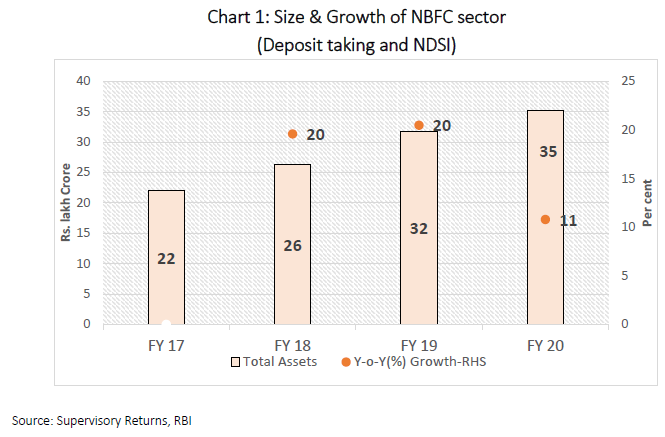
      Chart 1

      5. There is an increasingly complex web of inter-linkages of the sector with the banking sector, capital market and other financial sector entities, on both sides of the balance sheet. As such NBFCs, like other financial intermediaries, are increasingly exposed to counterparty, funding, market and asset concentration risks, even before the COVID-19 pandemic impacted financial markets and our lives.

      The Pandemic Effect

      6. In the aftermath of liquidity stress post IL&FS and DHFL events, the market funding conditions turned difficult for NBFCs. While NBFCs with better governance standards and better operating practices did well, others bore the brunt of the market forces. Smaller NBFCs and Microfinance Institutions (MFIs), who were contributing significantly to the last mile credit delivery, also got impacted as their funding sources got further squeezed. The Reserve Bank acted in a swift and proactive manner to improve access to funding and liquidity by its monetary policy and liquidity measures and resultantly, the cost of funds for NBFCs and HFCs has reduced substantially for all rating categories (Chart-2).
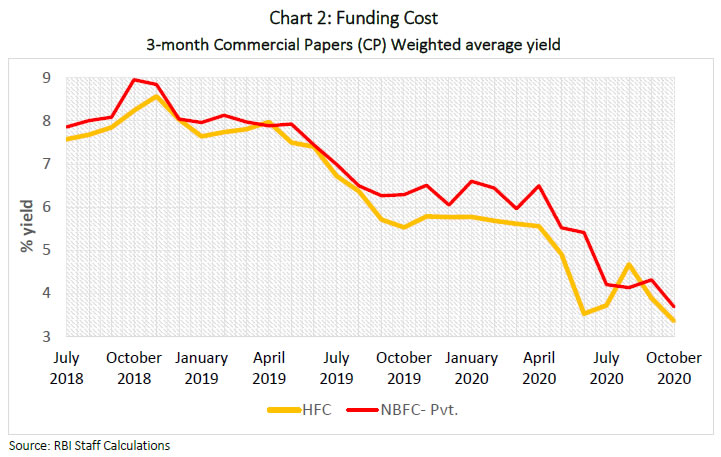
      Chart 2

      7. It is important to recognize that challenges faced by some of the NBFCs were reflective of inherent fragilities. As financial markets started differentiating between strong/well managed NBFCs and those having perceptible weaknesses, market discipline started to play out - entities with asset-liability mismatches or asset quality concerns faced constraints on market access. RBI, in response, took several calibrated steps to channel credit flow into the NBFC sector and improve the sector’s long-term resilience.

      8. As the sector was slowly inching towards normalcy (as can be seen from Table-1 below), the outbreak of COVID-19 and disruptions in economic activity due to lockdowns led to building up of huge stress in the financial system. While the entire financial system was affected, the impact was significantly greater on NBFCs due to their underlying business models, thereby straining their profitability.

      Table 1: Profitability of NBFC Sector (Deposit Taking and NDSI)
      (Amount in Rs. Crore)
      Profitability ParametersMarch 2017March 2018March 2019March 2020
      Net profit (Rs. Crore)31,92342,43417,46041,257
      Annualised RoA (%)1.51.60.61.2
      Annualised RoE (%)6.36.82.45.1
      Data source- Supervisory Returns, RBI

      The regulatory approach

      9. The regulatory approach of the Reserve Bank has adapted to the increase in complexity of the entities within the NBFC sector as well as the growing significance of NBFCs within the financial sector. The core principles of NBFCs regulation, however, has remained intact, i.e., - a) protection of depositors (in case of deposit-accepting companies) and customers; and, b) preserving financial stability. The varying emphasis on these objectives at different points in time has led RBI to deploy different policy tools as appropriate. We must recognise that NBFC regulation has undergone certain fundamental changes in recent years.

      10. Let me outline five of these most significant changes in brief -

      (i). First and foremost, in line with RBI’s emphasis on ownership-neutral regulations, Government owned NBFCs have been brought under the purview of prudential regulation since May 2018. Considering that Government owned NBFCs account for more than one-third of the sector, predominantly in infrastructure financing, this is a significant change.

      (ii). Second, considering the recent turmoil some NBFCs had to face because of liquidity stress, the criticality of sound liquidity risk management by NBFCs has been reinforced with the introduction of the liquidity risk management framework for NBFCs with asset size above ₹ 100 crore. All NBFCs, irrespective of size are encouraged to follow the framework. The guidelines emphasize the ‘Principles of Sound Liquidity Risk Management and Supervision’ published by Basel Committee on Banking Supervision. The framework expects the Boards of NBFCs to take an active role in the management of liquidity risk and deploy internal monitoring tools suitable to their business profile. More importantly, the regulations have devised a simplified and tailored Liquidity Coverage Ratio (LCR) meant for large NBFCs. It would prepare large NBFCs to effectively meet cash outflows even under severe liquidity stress scenarios over a 30-day horizon. No doubt, maintaining adequate high-quality liquidity assets would have repercussion on the overall yields of NBFCs, but the regulation is commensurate with the need to mitigate risks associated with maturity/liquidity transformation the NBFCs engage in.

      (iii). The third important development is in connection with FinTech based product delivery. It is now well recognised that non-banking financial sector would be a fertile ground for technology-based experimentation in financial products and services. Regulations have sought to create a conducive environment in this regard. For example, the timely introduction of guidelines for P2P lending platforms has ensured orderly growth of the segment anchored in high standards of prudence. Those have made lending platforms a neutral meeting place for lenders and borrowers and keeping them insulated from handling of funds involved in the underlying transactions. Regulations have brought down risks while creating the right environment for legitimate expansion of business opportunities. The ecosystem created under the Account Aggregator (AA) framework is yet another example of proactive regulation in the technology-intense activities. The AA framework has ushered in the required framework for safe, secure and consent-based sharing of information on financial assets of a customer. The critical regulatory aspect to be noted here is that the Account Aggregator does not store or view the data passing through it, thereby leaving no scope for any perverse incentive to abuse/ misuse the financial data. Let me also emphasize that the RBI has been flexible in according registered NBFCs to be completely app-based in financial intermediation.

      (iv). The RBI revised the regulatory framework under the principles of proportionality for Core Investment Companies (CICs) with transparency and disclosures being the focus of the revised regulations. The learnings from failure of a large NBFC - a Core Investment Company prompted this regulatory renovation. Large aggregate leverage at the group level aided by complex, multi-layered ownership structures were found to be nurturing the seeds of financial instability and vulnerability. Further, the aggregate risk view was missing at the holding company level. The revised regulatory framework tries to plug regulatory gaps in critical areas in respect of CICs.

      (v). Taking over the regulation of Housing Finance Companies (HFCs) is yet another significant move. Changes in the regulatory framework of HFCs have been issued after wide public consultations. The idea is to treat HFCs as a category of NBFC and bring about harmonisation of regulations while allowing HFCs to maintain their unique characteristics and allow them to transition to the revised regulations over a period of time, that is in a gradual manner, to make it least disruptive for the rest of the financial sector.

      11. With the growth in size and interconnectedness, NBFCs have increasingly become systemically significant and the prudential regulations for NBFC sector have evolved to give greater focus to the theme of financial stability. However, let’s not forget that regulation-light structure of NBFCs has enabled the flexibility enjoyed by them. This flexibility is the primary advantage of NBFCs over banks, enabling them to serve the last mile of financial intermediation. Therefore, it is imperative to strike a balance between regulating the NBFCs more tightly and the need to provide them the required flexibility. This will remain the cornerstone while we imagine the future of regulation for NBFCs.

      The Future

      Principle of Proportionality

      12. There is a view that any regulatory framework would ideally be designed according to the principle of proportionality. By extension, the spill-over of risks from a systematically important NBFC capable of transmitting perceptible impact on financial stability, must be dealt with in a proportionate manner. So, NBFCs with significant externalities and which contribute substantially to systemic risks must be identified and subjected to a higher degree of regulation. One can also argue that the design of prudential regulatory framework for such NBFCs can be comparable with banks so that beyond a point of criticality to systemic risks, such NBFC should have incentives either to convert into a commercial bank or scale down their network externalities within the financial system. This would make the financial sector sound and resilient while allowing a majority of NBFCs to continue under the regulation-light structure.

      13. Within the proportionality paradigm, one must deal with entities which neither belong to the critical ones in terms of systemic risk nor are they too small in their scale and complexity. These NBFCs currently enjoy great degree of regulatory arbitrage vis-à-vis banks. As a group, these entities can contribute to build-up of systemic risks because of the regulatory arbitrage enjoyed by them; hence there is a need to recalibrate the regulations.

      14. While dealing with proportionality principle, let me also touch upon the regulation of microfinance sector as well. We all are aware of the circumstances under which the regulatory framework for NBFC-MFIs was framed. Much water has flown under the bridge since then. Several large MFIs have converted into Small Finance Banks. The share of NBFC-MFIs in the overall microfinance sector has come down to a little over 30 per cent. Today we are in a situation, where the regulatory rigour is applicable only to a small part of the microfinance sector. There is a need to re-prioritise the regulatory tools in the microfinance sector so that our regulations are activity-based rather than entity-based. After all, the core of microfinance regulation lies in customer/consumer protection.

      15. We need to strike the right balance between the degree of regulation and the need for flexibility – a critical issue I alluded to a while ago. We could perhaps consider a graded regulatory framework for NBFCs calibrated in relation to their contribution to systemic significance.

      Regulating the FinTech

      16. Let me shift focus to another contemporary area of interest. Although significant regulatory steps have been taken already in the FinTech, the dynamic nature of the FinTech focused NBFCs keeps throwing up new challenges. The NBFC sector has been in the forefront in adopting innovative fintech-led delivery of products and services which are transforming the way one can imagine access to and interaction with these services. The advance technological solutions such as Big Data Analytics and Artificial Intelligence are being adopted by a large number of players to extend credit in an efficient manner over digital platforms. The Reserve Bank has been on the forefront of creating an enabling environment for growth of digital technology for new financial products and services. In fact, in the non-banking space, the RBI has been ahead of the curve and has come out with regulations for new products and services when the industry itself was at nascent stage. Peer to peer (P2P) lending, Account Aggregator (AA), and credit intermediation over “only digital platform” are case in point where the regulations have helped the industry to grow in a systematic and robust manner. While making regulation for the future in FinTech area, orderly growth and customer protection and data security will remain the guiding principles for the RBI.

      Ensuring transparency and governance

      17. Ensuring good corporate governance in NBFCs is at the core of any regulatory change. This is not an easy objective to meet, as good governance is essentially an aspirational achievement for an entity and it can seldom be founded only on regulatory prescriptions. Good governance would be a natural outcome if promoters/owners and senior management are fundamentally ‘fit and proper’. It is extremely critical that appropriate filtering mechanisms are in place to allow only the genuine and able promoters to start the business of NBFCs. After all, by issuing Certificate of Registration to new NBFCs, we provide them with the regulatory mandate to access public funds multiple times their net worth. Besides, it is necessary that NBFCs do not become conduits in money laundering and terrorist financing in any manner. While the current mechanism within RBI focuses on the above objective for companies seeking registration, there is a need to extend similar rigour of due diligence whenever there is a change in ownership/ control in an existing NBFC.

      Consumer protection and fair conduct

      18. A consumer of financial services provided by any regulated entity, whether a bank or NBFC, nurtures similar expectation of fair treatment and avenues for grievance redressal. Extension of the scheme of ombudsman to the NBFC sector is certainly a move in this direction. A transparent and self-disciplining mechanism has to be imagined for the future where the changing business models and newer credit delivery mechanisms do not deviate from the objective of fair treatment of the customer.

      Conclusions

      19. The Global Financial Crisis was primarily attributed to feather-touch regulatory approach, ignoring of the liquidity risks by financial intermediaries and unabated financial innovation. Abundant Liquidity, light touch regulation and financial innovation has also aided the growth of the NBFCs. The financial system today is significantly different from what it was at the outset of the financial crisis more than a decade ago. Regulatory reforms implemented in response to that crisis in India and globally, changes in technology and, more importantly, the growth of NBFCs have contributed to this dynamic landscape. The NBFC sector has become extremely diverse. The business model, customer profile and nature of financial products vary substantially depending on the category of the NBFC. The uniqueness of this sector lies in the inherent diversity of activities carried out by different NBFCs and thus, there can be no ‘one-size-fits-all’ prescription in the regulatory approach for NBFCs. Perhaps a calibrated and graded regulatory framework, proportionate to the systemic significance of entities concerned is the way forward.

      20. While on the one hand technological innovation and FinTech based delivery of financial services and products further the objective of improving access of financial products to the members of public, on the other, they push the regulator to recalibrate regulatory interventions to achieve the objective of consumer protection and financial stability. The regulatory challenges in marrying these diverse and sometimes conflicting objectives are many, but clarity of purpose would help us make the right policy choices.

      As I conclude, I pray that all of you and your family members stay safe in this long-drawn battle against the pandemic. Let me also wish you a happy and safe Deepawali.

      Thank You.

      -----

      1 Shri M. Rajeshwar Rao, Deputy Governor, Reserve Bank of India - speech delivered at the ‘National E-Summit on Non-Banking Finance Companies’ organized by ASSOCHAM on November 6, 2020. The inputs provided by Shri Manoranjan Mishra, Shri Chandan Kumar and Shri Pradeep Kumar are gratefully acknowledged.

      2 Report on Trend and Progress of Banking in India, RBI (2010 & 2019)

      3 Asset size of NBFCs (deposit taking, NDSI, non NDSI) – ₹ 37,38,162 crore. Asset size of Housing Finance Companies (HFCs) – ₹ 14.09 lakh crore

      4 Financial Stability Report, RBI, July 2020

      Topics

      ActsIncome Tax
