

Loading...

Top
Help
×

By creating an account you can:

Logo TaxTMI
Call Us / Help / Feedback

Contact Us At :

E-mail: [email protected]

Call / WhatsApp at: +91 99117 96707

For more information, Check Contact Us

FAQs :

To know Frequently Asked Questions, Check FAQs

Most Asked Video Tutorials :

For more tutorials, Check Video Tutorials

Submit Feedback/Suggestion :

Email :
Please provide your email address so we can follow up on your feedback.
Category :
Description :
Min 15 characters 0/2000
Make Most of Text Search
  1. Checkout this video tutorial: How to search effectively on TaxTMI.
  2. Put words in double quotes for exact word search, eg: "income tax"
  3. Avoid noise words such as : 'and, of, the, a'
  4. Sort by Relevance to get the most relevant document.
  5. Press Enter to add multiple terms/multiple phrases, and then click on Search to Search.
  6. Text Search
  7. The system will try to fetch results that contains ALL your words.
  8. Once you add keywords, you'll see a new 'Search In' filter that makes your results even more precise.
  9. Text Search
Add to...
You have not created any category. Kindly create one to bookmark this item!
Create New Category
Hide
Title :
Description :
❮❮ Hide
Default View
Expand ❯❯
Close ✕
🔎 News - Adv. Search
TEXT SEARCH:

Press 'Enter' to add multiple search terms. Rules for Better Search

Search In:
Main Text + AI Text
  • Main Text
  • Main Text + AI Text
  • AI Text
Category: ?
Categorized by AI
---- All Categories ----
  • ---- All Categories ----
  • Income Tax
  • GST
  • Customs, DGFT & SEZ
  • FEMA & RBI
  • Corp. Laws, SEBI & IBC
  • PMLA, Black Money & ED
  • Budget
  • News and Press Release
  • PTI News
Month:
---- All Months ----
  • ---- All Months ----
  • January
  • February
  • March
  • April
  • May
  • June
  • July
  • August
  • September
  • October
  • November
  • December
Year:
---- All Years ----
  • ---- All Years ----
  • 2026
  • 2025
  • 2024
  • 2023
  • 2022
  • 2021
  • 2020
  • 2019
  • 2018
  • 2017
  • 2016
  • 2015
  • 2014
  • 2013
  • 2012
  • 2011
Sort By: ?
In Sort By 'Default', exact matches for text search are shown at the top, followed by the remaining results in their regular order.
Relevance Default Date
    Lokta Opens Its Agentic Loan Servicing Platform to NBFCs Up to Rs 100 crore, with No Platform Fee for Up to Two Years
    RTI seeks Aadhaar date-of-birth changes after pre-poll Bihar pension hike; UIDAI says no such data
    IC Electricals Secures Approx. ₹6 Crore Railway Orders and ₹1 Crore Export Order
    Additional Information related to GDP Estimates Received After Release of Q1 Estimates of FY 2026-27
    Union Minister of Commerce & Industry Shri Piyush Goyal Chairs CEO Roundtable on Ease of Doing Business for Scaling India’s Data Centre Ecosystem
    India–Afghanistan Joint Working Group on Trade Holds Virtual Meeting; Reviews Measures to Strengthen Bilateral Trade and Economic Cooperation
    PM Surya Ghar Yojana 2026: How to Get Rs 78,000 Solar Subsidy & Cut Your Electricity Bill
    Japan's JCR upgrades India's sovereign rating to 'A-', cites solid growth, improved financial system
    In personal insolvency case before NCLAT, Subhash Chandra opposes formation of 5-member NCLT bench
    GoCredit Launches Free Loan App Checker to Verify If a Lending App Is Real, Fake or RBI Registered
    Rupee falls 2 paise to 94.97 against US dollar in early trade
    Senior bureaucrats attend IICA’s ‘weekend wisdom’ program initiave
    NLMC to Facilitate E-Auction of 459 RINL Land Parcels in Visakhapatnam
    CCI approves acquisition of Aseem Infrastructure Finance Limited by TPG Nicobar SG Pte. Ltd. and related transactions
    CCI approves acquisition of up to 100% equity shareholding of Apollo Fertility Centre (AFCPL) and Apollo Specialty Hospitals (ASHPL) by Kids Clinic In...
    ED arrests businessman in DMF-linked money laundering case
    Rupee gains 27 paise to close at 94.95 against US dollar
    India's CAD widens to USD 4.2 bn in Q1 amid West Asia conflict: RBI data
    Andhra commercial tax collections rise by 11 per cent in August to Rs 4,983 cr
❯❯
Maximize Maximize Maximize
0 / 200
Expand Note
Add to Folder

No Folders have been created

+

Are you sure you want to delete "My most important" ?

NOTE:

News
Showing Results for :
Reset Filters
Results Found:
Show All Summaries Hide All Summaries
September 2, 2026
Show AI Summary
NBFC loan servicing governance retains lender control through deterministic decision rules, maker-checker controls, reconciled migration and optional AI assistance.
Lokta Next 100 offers RBI-registered NBFCs with loan books up to Rs 100 crore post-approval loan servicing, accounting, reporting, analytics, collections, recovery and partner-management functions, excluding pure-play microfinance NBFCs. Credit, approval and money decisions remain with the lender. Maker-checker approval applies to every change, and migration requires line-by-line reconciliation before cutover. Records remain lender-owned, hosted in India and exportable. AI may propose changes but cannot post to the ledger; deterministic lender-policy rules decide changes. Platform fees are deferred for up to 24 months, subject to stated loan-book thresholds.
September 2, 2026
Show AI Summary
RTI access to maintained records does not require creation of Aadhaar date-of-birth update data on demand.
UIDAI did not maintain separate Aadhaar data on date-of-birth updates in Bihar following the announced social security pension enhancement, including month-wise or district-wise compilations. No internal review or flagging of unusual update patterns was available or applicable in its records. The Central Information Commission clarified that the RTI framework does not require a public authority to create, compile or generate information that it does not maintain in the form requested. The initial CPIO response treating the information as outside the RTI Act was considered inappropriate.
September 2, 2026
Show AI Summary
Transgender arrest and detention safeguards prompt calls for a standard operating procedure and clearer procedural protections.
Legal and regulatory issues include safeguards for arrest and detention of transgender persons, consultation requirements in Bar Council policy-making, and procedural accountability in electoral administration and policing. Personal insolvency proceedings raise questions about tribunal powers to constitute an expanded bench. Hospitality operators are expected to comply strictly with food-safety and hygiene norms. Proposed restrictions on minors' social-media accounts address cyberbullying, online exploitation, and harmful screen exposure.
September 2, 2026
Show AI Summary
Railway equipment purchase orders and export order expand IC Electricals' domestic and international business pipeline.
IC Electricals Company Limited has secured railway purchase orders for electrical and electronic supplies and an export order, creating combined order inflow across domestic railway operations and international markets. Its product portfolio includes regulators, battery chargers, emergency lights, inverters, microprocessor-based control systems, alternators, traction motors, and permanent magnet alternators with controllers. Forward-looking statements on business plans, projects, and research and development remain subject to risks and uncertainties and may differ materially from actual results.
September 2, 2026
Show AI Summary
Double deflation explains negative manufacturing GVA deflators when input prices rise faster than output prices.
Double deflation in manufacturing separately deflates gross output and intermediate consumption, with real GVA derived from their difference. Where input prices rise faster than output prices, nominal GVA may grow more slowly than real GVA, producing a negative implicit GVA deflator despite rising output and input prices. A negative manufacturing GVA deflator therefore does not establish a fall in manufactured-product prices or lower real growth. The implicit GDP deflator is a derived ratio between current-price and constant-price GDP and differs from CPI and WPI because of their distinct coverage, weights, and price concepts.
September 2, 2026
Show AI Summary
Data centre ease-of-doing-business reforms target reliable power, prepared land, streamlined approvals and building standards for faster infrastructure deployment.
Ease-of-doing-business reforms for India's data-centre ecosystem focus on faster and sustainable infrastructure deployment through reliable power, ready-to-use land, streamlined approvals and suitable building regulations. Proposed power measures include cluster-based transmission planning, first-day sanctioned load, dual feeders and cross-border renewable-energy procurement. Data-centre-ready land banks and power-ready parcels are intended to reduce development timelines. The National Building Code 2026 recognises data centres under Group E and contains a dedicated annex on fire-risk assessment and data-centre-specific performance indicators.
September 2, 2026
Show AI Summary
Trade facilitation and customs cooperation drive follow-up action on connectivity, regulatory coordination, investment promotion and bilateral commercial engagement.
India-Afghanistan bilateral trade and economic cooperation is being advanced through institutional engagement on trade facilitation, customs cooperation, connectivity, investment and commercial exchange. Priority areas include customs and data-sharing cooperation, visa facilitation for traders, banking and financial cooperation, pharmaceutical and agricultural trade, energy cooperation, tariff concessions, cargo connectivity and port-related matters. Follow-up action covers regulatory cooperation, improved connectivity, investment promotion and business-to-business engagement.
September 2, 2026
Show AI Summary
Residential rooftop solar subsidy requires eligibility, prior approval, registered installation, net metering, commissioning, and verified bank details for direct transfer.
PM Surya Ghar Muft Bijli Yojana provides central financial assistance for eligible grid-connected residential rooftop solar systems, capped at Rs. 78,000 for systems of three kilowatts or more. Applicants must be Indian citizens who own a suitable house, hold a valid electricity connection, and have not received an earlier solar-panel subsidy. Applications require portal registration, distribution-company feasibility approval, installation through a registered vendor, net metering, inspection, commissioning and submission of bank details. Assistance is transferred directly after verification. State-specific net-metering procedures, approvals and additional incentives may apply.
September 2, 2026
Show AI Summary
Sovereign credit rating upgrade reflects solid growth, stronger financial systems, and improving fiscal and external resilience.
JCR upgrades India's foreign-currency and local-currency long-term issuer ratings to A- with a stable outlook, citing sustained economic growth, productivity-oriented policies and improved financial-system soundness. Fiscal constraints include elevated deficits, intergovernmental fiscal transfers, electoral-cycle sensitivity, and high combined government debt and interest burdens. Greater emphasis on infrastructure capital expenditure has improved the quality of fiscal spending. External resilience is supported by a contained current account deficit, services surplus and foreign-exchange reserves exceeding short-term external debt.
September 2, 2026
Show AI Summary
Personal insolvency bench constitution and repayment-plan eligibility remain contested where a larger tribunal bench stays a third-member order.
Personal insolvency proceedings raised a challenge to the National Company Law Tribunal's authority to constitute a five-member bench after a split verdict. The challenge contended that the mechanism for differing views permits reference to another member or members, but does not authorise a five-member bench. The larger bench stayed the third member's order, restricted asset alienation, and suspended an order permitting settlement of personal-guarantee claims. The dispute concerned the validity of that bench, the split-verdict reference procedure, repayment-plan eligibility, and pending creditor appeals.
September 2, 2026
Show AI Summary
Digital lending app verification enables borrowers to identify regulated lenders, grievance channels, and warning signs before accepting loans.
GoCredit's Loan App Checker allows borrowers to search lending apps against the public Digital Lending App directory and identify the regulated lender, grievance contact and RBI Ombudsman escalation route where a match exists. Regulatory reporting by regulated entities enables app-level verification, while borrowers should also check the lender named in app disclosures and loan agreements. A directory listing is a regulated-entity disclosure, not RBI approval or endorsement. Unmatched apps should be assessed through verification steps and reported through official channels where appropriate.
September 2, 2026
Show AI Summary
Rupee depreciation in early trade reflected oil-price pressures, risk aversion, higher Treasury yields and broad dollar strength.
Early foreign-exchange trading saw the rupee weaken against the US dollar amid renewed US-Iran tensions, risk aversion, higher Brent crude prices, and a stronger dollar. Safe-haven demand, inflation concerns linked to potential oil-supply disruption, expectations of a September Federal Reserve rate increase, and higher US Treasury yields supported the broad dollar rally. RBI monitoring of the rupee's decline was noted.
September 2, 2026
Show AI Summary
Responsible AI governance requires ethical safeguards, privacy protection, accountability and adaptive oversight to build lasting corporate stakeholder trust.
Responsible artificial intelligence governance requires continuous innovation, inclusive development, responsible deployment and trust-based governance. AI systems should be ethical, safe, transparent, fair and human-centric, with safeguards for privacy, bias, security and accountability. Proportionate and adaptive regulation should provide clear accountability, standards, monitoring, auditability and grievance redressal. Good governance, cybersecurity, personal data protection and responsible AI together strengthen organisational resilience, stakeholder trust, transparency and sustainable innovation.
September 2, 2026
Show AI Summary
E-auction of surplus public land enables transparent outright sale of RINL parcels through registered, KYC-verified bidding.
National Land Monetization Corporation will facilitate the e-auction and outright sale of 459 encumbrance-free RINL land parcels, including residential plots and parcels suited for commercial and logistics use. Competitive bidding will occur through the RailTel E-Nivida e-procurement platform. Participation requires online registration, KYC verification, and plot-wise submission of an earnest money deposit within prescribed timelines. The process supports transparent monetisation of surplus land and non-core public assets.
September 2, 2026
Show AI Summary
Competition approval for infrastructure finance restructuring covers acquisition, minority transfer, investment divestment, and merger of regulated NBFCs.
Competition Commission of India approval applies to the acquisition of Aseem Infrastructure Finance Limited by TPG Nicobar SG Pte. Ltd., a subsequent minority share acquisition by ICICI Bank Limited, and Aseem's divestment of its shareholding in NIIF Infrastructure Finance Limited to National Investment and Infrastructure Fund II. Following the acquisition, Climate Finance India Private Limited is intended to merge into Aseem as the surviving entity. The entities involved include RBI-registered non-deposit taking NBFCs operating in infrastructure finance, investment and credit, and infrastructure debt financing.
September 2, 2026
Show AI Summary
Healthcare merger approval enables KCIL to acquire fertility and specialty hospital businesses alongside related equity issuances and investment.
Competition Commission approval covers KCIL's acquisition of up to 100% equity shareholding in AFCPL and 100% equity shareholding in ASHPL. The combination includes KCIL issuing equity shares and optionally convertible debentures to AHLL, representing 9.9% fully diluted shareholding as partial consideration, together with a further KCIL equity investment by Arvon Investments Pte. Ltd. KCIL operates mother and baby care hospitals, while AFCPL provides assisted reproductive treatment and reproductive-medicine services.
September 1, 2026
Show AI Summary
Money-laundering investigation into alleged District Mineral Fund diversion examines purported liaison activity and asset acquisition through proceeds of crime.
Money-laundering proceedings under the Prevention of Money Laundering Act concern alleged diversion of District Mineral Fund resources through the Chhattisgarh Seed Corporation. The investigation alleges siphoning of public funds by contractors in collusion with government officials and political executives. A businessman was identified as an alleged liaisoner and financial coordinator between public servants, district authorities and private vendors. Allegations also include receipt of commissions, acquisition of immovable assets from purported proceeds of crime, non-production of records, and contradictory statements during questioning.
September 1, 2026
Show AI Summary
Foreign exchange market dynamics: rupee appreciation reflected portfolio inflows, domestic growth, and possible central-bank intervention amid external pressures.
The rupee appreciated against the US dollar, supported by domestic growth, controlled fiscal slippage, portfolio-related inflows and possible Reserve Bank of India intervention. Its gains were limited by weak equity markets, rising crude oil prices and a stronger dollar. External geopolitical tensions and hawkish US monetary signals remained potential pressures. Domestic indicators showed strong economic activity, while the current account deficit widened because of a higher merchandise trade deficit. Foreign portfolio inflows continued despite investors remaining net sellers during the year.
September 1, 2026
Show AI Summary
Current account deficit widened as merchandise trade deficit increased, notwithstanding stronger services receipts, remittances, and foreign direct investment inflows.
India's current account deficit widened in the first quarter of 2026-27 as the merchandise trade deficit increased. Higher net services receipts, increased personal transfer receipts and lower net primary-income outgo partly supported the external account. Financial-account movements included higher net foreign direct investment inflows, a shift in foreign portfolio investment from net inflow to net outflow, and lower net inflows through non-resident deposits and external commercial borrowings. Foreign exchange reserves declined on a balance-of-payments basis during the quarter.
September 1, 2026
Show AI Summary
Technology-enabled tax compliance and enforcement supported higher commercial tax collections, while GST rate reductions moderated sectoral net GST growth.
Technology-enabled tax administration supported commercial tax and net GST collection growth in Andhra Pradesh during August 2026 and the cumulative period through August. AI-based analytics and scrutiny, IGST reversals, UPI-based enforcement, registration verification, Aadhaar authentication, digital payment enablement, predictive analytics and data sharing strengthened compliance, scrutiny and revenue mobilisation. Petroleum VAT, professional tax, liquor VAT and IGST settlement also increased, while GST rate reductions moderated net GST performance in specified product sectors.

News

Back

All News

Showing Results for :
Reset Filters
No Records Found

News

Showing Results for : Reset Filters

Finance Minister unveils Doorstep Banking Services and declares EASE 2.0 Index Results

September 10, 2020

Contents
Summary
Note

Note

-

Bookmark

Print

Print

Union Minister of Finance & Corporate Affairs Smt. Nirmala Sitharaman inaugurated Doorstep Banking Services by PSBs and participated in the awards ceremony to felicitate best performing banks on EASE Banking Reforms Index.

Secretary, Department of Financial Services Shri Debasish Panda and Chairman IBA, Shri Rajnish Kumar,were also present at the virtual event.

Doorstep Banking Services by PSBs

As part of the EASE Reforms, Doorstep Banking Services is envisaged to provide convenience of banking services to the customers at their door step through the universal touch points of Call Centre, Web Portal or Mobile App.  Customers canalso track their service request through these channels.

The services shall be rendered by the Doorstep Banking Agents deployed by the selected Service Providers at 100 centres across the country. 

At present only non-financial services viz. Pick up of negotiable instruments (cheque / demand draft / pay order, etc.), Pick up new cheque book requisition slip, Pick up of 15G / 15H forms, Pick up of IT / GST challan, Issue request for standing instructions, Request for account statement, Delivery of non-personalised cheque book, demand draft, pay order, Delivery of term deposit receipt, acknowledgement, etc., Delivery of TDS / Form 16 certificate issuance, Delivery of pre-paid instrument / gift card  are available to customers.  Financial services shall be made available from October 2020.

The services can be availed by customers of Public Sector Banks at nominal charges. The services shall benefit all customers, particularly Senior Citizens and Divyangs who would find it at ease to avail these services. 

Performance of PSB on EASE 2.0 Index

A common reform agenda for PSBs, EASE Agenda is aimed at institutionalizing clean and smart banking. It was launched in January 2018, and the subsequent edition of the program ― EASE 2.0 built on the foundation laid in EASE 1.0 and furthered the progress on reforms. Reform Action Points in EASE 2.0 aimed at making the reforms journey irreversible, strengthening processes and systems, and driving outcomes.

PSBs have shown a healthy trajectory in their performance over fourquarters since the launch of EASE 2.0 Reforms Agenda. The overall score of PSBs increased by 37% between March-2019 and March-2020, with the average EASE index score improving from 49.2 to 67.4 out of 100. Significant progress is seen across six themes of the Reforms Agenda, with the highest improvement seen in the themes of‘Responsible Banking’, ‘Governance and HR’, ‘PSBs as Udyamimitra for MSMEs’, and ‘Credit off-take’.
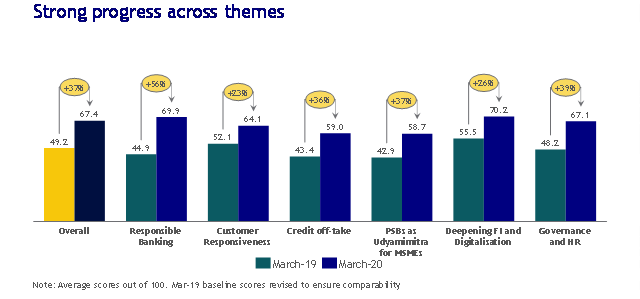
PSBs have adopted tech-enabled, smart banking in all areas, setting up retail and MSME Loan Management Systems for reduced loan turnaround time andPSBloansin59minutes.comandTReDS for digital lending. PSBs have instituted real-time visibility to retail and MSME customers on the status of their loans. Most branch-based services are now accessible from home and mobile, including in local languages.

EASE Reforms Index has equipped Boards and leadership for effective governance, instituted risk appetite frameworks, created technology- and data-driven risk assessment and prudential underwriting and pricing systems, introduced Early Warning Signals (EWS) systems and specialised monitoring for time-bound action in respect of stress, put in place focussed recovery arrangements, and established outcome-centric HR systems.

Bank of Baroda, State Bank of India, and erstwhile Oriental Bank of Commerce were felicitated for being the top three (in that order) in the ‘Top Performing Banks’ category according to the EASE 2.0 Index Results. Bank of Maharashtra, Central Bank of India &erstwhile Corporation Bank were awarded in the ‘Top Improvers’ category basis EASE 2.0 Index. Punjab National Bank, Union Bank of India, and Canara Bank were also recognized for outstanding performance in select themes.
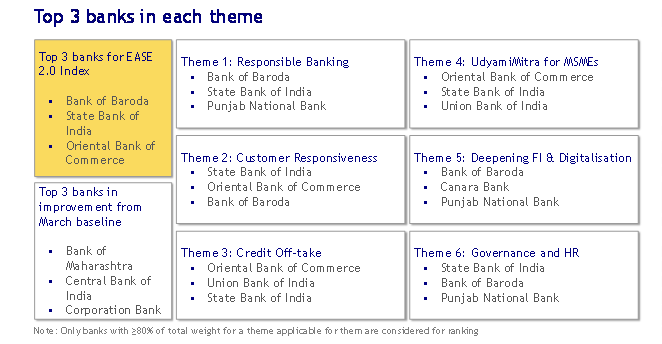
Major Reform achievements between March 2018 to March 2020

  • Most PSB customers now have access to 35+ services such as IMPS, NEFT, RTGS, intra-bank transfer, account statement, cheque book request on mobile/ Internet banking and23 services such as chequebook issuance, cheque status, issuance of form 16A, block/activate debit card on the call centre. The availability of services has nearly doubled over the last 24 months.
  • Nearly 4cractive customers on mobile and internet banking with 140% increase in financial transactions through mobile and internet banking channels and almost 50% of financial transactionsthrough digital channels.
  • Call centers now offer services in 13regional languagessuch as Telugu, Marathi, Kannada, Tamil, Malayalam, Gujarati, Bengali, Odia.
  • Complaint redressal average turnaround time reduced from the average of approximately 9 days to 5 days
  • 23 branch-equivalent services such as account opening, cash deposit, cash withdrawal, fund transfer made available by PSBs through Bank Mitras
  • PSBs have issued RuPay credit cards to nearly 23 crore basic savings account customers
  • Significant improvement in customer outreach through dedicated marketing force and external partnerships. The number of dedicated marketing employees has increased from 8,920 to 18,053.
  • Sourcing of retail and MSME loans through the dedicated salesforce and marketing tie-ups has increased nearly five times from 1.5 lakhs to 8.3 lakh loans
  • Turnaround time (weighted average) for retail loans reduced by 67% from the average of nearly 30 days to nearly 10 days
  • Cross-sell of non-banking financial products has made available bouquet of financial products to the customer
  • For prudential lending, PSBs are now systematically keeping watch on adherence to risk-based pricing, and cases with deviation have reduced from 59% to 20%, and have put in place data-driven risk-scoring for appraisal of high-value loans that factors in group-entities.
  • Most PSBs have deployed IT-based EWS systems leveraging third-party data, which have enabled early, time-bound action in stressed accounts. Monitoring has also been strengthened by deploying Agencies for Specialised Monitoring, and proactively monitoring listed entities based on published financials. Slippage into NPA has reduced from 3.90 lakh crore in 12-months ending March-18 to 1.45 lakh crorein 11-months ending February-20.
  • PSBs have adopted digital platforms such as online OTS, e-Bक्रय, e-DRT for expedited recovery. 88% of one-time settlement (OTS) cases are now tracked through dedicated IT systems.
  • PSBs have adopted new ways of credit, such as PSBloansin59minutes.com and Trade Receivables Discounting System (TReDS) for digital lending for MSMEs and retail. 73% of all PSB inland bills are now discounted through online TReDS.
  • The Government has introduced several governance reforms. The governance reforms include arm’s length selection of top bank management through Banks Board Bureau, introduction of non-executive chairpersons, broader talent pool for such selections, empowered bank Boards,  strengthening of the Board committees system, enhancing the effectiveness of non-official directors, and leadership development and succession planning for the top two levels below the Board. In larger PSBs, Executive Director strength has been increased, and Boards are empowered to introduce CGM level for increased business.

Like in the previous year, progress made by PSBs was tracked quarterly through a published EASE Reforms Index leading up to the annual review. In addition to the inclusion of the EASE Reforms Index in the evaluation of Whole Time Directors of PSBs, it has now been made part of the annual appraisal of PSB leadership up to two levels below the Whole Time Directors.

The Index measures the performance of each PSB on 120+objective metrics across six themes. It provides all PSBs a comparative evaluation showing where banks stand vis-à-vis benchmarks and peers on the Reforms Agenda. The Index follows a fully transparent scoring methodology, which enables banks to identify precisely their strengths as well as areas for improvement. The goal is to continue driving change by spurring healthy competition among PSBs and by encouraging them to learn from each other.

PSBs have stepped up to support the country during COVID-19

PSBs have massively stepped up to support the nation during the COVID-19 crisis. From different modes of staffing to remote working, 80,000+ bank branches were operational during COVID-19. Additionally, there has been 90% uptime of self-service machines during the COVID times andaroundthree times increase in Aadhaar Enabled Payment System (AEPS) transactions through micro ATMs, and enhanced doorstep banking support by 75,000+Bank Mitras. To further support the customers in these times, the banks have drastically increased the number of services being offered at the call centers, from 11 in March-19 to 23 as of June-20 in 13 regional languages.

PSBs way forward to Smart, Tech-enabled Banking for Aspiring India

A comprehensive agenda for smart, tech-enabled banking has been adopted for FY2020-21, under which PSBs have initiated eShishu Mudra for straight-through processing of loans to micro-enterprises and digital personal loan for customers. PSBs have started providing customer-need driven credit offers through analytics and partnerships with FinTechs and e-commerce companies.

Many PSBs have already started taking steps in line with the reform priorities. Progress of PSBs will continue to be tracked on metrics linked to Reform Action Points, and their progress will be published through a quarterly index.

Financial Health of the PSBsduring the EASE Reforms journey

Following the completion of recognition of legacy stress as NPA, PSBs have returned to profitability with sound financial health and institutionalised systems to prevent the recurrence of past weaknesses. The improved financial health of PSBs reflects in many parameters-

  • Gross NPAs reduced from ₹8.96 lakh crore in March-2018 to ₹6.78 lakh crore in March-2020;
  • A sharp decline in fraud occurrence from 0.65% of advances during FY10-FY14 to 0.06% in FY19-20; due to fraud prevention reforms and proactive checking of legacy NPA
  • Record recovery of 2.27 lakh crore in FY19-FY20 driven by newly setup dedicated stressed account management verticals in PSBs;
  • Asset quality has improved significantly, with the net NPA ratio reducing from 7.97% in March 2018 to 3.75% in March 2020
  • Number of PSBs under PCA down to three;
  • CRAR 197 bps above the regulatory minimum; and
  • The highest provision coverage ratio of 80.9% in eight years.

Link for Doorstep Banking Services and Declaration of EASE 2.0 Index Results: https://www.iba.org.in/events/past-events/launch-of-dsb-and-declaration-of-ease-2-0-index-results_972.htmlor https://www.iba.org.in

Topics

Acts Income Tax
