Political contribution deductions require genuine transactions; banking records and party registration alone cannot defeat evidence of accommodation e...
Post-death GST liability permits fresh proceedings against legal representatives, while discontinued-business recovery remains limited to the inherite...
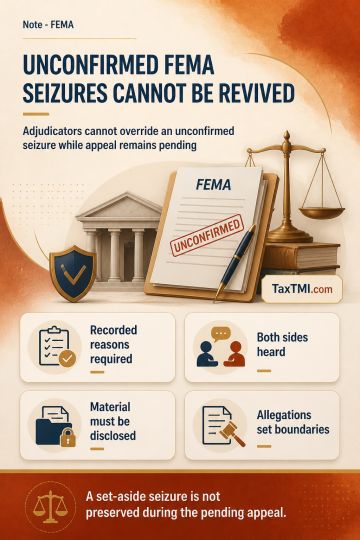
Non-confirmation of FEMA seizure prevents adjudicators from overriding pending appellate findings on recorded reasons and suspected foreign asset hold...
ITAT held that payments received by the taxpayer from its Indian affiliate and a third-party advisor do not constitute "royalty" under Article 13(2) of the India-UK DTAA and, accordingly, are not taxable in India under section 9(1)(vi). The Tribunal further determined there is no dependent agent permanent establishment (DAPE) in India: the Assessing Officer failed to discharge the burden of proving the Article 5(4) conditions (authority to conclude contracts, maintenance of stock, habitual order securing on behalf of the taxpayer), and the transfer-pricing finding that intercompany transactions were at arm's length remained uncontroverted. Prior ITAT decisions for earlier years were followed in favor of the taxpayer.
ITAT held that payments received by the taxpayer from its Indian affiliate and a third-party advisor do not constitute "royalty" under Article 13(2) of the India-UK DTAA and, accordingly, are not taxable in India under section 9(1)(vi). The Tribunal further determined there is no dependent agent permanent establishment (DAPE) in India: the Assessing Officer failed to discharge the burden of proving the Article 5(4) conditions (authority to conclude contracts, maintenance of stock, habitual order securing on behalf of the taxpayer), and the transfer-pricing finding that intercompany transactions were at arm's length remained uncontroverted. Prior ITAT decisions for earlier years were followed in favor of the taxpayer.
Note: It is a system-generated summary and is for quick reference only.
 TaxTMI
  TaxTMI