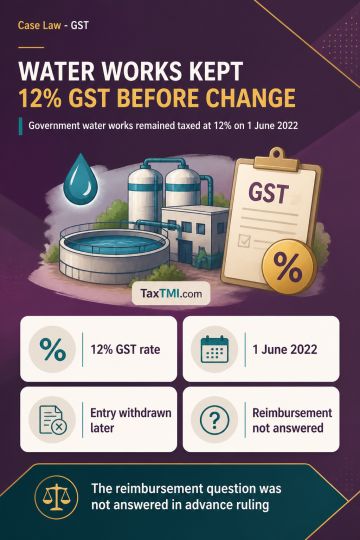
Government water works contract GST concession applied before its withdrawal, while contractual tax reimbursement claims lay outside advance-ruling sc...
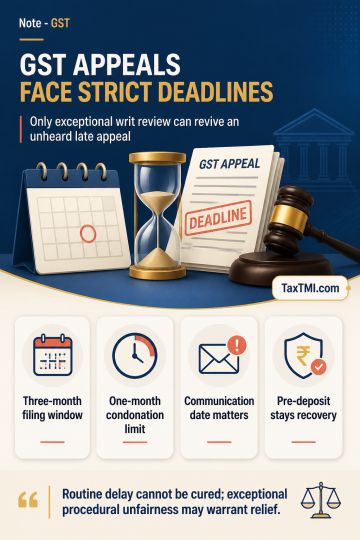
The HC dismissed the writ petition filed beyond the prescribed limitation period under Section 107(1) of the GST Act, declining to exercise jurisdiction under Articles 226 and 227. The petition challenged the disallowance of ITC on grounds that the supplier failed to discharge tax liability by filing GSTR-3B returns for supplies made during August to November 2019. The court held that the Assessing Authority's demand, based on examination of records under Section 74, was proper. Questions regarding the recipient's entitlement to ITC despite the supplier's non-compliance are factual and legal issues reserved for the appellate authority under Section 107, which is empowered to reappreciate evidence. The petitioner was permitted to pursue remedy before the appellate forum, and the court clarified that discussion of facts was not an opinion on merits. The petition was accordingly disposed of.
The HC dismissed the writ petition filed beyond the prescribed limitation period under Section 107(1) of the GST Act, declining to exercise jurisdiction under Articles 226 and 227. The petition challenged the disallowance of ITC on grounds that the supplier failed to discharge tax liability by filing GSTR-3B returns for supplies made during August to November 2019. The court held that the Assessing Authority's demand, based on examination of records under Section 74, was proper. Questions regarding the recipient's entitlement to ITC despite the supplier's non-compliance are factual and legal issues reserved for the appellate authority under Section 107, which is empowered to reappreciate evidence. The petitioner was permitted to pursue remedy before the appellate forum, and the court clarified that discussion of facts was not an opinion on merits. The petition was accordingly disposed of.
Note: It is a system-generated summary and is for quick reference only.
 TaxTMI
  TaxTMI