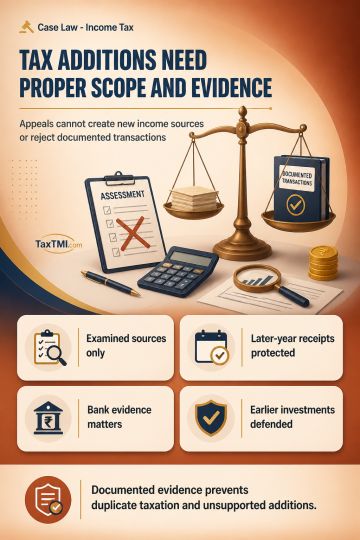
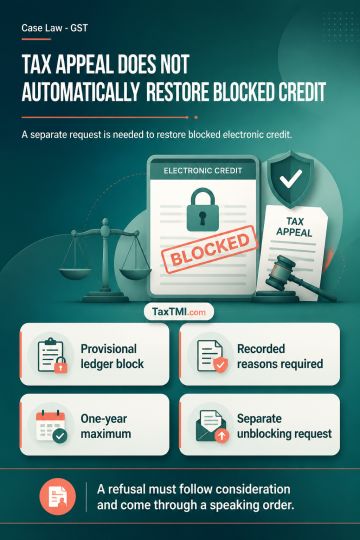
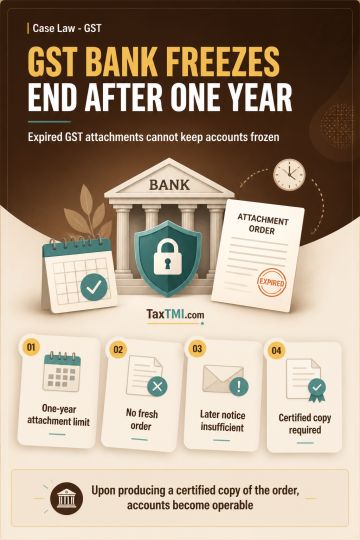
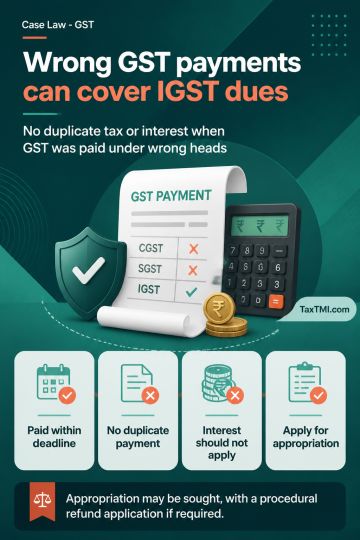
Appellate enhancement limits protect against new income sources, while documented credits and prior-year investments resist unexplained-income additio...
Capital-gains exemption for charitable trusts extends to qualifying fixed deposits, while unrecoverable TDS write-offs may constitute income applicati...
Page of 4868
Press 'Enter' after typing page number.
1 to 20 of 97344 Results
❮
❯
❯❯
0 / 200
Expand Note
Add to Folder
No Folders have been created
+
Are you sure you want to delete "My most important" ?
HC adjudicated a challenge to a SCN under Section 74 of CGST Act, 2017, primarily contesting non-compliance with Rule 142 of CGST Rules. The petitioners argued that the SCN was issued without jurisdictional validity, as no tax evasion was alleged, and the notice was not electronically uploaded. The court found a prima facie case in the petitioners' favor, noting that the subsequent final order issued on 21.01.2025 was potentially non-est due to procedural irregularities. Applying the legal maxim "sublato fundamento cadit opus", the HC admitted the petitions and stayed the operation of the impugned order pending final adjudication, emphasizing that procedural non-compliance could invalidate subsequent proceedings.
HC adjudicated a challenge to a SCN under Section 74 of CGST Act, 2017, primarily contesting non-compliance with Rule 142 of CGST Rules. The petitioners argued that the SCN was issued without jurisdictional validity, as no tax evasion was alleged, and the notice was not electronically uploaded. The court found a prima facie case in the petitioners' favor, noting that the subsequent final order issued on 21.01.2025 was potentially non-est due to procedural irregularities. Applying the legal maxim "sublato fundamento cadit opus", the HC admitted the petitions and stayed the operation of the impugned order pending final adjudication, emphasizing that procedural non-compliance could invalidate subsequent proceedings.
Note: It is a system-generated summary and is for quick reference only.
 TaxTMI
  TaxTMI