Political contribution deductions require genuine transactions; banking records and party registration alone cannot defeat evidence of accommodation e...
Post-death GST liability permits fresh proceedings against legal representatives, while discontinued-business recovery remains limited to the inherite...
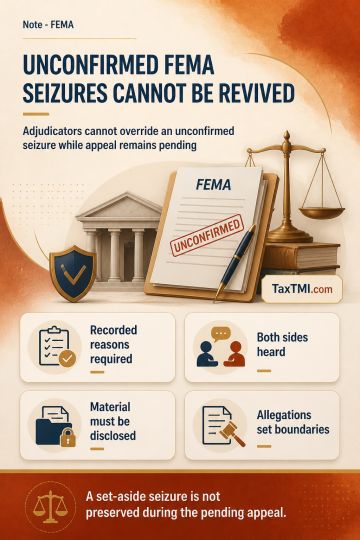
Non-confirmation of FEMA seizure prevents adjudicators from overriding pending appellate findings on recorded reasons and suspected foreign asset hold...
The assessee was allowed deduction u/s 54/54F without proper examination of relevant details and materials. The Assessing Officer (AO) framed the assessment u/s 143(3) after considering the details of assets sold and cost of acquisition, allowing the deduction u/s 54F. The assessee furnished investment details and bills/vouchers in response to the notice u/s 142(1). The AO/NFAC, after examining the relevant details, concluded on the allowability of deduction u/s 54F. The Principal Commissioner of Income Tax (PCIT) noted that the assessee furnished investment details of a huge amount, out of which deduction was claimed without specifying the expenses against which Section 54F deduction was claimed. However, it cannot be said that there was no enquiry or inadequate enquiry regarding the Section 54F exemption. The notice u/s 263 issued by the PCIT was vague and aimed at making deeper enquiry and re-considering the evidence already on record, claiming fresh facts emerged subsequent to the assessment order, which was factually incorrect and untenable. The conditions enabling the PCIT to invoke jurisdiction u/s 263 were not satisfied. The PCIT's discretionary power u/s 263 cannot be assumed arbitrarily, and something should be brought on record to show the error and prejudice to revenue caused by.
The assessee was allowed deduction u/s 54/54F without proper examination of relevant details and materials. The Assessing Officer (AO) framed the assessment u/s 143(3) after considering the details of assets sold and cost of acquisition, allowing the deduction u/s 54F. The assessee furnished investment details and bills/vouchers in response to the notice u/s 142(1). The AO/NFAC, after examining the relevant details, concluded on the allowability of deduction u/s 54F. The Principal Commissioner of Income Tax (PCIT) noted that the assessee furnished investment details of a huge amount, out of which deduction was claimed without specifying the expenses against which Section 54F deduction was claimed. However, it cannot be said that there was no enquiry or inadequate enquiry regarding the Section 54F exemption. The notice u/s 263 issued by the PCIT was vague and aimed at making deeper enquiry and re-considering the evidence already on record, claiming fresh facts emerged subsequent to the assessment order, which was factually incorrect and untenable. The conditions enabling the PCIT to invoke jurisdiction u/s 263 were not satisfied. The PCIT's discretionary power u/s 263 cannot be assumed arbitrarily, and something should be brought on record to show the error and prejudice to revenue caused by.
Note: It is a system-generated summary and is for quick reference only.
 TaxTMI
  TaxTMI