Personal liberty safeguards restrict arrest after court-directed GST appearance, requiring interim release where authorities overreach pending proceed...
Alternative statutory remedy and delay bar GST writ challenges despite pending rectification, while distinct subject matter permits parallel proceedin...
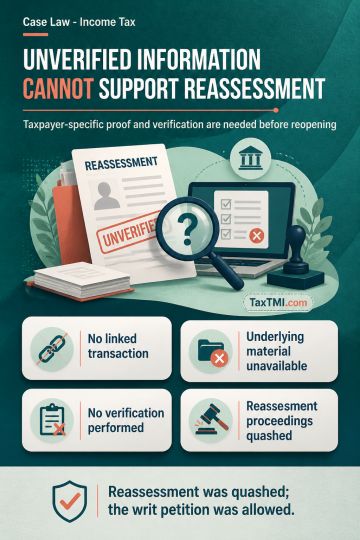
Unverified Insight Portal Information Cannot Justify Reassessment Without a Verified Taxpayer-Specific Income-Escape Nexus or Demonstrated Application...
Assessing Officer jurisdiction after statutory transfer invalidates reassessment notices issued by transferor officers and nullifies resulting proceed...
Consequential appeal-effect orders must implement rectification deleting working-capital adjustments and reconsider the resulting arm's-length range c...
Discounted cash flow valuation protects share premium where projections are reasonable, while audited book expenses defeat unexplained-expenditure add...
Deduction u/s 54F is not available to an assessee who owns more than one house property at the time of purchasing a new property. The assessee, despite jointly registering the new property with his wife and daughter, made the entire investment himself. Merely registering in joint names with close relatives does not circumvent the restriction u/s 54F. The assessee claimed full deduction for the new property's investment, although jointly owned with his wife. Even for the subsequent sale of the new property, the assessee is likely to argue that Section 54/54F restrictions do not apply due to joint ownership, citing judicial precedents. Accepting this contention would create a loophole for tax evasion. The assessee's argument cannot be accepted if the entire investment is made solely by the assessee. The assessee's farm property at Vishubaug, with a bungalow and residential amenities, was rightly considered a residential house by the authorities. The ITAT upheld the CIT(A)'s findings and dismissed the assessee's appeal.
Deduction u/s 54F is not available to an assessee who owns more than one house property at the time of purchasing a new property. The assessee, despite jointly registering the new property with his wife and daughter, made the entire investment himself. Merely registering in joint names with close relatives does not circumvent the restriction u/s 54F. The assessee claimed full deduction for the new property's investment, although jointly owned with his wife. Even for the subsequent sale of the new property, the assessee is likely to argue that Section 54/54F restrictions do not apply due to joint ownership, citing judicial precedents. Accepting this contention would create a loophole for tax evasion. The assessee's argument cannot be accepted if the entire investment is made solely by the assessee. The assessee's farm property at Vishubaug, with a bungalow and residential amenities, was rightly considered a residential house by the authorities. The ITAT upheld the CIT(A)'s findings and dismissed the assessee's appeal.
Note: It is a system-generated summary and is for quick reference only.
 TaxTMI
  TaxTMI