Faceless assessment and registration procedures are updated through electronic communication, revised recovery rules, extended deadlines, and replacem...
Risk-based selective vessel boarding requires accurate declarations and preserves master and agent liability where physical inspections are not select...
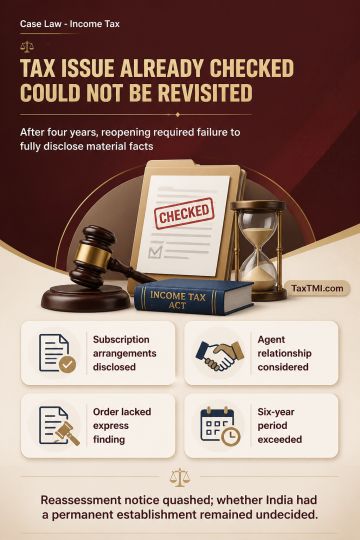
Permanent-establishment reassessment cannot revisit scrutinised disclosures; extended reopening fails without undisclosed material facts and within st...
The Appellate Tribunal considered a case involving a penalty u/s 271(1)(c) where the assessee, an employee, received salary and ex-gratia post Voluntary Retirement Scheme (VRS). The issue was the eligibility of claiming standard deduction u/s 16(1) if the total exceeded Rs. 5 lakhs. The Tribunal held that the assessee genuinely believed the deduction was permissible, especially as the total salary pre-VRS was below Rs. 5 lakhs. The Tribunal found no malafide intent in the assessee's actions, noting full disclosure in the return. Consequently, the penalty imposed by the Assessing Officer was overturned, and the assessee's appeal was successful.
The Appellate Tribunal considered a case involving a penalty u/s 271(1)(c) where the assessee, an employee, received salary and ex-gratia post Voluntary Retirement Scheme (VRS). The issue was the eligibility of claiming standard deduction u/s 16(1) if the total exceeded Rs. 5 lakhs. The Tribunal held that the assessee genuinely believed the deduction was permissible, especially as the total salary pre-VRS was below Rs. 5 lakhs. The Tribunal found no malafide intent in the assessee's actions, noting full disclosure in the return. Consequently, the penalty imposed by the Assessing Officer was overturned, and the assessee's appeal was successful.
Note: It is a system-generated summary and is for quick reference only.
 TaxTMI
  TaxTMI