Generate professional replies to Show Cause Notices, assessment orders, audit objections, and other legal communications using TaxTMI's AI Drafter.
Step 1 – Issue Identification & Review
The AI analyses your query, notice, order, or uploaded documents and identifies the key issues involved.
• Review the issues identified by the AI • Add, edit, remove, or refine issues as required
Step 2 – Draft Generation
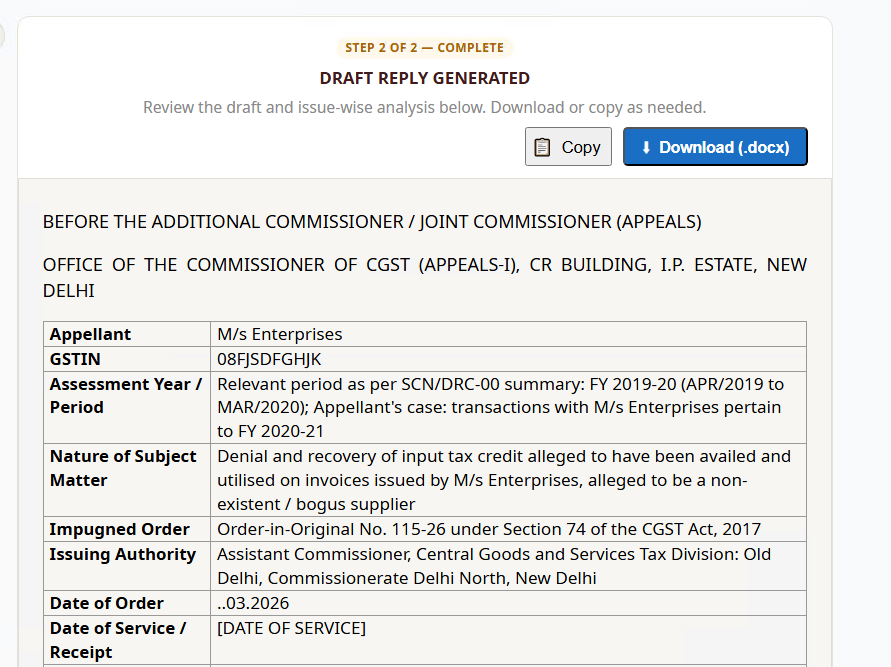
Once you approve the issues, the AI performs issue-wise legal research and prepares a structured draft response.
• Relevant statutory provisions • Judicial precedents and Supreme Court, High Court and other citations • Issue-wise legal analysis • Practical arguments and supporting content • Professionally structured draft ready for further review.
Tribunal upholds penalty deletion for failure to furnish documentation under Income Tax Act The Tribunal upheld the CIT(A)'s decision to delete the penalty under section 271G imposed on the assessee for failure to furnish required documentation ...
Cases where this provision is explicitly mentioned in the judgment/order text; may not be exhaustive. To view the complete list of cases mentioning this section, Click here.
Provisions expressly mentioned in the judgment/order text.
Tribunal upholds penalty deletion for failure to furnish documentation under Income Tax Act
The Tribunal upheld the CIT(A)'s decision to delete the penalty under section 271G imposed on the assessee for failure to furnish required documentation under Rule 10D(1) and Section 92D(3) of the Income Tax Act. The Tribunal considered the practical difficulties in the diamond trade, the substantial compliance by the assessee, and the reasonable cause shown, leading to the penalty deletion. The Tribunal emphasized that the assessee's failure to provide specific details was justified, aligning with Section 273B, and dismissed the Revenue's appeals, affirming the penalty deletion.
Issues Involved: 1. Deletion of penalty under section 271G for failure to furnish documentation as required under Rule 10D(1) and Section 92D(3) of the Income Tax Act. 2. Justification of benchmarking entity-level profit versus international transactions. 3. Difficulty in linking purchases with sales for computing net margin in international transactions. 4. Validity of deleting penalty on the grounds of difficulty and redundancy of Rule 10D. 5. Examination of segment-wise unaudited profit and loss account and its reliability for benchmarking. 6. Relevance of adjustment to ALP as a precondition for penalty under section 271G.
Issue-wise Detailed Analysis:
1. Deletion of Penalty under Section 271G: The Revenue's appeals challenge the CIT(A)'s decision to delete the penalty levied by the AO under section 271G for the assessee's failure to furnish required documentation under Rule 10D(1) and Section 92D(3). The AO initiated penalty proceedings as the assessee did not provide AE and non-AE segment details, which were essential for benchmarking international transactions. The AO observed that the assessee's conduct contravened Section 92D(3) and thus levied a penalty of Rs. 6,89,53,467.
2. Justification of Benchmarking Entity-Level Profit: The CIT(A) deleted the penalty, noting the assessee's substantial compliance and the peculiar nature of the diamond trading business. It was argued that the assessee maintained necessary books and provided various documents, including segment-wise PLI during penalty proceedings. The CIT(A) observed that the TPO did not examine the segment-wise unaudited P&L account submitted by the assessee, which could have been used for benchmarking.
3. Difficulty in Linking Purchases with Sales: The CIT(A) acknowledged the difficulties in linking purchases with sales due to the nature of the diamond trade, where diamonds vary significantly in size, shape, color, and weight. The CIT(A) detailed the complexities involved in diamond manufacturing and trading, highlighting that it is practically impossible to trace which rough diamond was converted into which polished diamond.
4. Validity of Deleting Penalty on Grounds of Difficulty: The CIT(A) reasoned that the TPO's insistence on segment-wise details was impractical given the nature of the diamond business. The CIT(A) suggested that the TPO could have compared the gross profitability levels of the assessee with its AEs or used other methods to determine the ALP. The CIT(A) concluded that the levy of penalty was neither fair nor reasonable, considering the substantial compliance by the assessee and the reasonable cause shown.
5. Examination of Segment-wise Unaudited Profit and Loss Account: The CIT(A) noted that the TPO did not examine the segment-wise unaudited P&L account submitted by the assessee during penalty proceedings. This account could have provided insights into the gross profit margins and profitability levels, aiding in the determination of the ALP. The CIT(A) criticized the TPO for not considering the peculiarities of the diamond trade and for not exploring alternative methods for benchmarking.
6. Relevance of Adjustment to ALP: The CIT(A) emphasized that no adjustments were made to the ALP in the preceding years, and the nature of the business remained the same. The CIT(A) relied on the Delhi High Court's decision in CIT vs. M/s. Leroy Somer & Controls (India) Pvt. Ltd., which supported the view that substantial compliance and reasonable cause are sufficient grounds to delete the penalty under section 271G.
Conclusion: The Tribunal upheld the CIT(A)'s decision, citing the practical difficulties in the diamond trade and the substantial compliance by the assessee. The Tribunal referenced its earlier decisions in similar cases, affirming that the assessee's failure to provide specific details was backed by reasonable cause, thus bringing the case within the scope of Section 273B. Consequently, the Tribunal dismissed the Revenue's appeals, confirming the deletion of the penalty under section 271G.
Full Summary is available for active users!
Note: It is a system-generated summary and is for quick reference only.
 TaxTMI
  AI Drafter ✕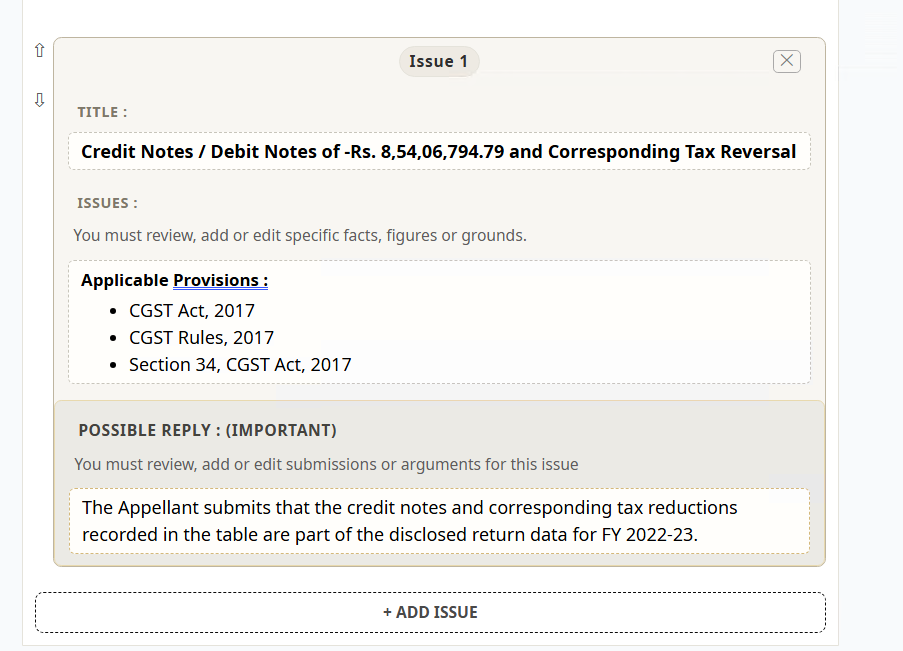
 TaxTMI
 TaxTMI


