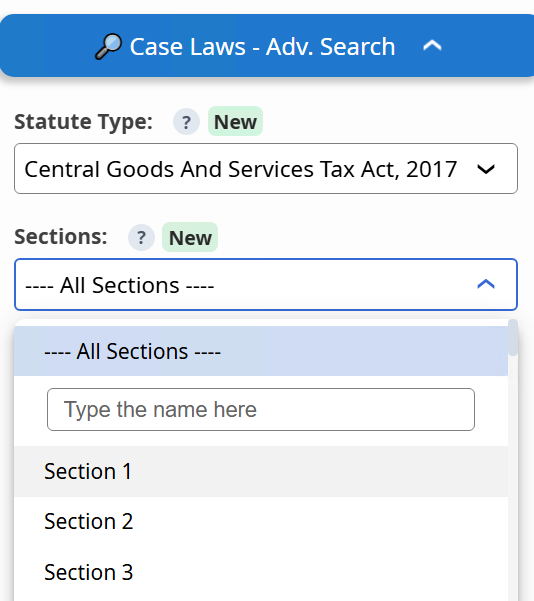
1. Search Case laws by Section / Act / Rule — now available beyond Income Tax. GST and Other Laws Available

2. New: “In Favour Of” filter added in Case Laws.
Try both these filters in Case Laws →
Just a moment...
1. Search Case laws by Section / Act / Rule — now available beyond Income Tax. GST and Other Laws Available
2. New: “In Favour Of” filter added in Case Laws.
Try both these filters in Case Laws →

Press 'Enter' to add multiple search terms. Rules for Better Search
---------------- For section wise search only -----------------
Accuracy Level ~ 90%
 of
of 
Press 'Enter' after typing page number.
of Press 'Enter' after typing page number.


No Folders have been created
Are you sure you want to delete "My most important" ?
NOTE:
of Press 'Enter' after typing page number.
of Press 'Enter' after typing page number.

All Case Laws
of Press 'Enter' after typing page number.
of Press 'Enter' after typing page number.
All Case Laws

Note

Bookmark

Share


Don't have an account? Register Here
of Press 'Enter' after typing page number.
<h1>Assessee wins appeal on disallowances, transfer pricing issues under scrutiny. Penalties dismissed as premature.</h1> The tribunal partly allowed the assessee's appeal and dismissed the revenue's appeal. Various disallowances were deleted, including interest on ECBs, ... Proviso to section 36(1)(iii) - allowability of interest on capital borrowed - extension of business vs continuation of existing business - capital expenditure versus revenue expenditure - depreciation under section 32 - accrual accounting and matching principle - year end accruals (circuit accruals) - transfer pricing - most appropriate method (TNMM v. CUP) - arm's length price - need, rendition and benefit tests in TP - verification of TDS certificates - consequential/corollary grounds (penalty; interest under ss. 234B/234D)Proviso to section 36(1)(iii) - extension of business vs continuation of existing business - allowability of interest on capital borrowed - Disallowance of interest on External Commercial Borrowings (ECB) of Rs. 4,54,131 by invoking the proviso to section 36(1)(iii). - HELD THAT: - The Tribunal examined whether assets acquired with ECBs were for 'extension' of business. The word 'extension' was held to connote starting a new or enlarging activity and, on the facts, the telecom equipment was for continuation of the assessee's existing telecommunication business. No evidence was produced to show extension of business; accordingly the proviso to section 36(1)(iii) did not apply and the disallowance was deleted. The Tribunal relied on the ordinary meaning of 'extension' and the Supreme Court's approach that 'extension' implies starting a new business activity. [Paras 18]Assessee's ground allowed; disallowance under the proviso to section 36(1)(iii) deleted.Capital expenditure versus revenue expenditure - depreciation under section 32 - Characterisation of payments to Narus Inc. (invoices referencing Lawful Intercept project) claimed as revenue expenditure. - HELD THAT: - On the material before it the Tribunal agreed with the AO and DRP that, absent evidence to substantiate the payments as post implementation professional/training services, the payments related to the LI project were capital in nature and properly capitalisable. However, the Tribunal directed that if the AO on verification finds the project completed by 31.03.2009, depreciation under section 32 should be allowed; the assessee must be given opportunity to produce working for depreciation claim. [Paras 23]Ground dismissed on merits (expenditure treated as capital), but assessee entitled to depreciation under section 32 upon verification - allowed on alternative.Proviso to section 36(1)(iii) - allowability of interest on capital borrowed - Disallowance of interest on short term loans (working capital borrowings) of Rs. 7,776,975 by applying proviso to section 36(1)(iii). - HELD THAT: - Having held in respect of ECBs that assets acquired were for continuation (not extension) of the existing business and that the proviso therefore did not apply, the Tribunal applied the same reasoning to short term borrowings. The proviso to section 36(1)(iii) was held not attracted on the facts and the disallowance was deleted. [Paras 29]Assessee's ground allowed; entire interest disallowance deleted.Year end accruals (circuit accruals) - accrual accounting and matching principle - Disallowance of circuit accruals (year end provisions for bandwidth/last mile) proposed by AO. - HELD THAT: - The Tribunal accepted the assessee's explanation of an automated, documented and consistent process (GAIM) for creating circuit accruals on a scientific basis in accordance with mercantile accounting and matching principle. The practice resulted in timing differences only, and the lower authorities' approach of disallowing in year of creation and allowing in subsequent year was rejected. The assessee produced invoices and reversals showing the accruals crystallised and/or reversed subsequently; therefore the accruals are deductible in the year of creation. [Paras 35]Ground allowed; year end circuit accruals accepted as deductible in AY 2009 10.Verification of TDS certificates - Short grant of TDS credit claimed by assessee (additional TDS certificates). - HELD THAT: - Parties agreed that if the additional TDS certificates are genuine the AO should verify and grant credit. The Tribunal directed the AO to verify genuineness and allow credit in accordance with law. [Paras 36]Assessee's ground allowed for statistical purposes; TDS credit to be verified and granted as per law.Transfer pricing - most appropriate method (TNMM v. CUP) - arm's length price - need, rendition and benefit tests in TP - Transfer pricing adjustments in respect of intra group services and royalty (aggregate adjustment); adequacy of evidence; choice and application of TP method. - HELD THAT: - The Tribunal found that for several intra group services the assessee had satisfied need, rendition and benefit tests and had produced documentary material; accordingly those services should be examined under an appropriate benchmarking analysis. The Tribunal held that the TPO/DRP had not applied proper comparability or reliable data when treating certain payments as NIL under CUP and that TNMM (including aggregated approach for closely linked transactions) may be appropriate where direct comparables are unavailable. For three services (country services, IT, project management) evidence was not furnished and AO/TPO to verify. As to royalty, the Tribunal found the record insufficient and remitted the matter to the TPO to determine ALP afresh after proper method selection, comparability and analysis; the benefit test cannot be used by TPO to disallow absent TP analysis. The Tribunal directed the TPO to re examine comparability under TNMM/CUP and determine ALP. [Paras 53, 68]Part allowed and part remanded: adjustments in respect of intra group services where evidence exists to be examined under proper TP analysis; three services left open for assessee to produce evidence; royalty and certain TP determinations remitted to TPO for fresh determination of ALP with directions on methodology and comparability.Consequential/corollary grounds (penalty; interest under ss. 234B/234D) - Invocation of penalty under section 271(1)(c) and levy of interest under sections 234B/234D as raised by assessee. - HELD THAT: - The Tribunal treated these grounds as consequential/ premature since they arise only if the underlying adjustments sustain. As such no interference was warranted at this stage and the grounds were dismissed. [Paras 70]Assessee's grounds dismissed as premature (no interference).Commercial expediency and genuineness of support service expense - commercial expediency of expenditure - Departmental appeal seeking disallowance of support service expenditure (Rs. 11,61,76,903) paid to group company ACSI. - HELD THAT: - The Tribunal found that the assessee produced service agreement, invoices, allocation workings and bank evidence and that the DRP correctly observed the AO had not produced fresh evidence to contradict the assessee. The Tribunal applied established principles that commercial expediency is assessed from the business viewpoint and, absent evidence of sham or non rendering, the expenditure cannot be disallowed merely on suspicion. Both entities being profitable negated any tax avoidance motive. Accordingly the disallowance proposed by AO was rejected. [Paras 76]Revenue's appeal dismissed; support service expenditure allowed.Final Conclusion: The assessee's appeal is partly allowed. Key outcomes: disallowances under proviso to section 36(1)(iii) in respect of ECB and short term loans deleted; circuit accruals accepted on accrual basis; payments to Narus held capital but depreciation may be allowed on verification; additional TDS certificates to be verified and credited; transfer pricing adjustments partially upheld for reconsideration - several intra group services accepted on evidence while certain services and royalty matter remitted to the TPO for fresh ALP determination using appropriate methodology; penalty and interest grounds dismissed as premature; revenue's challenge to support services expenditure dismissed. Issues Involved:1. Double addition on account of income suo moto offered to tax.2. Double disallowance on account of excess depreciation claimed.3. Disallowance of interest incurred on External Commercial Borrowings (ECBs).4. Disallowance of expenses of capital nature claimed as revenue expenditure.5. Disallowance of interest incurred on short term loans.6. Disallowance of circuit accruals.7. Short grant of credit in respect of taxes deducted at source (TDS).8. Transfer Pricing Matters related to intra-group services and royalty payments.9. Initiation of penalty proceedings.10. Levy of interest under sections 234B and 234D of the Act.11. Disallowance of support services expenditure.Detailed Analysis:1. Double Addition on Account of Income Suo Moto Offered to Tax:The assessee raised a ground regarding the double addition of Rs. 10.91 crores, which was suo moto offered to tax in the revised return. The rectification order dated 22.07.2014 passed by the Assessing Officer addressed this issue, and thus, the ground was dismissed as infructuous.2. Double Disallowance on Account of Excess Depreciation Claimed:Similarly, the issue of double disallowance of excess depreciation claimed (Rs. 22,89,758) was also resolved by the rectification order dated 22.07.2014, and hence, this ground was dismissed as infructuous.3. Disallowance of Interest Incurred on External Commercial Borrowings (ECBs):The AO disallowed Rs. 4,54,131 towards interest on ECBs, invoking the proviso to section 36(1)(iii) of the Act, stating that the interest should be capitalized until the assets are put to use. The DRP upheld this view. However, the appellate tribunal found that the assets were acquired for the existing business and not for the extension of business. Thus, the proviso to Section 36(1)(iii) did not apply, and the disallowance was deleted.4. Disallowance of Expenses of Capital Nature Claimed as Revenue Expenditure:The AO disallowed Rs. 3,47,45,337, treating it as capital expenditure related to the Lawful Intercept (LI) project. The DRP upheld the disallowance but directed the AO to verify if the project was completed by 31.03.2009 for depreciation purposes. The tribunal upheld the disallowance but directed the AO to allow depreciation after verification.5. Disallowance of Interest Incurred on Short Term Loans:The AO disallowed Rs. 77,76,965, stating that the loan was used for acquiring fixed assets. The DRP upheld the disallowance. The tribunal, however, held that the proviso to Section 36(1)(iii) did not apply as there was no extension of existing business, and thus, the disallowance was deleted.6. Disallowance of Circuit Accruals:The AO disallowed Rs. 19,91,52,615, stating that the accruals were not supported by invoices. The DRP allowed partial relief of Rs. 17.04 crores based on additional invoices. The tribunal held that the circuit accruals were created on a scientific basis and should be allowed in the year of creation, thus deleting the disallowance.7. Short Grant of Credit in Respect of Taxes Deducted at Source (TDS):The tribunal directed the AO to verify the genuineness of the additional TDS certificates and allow credit accordingly.8. Transfer Pricing Matters:The tribunal addressed the intra-group services and royalty payments separately:- Intra-Group Services: The tribunal held that the assessee had justified the need, benefit, and rendition of services for most of the intra-group services. However, for three services (country services, IT services, and project management), the assessee was directed to furnish evidence before the AO/TPO for verification.- Royalty Payments: The tribunal directed the TPO to determine the ALP of royalty payments afresh, rejecting the benefit test applied by the TPO.9. Initiation of Penalty Proceedings:The tribunal held that this ground was consequential and premature, thus dismissing it.10. Levy of Interest Under Sections 234B and 234D of the Act:Similarly, this ground was held to be consequential and premature, and thus, it was dismissed.11. Disallowance of Support Services Expenditure:The AO disallowed Rs. 11,61,76,903, stating that the services were not rendered and the expenses were duplicative. The DRP deleted the disallowance, finding that the services were rendered, and the expenses were justified. The tribunal upheld the DRP's decision, affirming the deletion of the disallowance.Conclusion:The appeal of the assessee was partly allowed, and the appeal of the revenue was dismissed. The tribunal provided detailed directions for verification and re-examination of certain issues, ensuring that the assessments are made in accordance with the law and based on proper evidence.
 TaxTMI
  TaxTMI
  TaxTMI
