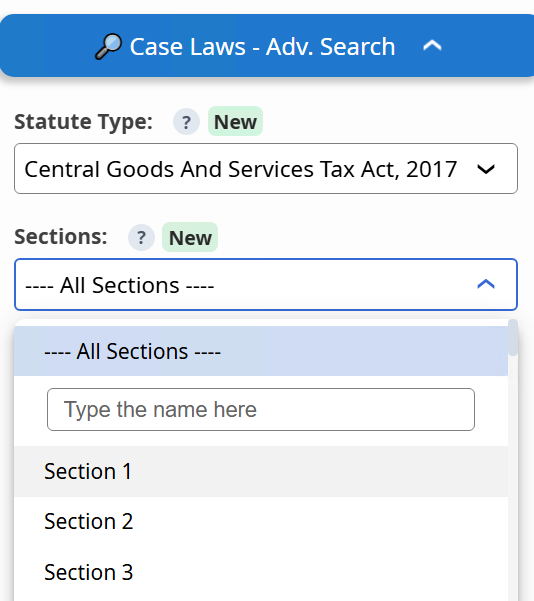
1. Search Case laws by Section / Act / Rule — now available beyond Income Tax. GST and Other Laws Available

2. New: “In Favour Of” filter added in Case Laws.
Try both these filters in Case Laws →
Just a moment...
1. Search Case laws by Section / Act / Rule — now available beyond Income Tax. GST and Other Laws Available
2. New: “In Favour Of” filter added in Case Laws.
Try both these filters in Case Laws →

Press 'Enter' to add multiple search terms. Rules for Better Search
---------------- For section wise search only -----------------
Accuracy Level ~ 90%
 of
of 
Press 'Enter' after typing page number.
of Press 'Enter' after typing page number.


No Folders have been created
Are you sure you want to delete "My most important" ?
NOTE:
of Press 'Enter' after typing page number.
of Press 'Enter' after typing page number.

All Case Laws
of Press 'Enter' after typing page number.
of Press 'Enter' after typing page number.
All Case Laws

Note

Bookmark

Share


Don't have an account? Register Here
of Press 'Enter' after typing page number.
<h1>Tax Tribunal Rules in Favor of Assessee on Withholding, Interest, and Penalty Issues</h1> The case involved issues regarding tax withholding under Section 194H of the Income Tax Act, reliance on internal records over statutory books, interest ... Tax deduction at source under Section 194H - Commission as 'income' and constructive payment - Reliance on Management Information System vs audited statutory books - Liability under sections 201 and 201(1A) where tax paid by payee - Penalty under Section 271C and scope of Section 273B (reasonable cause) - Tax deduction under Section 194J for fees for technical/roaming services - Powers of Commissioner (Appeals) to set aside or restore assessmentTax deduction at source under Section 194H - Commission as 'income' and constructive payment - Whether amounts treated as discounts/'commission' to distributors attract withholding under Section 194H - HELD THAT: - The Court examined the contractual arrangements and surrounding facts and concluded that Section 194H presupposes a payment by the payer to the payee. Where no amount was in fact paid by the assessee (the alleged benefit took the form of a reduction in consideration/discount reflected in commercial arrangements) there was no occasion to invoke Section 194H. The Tribunal and lower authorities had travelled beyond the statutory condition precedent by treating ledger/MIS entries as establishing a payment obligation; the High Court held that such reliance was misplaced where the arrangement and audited/statutory records did not show an actual payment of commission by the assessee. [Paras 44, 45, 46, 48]Answered in favour of the assessees; Section 194H was wrongly invoked and TDS was not exigible.Reliance on Management Information System vs audited statutory books - Whether internal Management Information System records can supplant statutory/audited books in determining the nature of transactions for TDS purposes - HELD THAT: - The Court held that MIS extracts, not forming part of statutory/audited accounts, cannot be permitted to determine the legal character of transactions where audited books and statutory records exist. The Tribunal erred in placing decisive reliance on MIS process data to recharacterise principal-to-principal sales as agency/commission arrangements. [Paras 49]Answered in favour of the assessees; MIS records could not displace statutory/audited accounts for this purpose.Liability under sections 201 and 201(1A) where tax paid by payee - Whether interest or tax liability under sections 201/201(1A) can be fastened on the deductor where tax has already been paid by the recipient - HELD THAT: - Applying precedent and statutory scheme, the Court observed that where no withholding obligation arose (see issue on Section 194H) there was no basis for treating the deductor as an assessee-in-default under section 201; further, several authorities hold that where tax due on the recipient's income has been in fact paid by the recipient, enforcement against the deductor is not appropriate and interest under section 201(1A) must be reconsidered. The Court found the proceedings under sections 201/201(1A) misconceived on the facts before it. [Paras 50, 51]Answered in favour of the assessees; no interest/demand under sections 201/201(1A) arising from the impugned transactions.Penalty under Section 271C and scope of Section 273B (reasonable cause) - Whether penalty under Section 271C was leviable for alleged failure to deduct TDS - HELD THAT: - Having held that the withholding obligation was not attracted and having regard to judicial authorities on penalty (including the need to show absence of reasonable cause under section 273B), the Court concluded that penalty could not be sustained. The Supreme Court and other precedents emphasise that penalty under Section 271C is not automatic where reasonable cause is established or the obligation itself is doubtful. [Paras 51]Answered in favour of the assessees; penalty under Section 271C not leviable on the facts and law in these appeals.Tax deduction under Section 194J for fees for technical/roaming services - Whether payments described as roaming/interconnection charges attract TDS under Section 194J as fees for technical services - HELD THAT: - The Court reviewed relevant decisions and authority and, in respect of the telecom-company appeals, accepted that the facility of interconnection/roaming is provided automatically by machines and does not constitute human-rendered 'fees for technical services' as construed in precedents. On the material and precedents considered (including Kerala and other High Court decisions), the Court answered the Section 194J challenge in favour of the assessees in the telecom matters. [Paras 52, 55]Answered in favour of the assessees; Section 194J not attracted to the roaming/interconnection charges on the facts before the Court.Powers of Commissioner (Appeals) to set aside or restore assessment - Whether the Commissioner (Appeals) has jurisdiction to set aside or restore an assessment to the Assessing Officer for compliance with Tribunal directions - HELD THAT: - The Court accepted the proposition that the Commissioner (Appeals) has jurisdiction to annul an assessment and direct the AO to implement the Tribunal's remand/directions where the AO's order is contrary to those directions. The appellate authority's power to ensure implementation of a final Tribunal direction was recognised as within statutory appellate competence. [Paras 57]Answered in favour of the assessees; CIT(A) may set aside/restore the assessment for compliance with Tribunal directions where appropriate.Final Conclusion: For the appeals considered collectively the High Court allowed the assessees' contentions: amounts characterised as discounts/margins were not held to attract TDS under Section 194H (and Section 194J in the telecom cases), MIS data could not supplant statutory/audited records, demands/interest under sections 201/201(1A) and penalties under Section 271C were not sustainable on the facts, and the Commissioner (Appeals) retained jurisdiction to set aside or restore assessments for compliance with Tribunal directions. All the departmental appeals were dismissed and the assessees' appeals allowed. Issues Involved:1. Whether the assessee was liable to withhold tax at source under Section 194H of the Income Tax Act, 1961.2. Whether the Tribunal was justified in ignoring statutory books of accounts and relying on internal Management Information System records.3. Whether interest under Sections 201(1A) and 220(2) of the Income Tax Act should be levied when taxes had already been paid by the distributor(s).4. Whether the notice proposing penalty was time-barred and the order levying penalty under Section 271C of the Act was void ab initio.5. Whether the liability of payment of tax can be fastened under Section 201 apart from the liability of interest and penalty.6. Whether TDS is applicable under Section 194J on roaming charges paid for facilities provided by service providers.Detailed Analysis:1. Liability to Withhold Tax at Source under Section 194H:The Tribunal misdirected itself by considering the relationship between the company and the distributor as one of principal and agent. The Tribunal relied on the Management Information System records instead of the statutory audit report, which was deemed final. The Tribunal's conclusion that the amount was paid as commission was erroneous since no payment was actually made by the assessee company. The relationship between the company and the distributor was on a principal-to-principal basis, and the restrictions on the distributor did not change this relationship. Therefore, the provisions of Section 194H were wrongly invoked.2. Ignoring Statutory Books of Accounts:The Tribunal erred in relying on the internal Management Information System records instead of the statutory books of accounts and the auditor's report. The statutory audit report should have been considered final, and the Management Information System records were not a part of the official books of accounts. Therefore, the Tribunal's reliance on these records was misplaced.3. Levy of Interest under Sections 201(1A) and 220(2):Since the amount was not required to be deducted under Section 194H, any proceedings under Sections 201 or 201(1A) were misconceived. The taxes had already been paid by the distributor(s), and therefore, the levy of interest under these sections was not justified.4. Penalty under Section 271C:The penalty provisions under Section 271C were not applicable as the amount was not required to be deducted under Section 194H. The Supreme Court's decision in CIT vs. Eli Lilly & Co. (India) P. Ltd. was cited, which stated that penalty should not be imposed if there was a reasonable cause for the failure to deduct tax at source. Therefore, the penalty levied under Section 271C was void ab initio.5. Liability of Payment of Tax under Section 201:The liability of payment of tax under Section 201 could not be fastened as the amount was not required to be deducted under Section 194H. The Tribunal's conclusion that the assessee was liable for the payment of tax under Section 201 was incorrect. The liability of interest and penalty under Section 201 was also not applicable.6. TDS on Roaming Charges under Section 194J:The Tribunal's conclusion that TDS was applicable under Section 194J on roaming charges was incorrect. The roaming charges paid for facilities provided by service providers did not involve human intervention and were managed automatically by machines. Therefore, the provisions of Section 194J were not applicable to the roaming charges.Conclusion:All the issues were answered in favor of the assessee and against the department. The Tribunal's findings were based on incorrect interpretations and reliance on non-statutory records. The relationship between the company and the distributor was on a principal-to-principal basis, and no tax was required to be deducted under Section 194H. The levy of interest and penalty under Sections 201, 201(1A), and 271C was not justified. The appeals filed by the assessees were allowed, and those filed by the department were dismissed.
 TaxTMI
  TaxTMI
  TaxTMI
