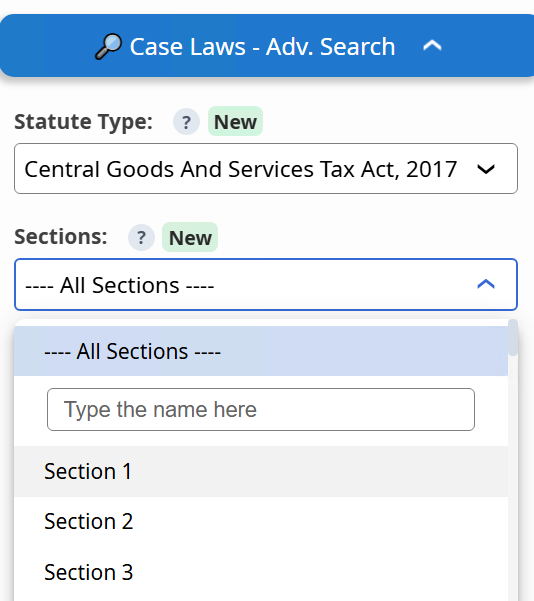
1. Search Case laws by Section / Act / Rule — now available beyond Income Tax. GST and Other Laws Available

2. New: “In Favour Of” filter added in Case Laws.
Try both these filters in Case Laws →
Just a moment...
1. Search Case laws by Section / Act / Rule — now available beyond Income Tax. GST and Other Laws Available
2. New: “In Favour Of” filter added in Case Laws.
Try both these filters in Case Laws →

Press 'Enter' to add multiple search terms. Rules for Better Search
---------------- For section wise search only -----------------
Accuracy Level ~ 90%
 of
of 
Press 'Enter' after typing page number.
of Press 'Enter' after typing page number.


No Folders have been created
Are you sure you want to delete "My most important" ?
NOTE:
of Press 'Enter' after typing page number.
of Press 'Enter' after typing page number.

All Case Laws
of Press 'Enter' after typing page number.
of Press 'Enter' after typing page number.
All Case Laws

Note

Bookmark

Share


Don't have an account? Register Here
of Press 'Enter' after typing page number.
<h1>Court Rules on Warrants & Search Procedures Under Income Tax Act: No Prior Notice, Bank Books Valid</h1> The court held that a warrant of authorization under Section 132 of the Income Tax Act does not require prior notice to the person being searched. Issuing ... Search under section 132 - requisition under section 132A - Section 158BC - service of warrant of authorization - Form 45 compliance - Taxpayers' Charter - reasonable belief / satisfaction note - competence of Additional Director to issue authorizationSection 158BC - search under section 132 - requisition under section 132A - Whether proceedings under Chapter XIVB (section 158BC) can be validly initiated only if a valid search under section 132 or a requisition under section 132A has been made - HELD THAT: - The Court held that initiation of proceedings under section 158BC is contingent upon existence of either a search under section 132 or requisition of books/documents/assets under section 132A. If neither condition exists the proceedings under section 158BC are non est. The petitioners bore the burden to plead and prove absence of those conditions, while the Revenue must satisfy the court that a valid search or requisition occurred. Authorities including Ajit Jain and Seth Brothers were relied upon to confirm that an illegal search is no search and Chapter XIVB cannot be invoked without a valid predicate search or requisition. [Paras 7, 8, 10, 12, 14]Proceedings under section 158BC can be validly initiated only if a valid search under section 132 or a valid requisition under section 132A existed; absence of such a predicate vitiates Chapter XIVB action.Service of warrant of authorization - Form 45 compliance - Taxpayers' Charter - Whether a warrant of authorization must be served upon or shown to the person named in it for the search to be lawful, and whether the Taxpayers' Charter alters that statutory requirement - HELD THAT: - The Court analysed section 132, Rule 112 and Form 45 and concluded there is no statutory requirement to serve the warrant on the person named in the authorization when the place searched is a thirdparty premises (e.g., a bank). It is sufficient that the authorisation be issued by the designated authority and that the warrant be produced to the officerincharge at the premises searched. The Taxpayers' Charter and the CBDT circular (search kit) afford procedural rights (e.g., to see the warrant) to the person in charge of the premises but do not convert into a statutory condition precedent the service of the warrant on the owner of the undisclosed property. The Court rejected the petitioners' submission that nonservice vitiated the search, explaining that prior service would frustrate the object of surprise inherent in search provisions. [Paras 31, 33, 38, 39, 41]No statutory obligation exists to serve the warrant on the person named; showing the warrant to the officerincharge at the premises suffices and the Taxpayers' Charter does not alter the statutory scheme.Form 45 compliance - search under section 132 - Whether a common warrant of authorization naming more than one person is impermissible - HELD THAT: - Examining Form 45 and its proforma, the Court observed that the form contemplates naming one or more persons (e.g., use of 'Sarvashri') and there is no prohibition on issuing a common authorization where the authorising officer has reason to believe multiple persons are involved in interconnected transactions. The Court relied on precedent (Madhupuri Corporation) to hold that a common authorization does not vitiate the search. [Paras 42, 43, 44, 45, 46]Issuance of a common warrant naming multiple persons is permissible and does not invalidate the search.Search in bank premises - treatment of bank books and deposits - FDRs and valuable articles - Whether books of account of a bank, deposits (including FDRs) and bank records can be treated as books/money of the person named in the warrant and thus be subject to search and seizure under section 132 - HELD THAT: - The Court rejected the petitioners' contention that the banker-customer relationship (debtor-creditor) prevents bank records or deposits from being treated as the undisclosed property of the person named in the authorization. Section 132 authorises search of premises (including banks) where undisclosed income/property of a named person is suspected to be kept; the authorized officer may require the officerincharge to furnish account details, FDRs and locker contents. The Court distinguished decisions about whether FDRs qualify as 'valuable articles' for specific provisions no longer relevant (e.g., s.132(5)) and held that restraint orders under s.132(3) and seizure/requisition under s.132/132A in respect of bank items do not ipso facto render the search invalid. [Paras 55, 58, 62, 71, 72]Bank books, deposits and related documents may be searched and dealt with under section 132 (and by requisition under section 132A) in respect of undisclosed income/property of the named person; the banker-customer relationship does not render such items immune.Requisition under section 132A - custody of seized materials - Whether documents seized by police could be requisitioned by incometax authorities under section 132A without prior court permission - HELD THAT: - The Court noted section 132A permits requisition of books/documents/assets taken into custody by any authority from the person referred to in section 132(1). The record indicated the policeseized material was not held as custodia legis nor under court custody; the District Magistrate informed the Incometax Officer about the seized documents and their relevance. Given that subsection (13) makes CrPC provisions applicable and the factual satisfaction of the requisitioning authority, the Court found requisition under section 132A to be lawful and that no prior court permission was required in these circumstances. [Paras 93, 94, 95]Requisition of policeseized documents under section 132A was lawful on the facts; prior court permission was unnecessary where the material was not in court custody and requisition complied with statutory conditions.Competence of Additional Director to issue authorization - delegation and statutory authority - Whether the Additional Director (Investigation) had statutory authority to issue the warrant of authorization under section 132(1) - HELD THAT: - After analysing the definition clauses and relevant authorities, the Court agreed with the view expressed by the Delhi High Court in Dr. Nalini Mahajan that an Additional Director is not vested with the statutory power to issue authorization under section 132(1) unless such power is expressly conferred. The Court rejected the contrary reasoning of Punjab & Haryana High Court (Vinod Goel) and held that the power to issue warrants must be exercised by the authority expressly conferred by statute; absence of such authority renders the authorization and consequent search void. [Paras 99, 101, 107, 109, 110]An authorization issued by an Additional Director (Investigation) without statutory empowerment is invalid; searches and consequent proceedings based on such authorization are without jurisdiction.Final Conclusion: The Court dismissed the first set of petitions, finding the searches and requisitions (as conducted and authorised) valid and sufficient to invoke section 158BC for the block period commencing from 1.4.1996 to16.12.2002; conversely, the Court allowed the second set of petitions, quashed the searches and proceedings where the warrant was issued by an Additional Director lacking statutory authority, and issued prohibition against continuing section 158BC proceedings in those secondset matters. Issues Involved:1. Validity of search under Section 132 of the Income Tax Act without service of warrant of authorization.2. Issuance of a common warrant of authorization naming more than one person.3. Treatment of bank books of account as books of account/documents of the person other than the bank.4. Legality of warrant of authorization served on the bank for furnishing information.5. Powers of calling information under Sections 131, 133(6), and 132 of the Act.6. Requisition under Section 132(A) against a person not in possession of the seized documents, books of accounts, assets, etc.7. Requisition under Section 132(A) from the police without court permission.8. Competence of the Additional Director of Income Tax (Investigation) to issue the warrant of authorization.Issue-wise Detailed Analysis:1. Validity of Search under Section 132 without Service of Warrant of Authorization:The court held that Section 132 of the Income Tax Act does not require prior notice or service of the warrant of authorization on the person whose premises are to be searched. The provision mandates that the designated officer must have information leading to a reasonable belief that the conditions in sub-clauses (a), (b), or (c) of Section 132(1) are met. The court cited several cases, including I. Devrajan v. Tamil Nadu Farmers Service Co-operative Federation and Jain & Jain v. Union of India, to support that the warrant need not be served on the person being searched but must be shown to the officer-in-charge of the premises being searched.2. Issuance of a Common Warrant of Authorization Naming More than One Person:The court found that issuing a common warrant of authorization naming more than one person is permissible under the Act. The term 'Sarvashri' used in Form 45 indicates the inclusion of multiple persons. The court referenced Madhupuri Corporation v. Prabhat Jha, which upheld the issuance of common authorization when interconnected transactions involving multiple persons are suspected.3. Treatment of Bank Books of Account as Books of Account/Documents of the Person Other than the Bank:The court rejected the argument that bank books of account cannot be treated as the books of account of the person being searched. It emphasized that the relationship between a bank and its customer is that of debtor and creditor, and the money in the bank account can be considered the money of the person being searched. The court cited several cases, including Commissioner of Income Tax v. Bhaichand H. Gandhi, to support this view.4. Legality of Warrant of Authorization Served on the Bank for Furnishing Information:The court held that the warrant of authorization served on the bank for furnishing information constitutes a legal search under Section 132. It reasoned that the search in a bank involves obtaining details of accounts, FDRs, and other valuable articles, which is a legitimate part of the search process.5. Powers of Calling Information under Sections 131, 133(6), and 132 of the Act:The court clarified that while Sections 131 and 133(6) allow for calling information, Section 132 specifically deals with search and seizure. The warrant of authorization issued under Section 132 was valid for conducting a search in the bank, and the subsequent actions taken under Section 132(3) were also valid.6. Requisition under Section 132(A) Against a Person Not in Possession of the Seized Documents, Books of Accounts, Assets, etc.:The court found that requisition under Section 132(A) is valid if the documents or assets are seized from the custody of a person related to the person being searched. The requisition made in the case was justified as the documents seized by the police were not in court custody and were relevant for the investigation.7. Requisition under Section 132(A) from the Police without Court Permission:The court held that requisitioning documents from the police without court permission is valid under Section 132(A) if the documents are not custodia legis. The documents seized by the police in this case were not in court custody, making the requisition valid.8. Competence of the Additional Director of Income Tax (Investigation) to Issue the Warrant of Authorization:The court agreed with the Delhi High Court's decision in Dr. Nalini Mahajan v. Director of Income Tax (Investigation), holding that the Additional Director (Investigation) does not have the authority to issue a warrant of authorization under Section 132. The court found that the warrant issued by the Additional Director was invalid, and the subsequent search and block assessment proceedings were without jurisdiction.Judgment:The court dismissed the first set of writ petitions (Writ Petition Nos. 5731(MB) of 2004, 5730(MB) of 2004, 5729(MB) of 2004, 5931(MB) of 2004, and 5932(MB) of 2004) and allowed the second set of writ petitions (Writ Petition Nos. 5005(MB) of 2004, 5015(MB) of 2004, and 5017(MB) of 2004). The court quashed the search proceedings and block assessment proceedings in the second set of writ petitions, restraining the income-tax authorities from proceeding under Section 158 BC against the petitioners in the second set.
 TaxTMI
  TaxTMI
  TaxTMI
