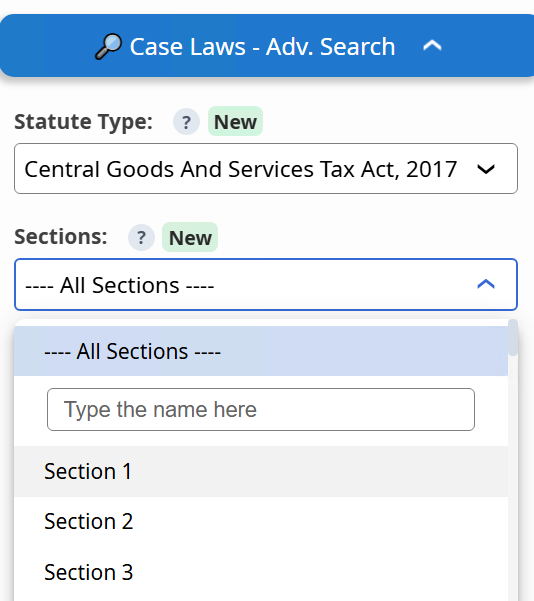
1. Search Case laws by Section / Act / Rule — now available beyond Income Tax. GST and Other Laws Available

2. New: “In Favour Of” filter added in Case Laws.
Try both these filters in Case Laws →
Just a moment...
1. Search Case laws by Section / Act / Rule — now available beyond Income Tax. GST and Other Laws Available
2. New: “In Favour Of” filter added in Case Laws.
Try both these filters in Case Laws →

Press 'Enter' to add multiple search terms. Rules for Better Search
---------------- For section wise search only -----------------
Accuracy Level ~ 90%
 of
of 
Press 'Enter' after typing page number.
of Press 'Enter' after typing page number.


No Folders have been created
Are you sure you want to delete "My most important" ?
NOTE:
of Press 'Enter' after typing page number.
of Press 'Enter' after typing page number.

All Case Laws
of Press 'Enter' after typing page number.
of Press 'Enter' after typing page number.
All Case Laws

Note

Bookmark

Share


Don't have an account? Register Here
of Press 'Enter' after typing page number.
<h1>Court Dismisses Writ Petition on CRZ Rules & Land Regulations</h1> The court dismissed the writ petition, ruling in favor of the respondents on various issues including the violation of Coastal Regulation Zone (CRZ) ... Judicial review in public interest litigation - applicability of Chapter XX-C of the Income-tax Act to courtsanctioned amalgamation - finality of company court's sanction under sections 391-394 of the Companies Act and res judicata - requirement of declaration in Form No.37I and jurisdiction of the appropriate authority under Chapter XXC - Coastal Regulation Zone (CRZ) restrictions and permissible construction activity - validity of exemption under Urban Land (Ceiling and Regulation) Act - development permission and conformity with sanctioned development plan and Development Control Regulations - power to alter designation/reservation under Development Control Regulation 11(4)Coastal Regulation Zone (CRZ) restrictions and permissible construction activity - Whether the construction on the concerned plot contravened the CRZ notifications - HELD THAT: - The court examined the CRZ classifications and the notified permissions. It held that the concerned plot did not fall within a CRZI area so as to attract a total prohibition and that construction of hotels is permitted in CRZII/III under the relevant notifications and subsequent clarifications. The court found no breach of the specific subclauses of the CRZ notifications relied upon by the petitioners and concluded the construction did not contravene the applicable CRZ regulations.No violation of the CRZ notifications was made out.Validity of exemption under Urban Land (Ceiling and Regulation) Act - Whether the exemption granted under the Urban Land (Ceiling and Regulation) Act and conditions thereunder were contravened by the respondents - HELD THAT: - Having considered the exemption order and its stipulated conditions, and earlier judicial scrutiny culminating in the Supreme Court's decision, the court found no material to hold that the exemption or its conditions were violated in a manner invalidating the development permission or subsequent acts.The exemption order under the Urban Land (Ceiling and Regulation) Act was not shown to have been contravened.Development permission and conformity with sanctioned development plan and Development Control Regulations - Whether the grant and subsequent extensions of development permission and the sanctioned development plan were vitiated - HELD THAT: - The court held that the Municipal Corporation's practice of extending development permission (where initial construction commenced within prescribed time) and the State Government's actions in relation to reservation and road realignment did not amount to failure of application of mind or illegality affecting the validity of building sanctions. Challenges based on alleged contraventions of the MRTP Act, sanctioned development plan or Development Control Regulations (including height restrictions) were examined and rejected on the merits: the planning authority acted within its competence and interpreted the plan and regulations reasonably.The development permission(s) and sanctioned development plan were not vitiated; the challenges to them fail.Power to alter designation/reservation under Development Control Regulation 11(4) - Whether the corrigendum/realignment effected by the Commissioner under DCR 11(4) required the formal modification procedure under the MRTP Act - HELD THAT: - The court analysed DCR 11(4) which empowers the Commissioner to shift or interchange designation/reservation provided the actual area is not altered. It held that such exercise by the Commissioner or State did not amount to a modification necessitating the statutory procedure of inviting objections and sanction under the MRTP Act, and therefore rejected the contention that the corrigendum was invalid for want of those procedures.Exercise of DCR 11(4) power to shift designation/reservation did not require the MRTP Act modification procedure and was not invalid.Role of appropriate authority under Chapter XXC and Form No.37I filing requirement - Whether the appropriate authority under Chapter XXC could investigate or act absent filing of a declaration in Form No.37I and whether Chapter XXC applied to the amalgamation transfer - HELD THAT: - The appropriate authority took the position that it lacked jurisdiction to proceed in the absence of a declaration in Form No.37I and that its view was one of waiting for statutory preconditions. The court explored Chapter XXC's scheme, definitions of 'transfer' and 'apparent consideration', and the practical consequences of applying Chapter XXC to courtsanctioned amalgamations. It concluded that the authority's inhibition arose from its statutory reading but that, on interpretation, Chapter XXC is not intended to apply to transfers effected by operation of law upon a courtsanctioned amalgamation. The court accepted that Form No.37I is the procedural vehicle under Chapter XXC, but found the Chapter unsuited to govern transfers consummated by statutory court orders because such schemes operate by force of statute and not by consensual agreements contemplated by section 269UC.The appropriate authority's reliance on absence of Form No.37I explains its nonaction, but Chapter XXC does not apply to transfers effected by courtsanctioned amalgamation; consequently Chapter XXC was not attracted to the amalgamation here.Applicability of Chapter XXC of the Incometax Act to courtsanctioned amalgamation - Whether the transfer of the concerned land pursuant to the courtsanctioned amalgamation attracted Chapter XXC and its consequences (including compulsory purchase and criminal liability for nonfiling) - HELD THAT: - The court analysed statutory definitions, precedents recognising that an amalgamation sanctioned under sections 391-394 operates by order of the company court and by operation of law, and doctrinal differences between contractual transfers and statutory vesting. It observed practical and legal difficulties in treating amalgamation as an agreement under section 269UC, in identifying 'apparent consideration' for individual assets, and in giving effect to compulsory purchase or vesting provisions visavis liabilities and corporate personality. Applying these principles and contemporanea expositio considerations, the court held that Chapter XXC was not intended to apply to amalgamationdriven transfers and therefore could not be invoked to invalidate or unwind the amalgamation or the resultant transfer of the plot.Chapter XXC does not apply to the transfer of immovable property consequent upon a courtsanctioned amalgamation; the provision could not be used to invalidate the amalgamation or transfer in this case.Finality of company court's sanction under sections 391-394 of the Companies Act and res judicata - Whether the amalgamation order of the company court could be attacked collaterally in the writ petition on grounds of fraud or misrepresentation - HELD THAT: - After scrutinising the companycourt record, valuation reports, correspondence with the Company Law authorities and steps taken pursuant to the sanctioned scheme, the court found the omission in clause (11) to be an inadvertent typographical omission corrected by surrounding record and conduct. The company court's sanction expressly implemented the intended share exchange ratio; the order became final and binding and the statutory appeal route under section 391(7) was available but not pursued. The court emphasised that orders under sections 391-394 constitute a complete code and cannot be collaterally attacked in writ proceedings by persons without locus; absent any challenge under the Companies Act, the amalgamation order was conclusive.The amalgamation order is final and binding; collateral attack in this writ petition fails and no fraud was proved to vitiate the sanction.Judicial review in public interest litigation - Whether the writ petition was a bona fide public interest litigation and whether the court should exercise writ jurisdiction to grant the reliefs sought - HELD THAT: - The court applied established limits on judicial intervention in policy and technical matters, and reviewed the petitioners' long history of litigation. Although the court was prepared to accept bona fides at the threshold, it observed that persistent and repetitive litigation beyond reasonable limits can become oppressive. On merits, having examined the legal contentions (CRZ, ULCA, MRTP, Chapter XXC and others) and relevant records, the court found no ground to interfere with the statutory permissions and sanctions already granted and upheld by higher courts.The petition was treated as a public interest litigation but, on merits and having regard to limits of judicial review, the writ petition was dismissed.Final Conclusion: All substantive challenges to the hotel construction and related administrative and statutory acts were rejected: no breach of CRZ norms or Urban Land Ceiling exemption was established; development permissions and plan alterations were held valid; the companycourt amalgamation sanction was final and not vitiated by fraud; and Chapter XXC of the Incometax Act was held not to apply to courtsanctioned amalgamation transfers. The writ petition is dismissed and costs awarded to specified respondents. Issues Involved:- Violation of Coastal Regulation Zone (CRZ) Rules.- Contravention of the Urban Land (Ceiling and Regulation) Act, 1976, and the exemption thereunder.- Contravention of the provisions of the Maharashtra Regional and Town Planning Act, 1966.- Violation of the sanctioned development plan.- Challenge to the decision of the Ministry of Environment and Forests, Government of India.- Challenge to the corrigendum notification dated November 22, 1996.- Challenge to the sanctioned development plan.- Challenge to permission granted by the State Pollution Control Board.- Contravention of the provisions of the Maharashtra Regional and Town Planning Act, 1966, and the Development Control Regulations for Greater Bombay, 1991.- Contravention of the Development Control Regulation No. 59.- Amalgamation of sixth and ninth respondents fraudulent, illegal and intended to circumvent law.- Application of Chapter XX-C of the Income-tax Act, 1961.Summary:(a) Violation of Coastal Regulation Zone (CRZ) Rules:The court found no violation of CRZ rules, stating that construction of hotels is permitted in CRZ-II and CRZ-III and that the concerned plot does not fall within CRZ-I area. The construction does not contravene the CRZ-II Regulations.(b) Contravention of the Urban Land (Ceiling and Regulation) Act, 1976, and the exemption thereunder:The court did not find any violation of the exemption order under the Urban Land (Ceiling and Regulation) Act or the conditions stipulated therein.(c) Contravention of the provisions of the Maharashtra Regional and Town Planning Act, 1966:The court agreed with the respondents that the validity of the sanctioned building plans would not be affected by the Bombay Municipal Corporation's failure to take over the land.(d) Violation of the sanctioned development plan:The court found that the sanction granted by the State Government to the development plan was not vitiated on account of non-application of mind and the contention must fail.(e) Challenge to the decision of the Ministry of Environment and Forests, Government of India:The court held that the Ministry of Environment and Forests reconsidered its stand and granted the sanction after detailed consideration. The court saw nothing wrong and refused to sit in appeal over the decision.(f) Challenge to the corrigendum notification dated November 22, 1996:The court found that the exercise of power by the Commissioner or the State Government to shift/interchange the designation/reservation did not amount to a modification of the sanctioned Development Plan requiring the prescribed procedure.(g) Challenge to the sanctioned development plan:The court deemed the contention immaterial at this stage and did not decide on it.(h) Challenge to permission granted by the State Pollution Control Board:The court found no substance in the challenge as the ninth respondent obtained permission subject to certain restrictions which it is bound to comply with.(i) Contravention of the provisions of the Maharashtra Regional and Town Planning Act, 1966, and the Development Control Regulations for Greater Bombay, 1991:The court held that the development permission extended from time to time in the case of the sixth and the ninth respondents cannot be said to be illegal.(j) Contravention of the Development Control Regulation No. 59:The court found no error in granting development permission to the sixth and the ninth respondents, stating that the height restriction in the Development Control Regulation No. 59 would not apply.(k) Amalgamation of sixth and ninth respondents fraudulent, illegal and intended to circumvent law:The court meticulously examined the allegations and found no fraud or misrepresentation in the amalgamation order. The court held that the amalgamation order, which has become final and binding, cannot be challenged by the petitioners in a collateral proceeding in the present writ petition.(l) Application of Chapter XX-C of the Income-tax Act, 1961:The court held that Chapter XX-C is not intended to apply to situations of transfer of immovable property consequent upon an amalgamation scheme being sanctioned by an order of the court. The court found no statutory basis for the contention that a no objection certificate under Chapter XX-C is a condition precedent to the company court considering the scheme for amalgamation.Conclusion:The writ petition was dismissed with costs of Rs. 20,000 each to the first, second, fourth, sixth, and ninth respondents. All interim orders were vacated.
 TaxTMI
  TaxTMI
  TaxTMI
