
Just a moment...

Top
Help
×

By creating an account you can:

Logo TaxTMI
Call Us / Help / Feedback

Contact Us At :

E-mail: [email protected]

Call / WhatsApp at: +91 99117 96707

For more information, Check Contact Us

FAQs :

To know Frequently Asked Questions, Check FAQs

Most Asked Video Tutorials :

For more tutorials, Check Video Tutorials

Submit Feedback/Suggestion :

Email :
Please provide your email address so we can follow up on your feedback.
Category :
Description :
Min 15 characters0/2000
Make Most of Text Search
  1. Checkout this video tutorial: How to search effectively on TaxTMI.
  2. Put words in double quotes for exact word search, eg: "income tax"
  3. Avoid noise words such as : 'and, of, the, a'
  4. Sort by Relevance to get the most relevant document.
  5. Press Enter to add multiple terms/multiple phrases, and then click on Search to Search.
  6. Text Search
  7. The system will try to fetch results that contains ALL your words.
  8. Once you add keywords, you'll see a new 'Search In' filter that makes your results even more precise.
  9. Text Search
Add to...
You have not created any category. Kindly create one to bookmark this item!
Create New Category
Hide
Title :
Description :
❮❮ Hide
Default View
Expand ❯❯
Close ✕
🔎 News - Adv. Search
TEXT SEARCH:

Press 'Enter' to add multiple search terms. Rules for Better Search

Search In:
Main Text + AI Text
  • Main Text
  • Main Text + AI Text
  • AI Text
Category: ?
Categorized by AI
---- All Categories ----
  • ---- All Categories ----
  • Income Tax
  • GST
  • Customs, DGFT & SEZ
  • FEMA & RBI
  • Corp. Laws, SEBI & IBC
  • PMLA, Black Money & ED
  • Budget
  • News and Press Release
  • PTI News
Month:
---- All Months ----
  • ---- All Months ----
  • January
  • February
  • March
  • April
  • May
  • June
  • July
  • August
  • September
  • October
  • November
  • December
Year:
---- All Years ----
  • ---- All Years ----
  • 2026
  • 2025
  • 2024
  • 2023
  • 2022
  • 2021
  • 2020
  • 2019
  • 2018
  • 2017
  • 2016
  • 2015
  • 2014
  • 2013
  • 2012
  • 2011
Sort By: ?
In Sort By 'Default', exact matches for text search are shown at the top, followed by the remaining results in their regular order.
RelevanceDefaultDate
    DGFT Removes Physical Duty Payment Challans for Export Obligation Discharge Certificate Applications under Advance Authorisation and Export Promotion ...
    TRAI directs use of 1601-series for service, transactional calls by utilities, logistics cos
    Nagaland tax revenue rises to Rs 1,597 crore in FY'26
    India's Russian crude imports hit record for second straight month
    Stolen phone of 88-year-old leads Delhi Police to bust interstate cyber-fraud syndicate; 9 held
    Rupee falls 11 paise to close at 95.28 against US dollar on firm crude oil prices
    Loan Utsav 2026: Bajaj Finance Personal Loan Now Comes with an Exclusive Reward Bundle for Eligible Customers
    Freedom to Spend Smarter: AU Small Finance Bank Credit Cards Bring Rewards, EMI Flexibility and Lounge Access to India''s Biggest Shopping Month
    Rupee falls 8 paise to 95.25 against US dollar in early trade
    APEDA Facilitates First-Ever Export of GI-tagged Mithila Makhana by Sea Route from Bihar to Australia
    Government signs strategic MoUs with key industry leaders and ecosystems to strengthen support to StartUps
    No Charges for UPI Users
    Competition Commission of India (CCI) hosts BRICS Heads of Competition Authorities 2026 meeting
    ICoAS fraternity reaffirms commitment to cost optimisation for Atmanirbhar Bharat on ICoAS day 2026
    Govt to introduce bill in Lok Sabha to broaden NCDC's mandate for co-operative sector growth
    AAP govt indulged in large-scale financial irregularities, caused losses to exchequer: Delhi minister
    ED files chargesheets in 2 PMLA cases against Anil Ambani Group companies, ex-executives
    RJD criticises UDF govt's move not to disburse pensions through cooperative banks
    Raymond Limited reports a healthy Q1 FY27 performance
    Why Most People Choose the Wrong Savings Account And How Not to Be One of Them
❯❯
MaximizeMaximizeMaximize
0 / 200
Expand Note
Add to Folder

No Folders have been created

    +

    Are you sure you want to delete "My most important" ?

    NOTE:

    News
    Showing Results for :
    Reset Filters
    Results Found:
    Show All SummariesHide All Summaries
    August 10, 2026
    Show AI Summary
    Digital EODC processing removes physical duty challans through authenticated payment verification for export authorisation closure.
    Export Obligation Discharge Certificate processing under the Advance Authorisation and Export Promotion Capital Goods schemes no longer requires physical duty-payment challans for voluntary customs-duty payments made on or after 1 August 2026. Authenticated licence-wise payment information is electronically transmitted from Customs/ICEGATE to DGFT systems and mapped to the relevant authorisation. Exporters can verify payment details on the customer portal, while Regional Authorities use corresponding back-office records, replacing manual submission and verification for authorisation closure.
    August 10, 2026
    Show AI Summary
    Trusted service-call numbering requires verified utilities and logistics entities to use dedicated numbers exclusively for transactional and service communications.
    The 1601-series is introduced for verified utilities, courier and logistics entities making service and transactional voice calls. Numbers must be allocated directly to eligible entities, not intermediaries or aggregators, following verification by telecom service providers and an undertaking of exclusive use. Promotional voice calls are prohibited on this series and remain associated with the 140-series. The framework separates these calls from the 1600-series reserved for regulated financial-sector and government-to-citizen communications, supporting consumer recognition of legitimate calls and reducing impersonation risks.
    August 10, 2026
    Show AI Summary
    GST revenue collection drives tax growth while data scrutiny, taxpayer verification, and compliance capacity remain key administrative priorities.
    GST constituted the principal component of tax revenue for the 2025-26 fiscal year. Tax administration faces staff shortages, information-technology upgrade needs, and increased workloads from taxpayer registrations and return filings. Compliance oversight requires GST data scrutiny, risk assessment, identification of unregistered taxpayers, tax-evasion detection, and field verification of high-risk taxpayers. Long-term revenue planning sets progressively higher collection targets through 2063.
    August 10, 2026
    Show AI Summary
    Russian crude imports reshape India's refining trade as processed petroleum products reach sanctioning jurisdictions despite import restrictions.
    Indian imports of Russian crude oil reached a second consecutive monthly record in July 2026, with Russian crude forming the dominant share of India's Russian fossil-fuel purchases and more than half of total crude imports. Higher receipts through smaller terminals offset reduced volumes at Paradip. Indian refineries processing Russian crude also exported refined petroleum products to sanctioning jurisdictions, including the European Union, Australia and the United States, despite the European Union prohibition on imports of oil products made from Russian crude.
    August 10, 2026
    Show AI Summary
    Cyber-fraud through stolen phones allegedly used mule accounts, banking credentials and coordinated technical operations to divert victims' funds.
    Investigation into unauthorised withdrawals after theft of a mobile phone uncovered an alleged interstate cyber-fraud network using stolen devices, linked banking credentials and mule bank accounts. The scheme allegedly involved phone theft, supply of accounts and banking instruments, and a technical operation that accessed victims' accounts and routed funds for withdrawal or transfer. Digital surveillance, transaction mapping, seized devices, victim data and transaction records are being examined to identify linked complaints and the extent of funds allegedly diverted.
    August 10, 2026
    Show AI Summary
    Rupee depreciation reflected stronger dollar, elevated crude prices and geopolitical uncertainty, while portfolio inflows and equity gains provided support.
    The rupee depreciated against the US dollar amid a stronger dollar, higher global crude oil prices and uncertainty surrounding West Asia-related negotiations. Concerns over crude oil's potential impact on the trade deficit weighed on the currency, while positive domestic equity markets and foreign portfolio investment inflows provided support. Market caution remained focused on forthcoming US inflation data, dollar-index movements and Brent crude prices. Foreign-exchange reserves increased during the reported period.
    August 10, 2026
    Show AI Summary
    Collateral-free personal loans offer extended repayment flexibility, conditional reward benefits, and online application subject to eligibility and disbursal requirements.
    Loan Utsav 2026 provides eligible Bajaj Finance Personal Loan applicants an exclusive reward bundle where the loan is successfully disbursed during the campaign period. The collateral-free facility supports personal expenses, offers repayment tenures from 12 to 108 months, and may enable lower monthly EMI obligations through a longer selected tenure. Interest rates depend on eligibility, credit assessment, financial profile and lending criteria. Online applications require personal and financial details and required documents, with disbursal for eligible applicants possible after verification and approval.
    August 10, 2026
    Show AI Summary
    Credit card payment flexibility supports seasonal shopping and travel through eligible EMIs, rewards, tracking tools and conditional merchant benefits.
    Credit-card spending features include conversion of eligible purchases into EMIs, selected no-cost EMI options, reward points, cashback, merchant discounts and payment flexibility. Travel-related benefits may include domestic airport lounge access, travel-booking discounts, fuel-surcharge waiver and anniversary-linked rewards. The AU 0101 application enables transaction tracking, balance and interest-rate monitoring, EMI conversion and bill-payment management. Features and offers are subject to change, customer eligibility, internal policies and partner-merchant terms.
    August 10, 2026
    Show AI Summary
    Foreign-exchange market conditions weakened the rupee as stronger dollar and crude prices offset support from reserve growth and inflows.
    Foreign-exchange market conditions saw the rupee weaken against the US dollar in early trading, influenced by a stronger dollar and higher global crude oil prices. Foreign institutional equity inflows and increased foreign-exchange reserves moderated pressure on the rupee. Market attention remained focused on developments in West Asia and the Reserve Bank of India, alongside movements in the dollar index, crude oil prices and domestic equity markets.
    August 10, 2026
    Show AI Summary
    GI-tagged Mithila Makhana export facilitation expands sea-route market access while supporting quality compliance and farmer-linked value chains.
    Export facilitation for GI-tagged Mithila Makhana enabled the first commercial sea-route shipment from Bihar to Australia. APEDA, in association with the Bihar agriculture department, supported market access, coordination, capacity building and stakeholder engagement. The export model is intended to improve farmer price realisation, require adherence to global quality standards, and strengthen growers, processors and exporters. A separate HS Code for Makhana has taken effect under the Finance Bill, 2025, supporting product-specific trade classification.
    August 10, 2026
    Show AI Summary
    Startup ecosystem support expands through digital payments, cloud access, AI innovation, investment readiness, governance support and global market programmes.
    DPIIT has entered into strategic MoUs to support DPIIT-recognised startups through payment infrastructure, entrepreneurship development, cloud technology, mobility innovation, investment readiness and global-market access. Eligible startups may receive payment and cloud support, technical training, mentorship, startup formalisation assistance, market and investor connections, AI and mobility enablement, and programmes addressing governance, financial readiness, compliance and international expansion. The collaborations promote innovation across digital payments, clean energy, artificial intelligence, climate technology, advanced manufacturing, mobility and automotive technology.
    August 10, 2026
    Show AI Summary
    UPI transaction charges remain unavailable for consumers and person-to-person payments, while limited threshold-based merchant MDR may be considered.
    Proposed amendment of section 10A of the Payment and Settlement Systems Act, 2007 is intended to support UPI sustainability, technological advancement and resilience. Consumer payments and person-to-person transactions are to remain free. Any future merchant discount rate would apply only to limited merchant transactions above a threshold, at a nominal rate, while most merchant transactions remain free. The framework supports investment in cybersecurity, fraud prevention and infrastructure, alongside a self-sustaining and inclusive digital-payment ecosystem.
    August 10, 2026
    Show AI Summary
    Fair competition cooperation in renewable energy markets advances knowledge-sharing and evidence-based enforcement across interconnected digital and energy markets.
    BRICS competition authorities adopted a Joint Statement strengthening cooperation to promote fair competition, including in renewable energy markets. Cooperation focuses on dialogue, knowledge-sharing and consideration of cross-border competition challenges in digital markets, emerging technologies and the energy transition. Competition enforcement is to remain principled and evidence-based, supporting efficiency, consumer welfare, innovation and merit-based competition. A collaborative renewable-energy competition study identified evolving market dynamics and areas for future cooperation.
    August 10, 2026
    Show AI Summary
    Cost optimisation in public finance strengthens investment decisions, risk allocation, indigenous manufacturing and value-driven government expenditure through specialised financial expertise.
    ICoAS cost optimisation supports public financial management through prudent resource utilisation, financial oversight and improved cost management across government. Its role includes supporting indigenous manufacturing, better investment decisions, efficient public expenditure and maximum value for public spending. With greater private-sector participation and Public-Private Partnerships, ICoAS officers are expected to promote cost efficiency, appropriate risk allocation and sound project structuring. Capacity building emphasises integrity, financial modelling, data visualisation, analytical frameworks and artificial intelligence for improved public-finance management.
    August 9, 2026
    Show AI Summary
    Co-operative development financing would expand through direct assistance, share-capital participation and wider operational powers for sectoral support.
    National Cooperative Development Corporation (Amendment) Bill, 2026 proposes to broaden the Corporation's mandate to promote co-operative development. It would permit direct loans and grants to co-operative societies and other entities engaged in co-operative development, where funds are used for co-operative purposes. With Central Government approval, the Corporation could participate in the share capital of such entities. The proposals also expand the meaning of foodstuffs, remove geographical restrictions for industrial-goods assistance, and provide additional functional powers.
    August 9, 2026
    Show AI Summary
    GST compliance failures and electricity subsidy controls raise allegations of financial irregularities and potential losses to the public exchequer.
    Allegations based on a Comptroller and Auditor General report identified purported GST compliance failures involving outstanding tax liabilities, e-way bills generated after cancellation of GST registrations, limited bill scrutiny, non-compliance, and turnover mismatches. The allegations also concerned electricity subsidies extended to consumers with prolonged zero bills or apparent non-residence, presenting these issues as possible financial irregularities and losses to the public exchequer.
    August 9, 2026
    Show AI Summary
    Money-laundering prosecution complaints allege fund diversion through shell entities, credit-facility evergreening, layered transactions and fictitious project expenditure.
    Money-laundering prosecution complaints allege that funds from toll-road projects and credit facilities were diverted through group companies, contractors, shell entities and conduit accounts. In the toll-road matter, allegedly sham or back-dated subcontracting arrangements and subsequent documentation were used to portray transfers as genuine project expenditure. In the credit-facilities matter, fresh facilities were allegedly used to repay, rotate and evergreen earlier liabilities rather than for sanctioned end-use, with funds layered and presented as legitimate business expenditure or receipts. Attached assets are sought to be confiscated as alleged proceeds of crime.
    August 9, 2026
    Show AI Summary
    Direct Benefit Transfer pension disbursement replaces cooperative-bank doorstep delivery, while preserving home payments for beneficiaries unable to use bank accounts.
    Direct Benefit Transfer of social security and welfare pensions to Aadhaar-linked bank accounts is intended to replace cooperative-bank doorstep delivery, except for bedridden and similarly situated beneficiaries. The change addresses delays in remitting undistributed pensions, deficient record updates and reconciliation, duplicate payments, delivery incentives, and compliance with Direct Benefit Transfer norms. Criticism focuses on beneficiary access to linked commercial-bank accounts, possible minimum-balance deductions, exclusion of cooperative banks, and the effect on doorstep-delivery workers.
    August 8, 2026
    Show AI Summary
    Engineering business growth supported Raymond's first-quarter performance, with export expansion, capacity investment and net-debt-free financial flexibility.
    Raymond Limited reported unaudited first-quarter FY27 growth in total income, EBITDA and profit before tax before exceptional items, while remaining net-debt-free with a net cash surplus. Its Engineering business comprises Precision Technology & Auto Components and Aerospace & Defence. Growth in the former was attributed to export expansion, operating leverage, product mix and cost reductions. Aerospace & Defence growth was linked to production for global OEMs, portfolio expansion and increased capacity, although margins were affected by targeted research and development investment. Forward-looking statements remain subject to regulatory, political, economic and technological risks.
    August 8, 2026
    Show AI Summary
    Savings account selection requires comparison of effective interest, fees, digital service, access, and individual banking needs.
    Savings-account selection should compare effective interest returns under slab-based rates, recurring operating charges and the customer's actual banking needs. Net value depends not only on advertised rates but also on relevant minimum-balance, card, ATM, alert and transfer fees. Digital reliability, customer support, branch availability and ATM access should be assessed according to the customer's average balance, cash use, transfer frequency, travel patterns and need for in-person assistance. The suitable account is one that matches real banking behaviour.

    News

    Back

    All News

    Showing Results for :
    Reset Filters
      No Records Found

      News

      Back

      All News

      whatsappJoin Channel
      Showing Results for : Reset Filters
      News and Press Release

      Ministry of Finance Year Ender 2025: Department of Expenditure

      January 8, 2026

      Contents
      Summary
      Note

      Note

      -

      Bookmark

      Print

      Print

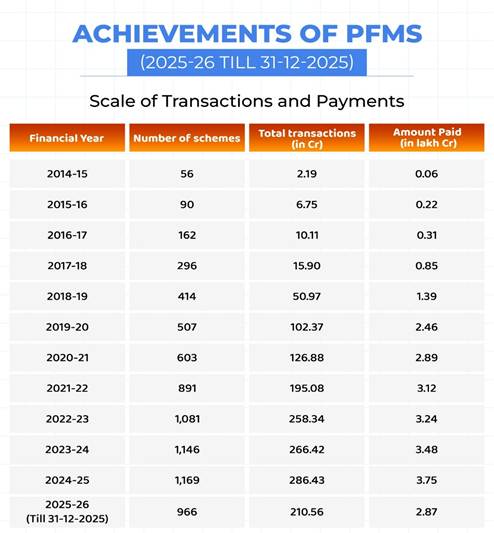
      The Department of Expenditure (DoE), Ministry of Finance, has consistently advanced fiscal governance and public welfare through innovative financial management and policy reforms. A pivotal achievement is the implementation of Direct Benefit Transfer (DBT) via the Public Financial Management System (PFMS). Public Financial Management System makes a direct and significant contribution to the Digital India Initiative of Government of India enabling Direct Benefit Transfer for Ministries/departments in Government of India. This initiative has supported the Digital India mission by enabling real-time, transparent fund transfers for over 966 schemes covered under Direct Benefit Transfer (DBT) initiative in 2025-26. In FY 2025-26, 210.56 crore. transactions were reported & ₹2.87 Lakh Crore were paid to beneficiaries in FY 2025-26 till 31st December 2025. Centrally Sponsored (CS) Schemes and Central Sector Schemes (CSS) are on the PFMS and all the Major Banks including RBI have interface with PFMS.

      ACHIEVEMENTS OF PFMS

      I. Scale of Transactions and Payments
      ii.  Breakup of total number of Schemes

      Scheme Type

      No. of
      Schemes


      Central Assistance to State Plan

      1


      State Govt. Scheme

      252


      Centrally Sponsored Scheme

      13


      Establishment Expenditure

      1


      Other Central Expenditure

      5


      Central Sector Scheme

      50


      UT-SLS

      74


      Other Schemes

      2


      CSS-SLS

      476


      UT

      92


      TOTAL

      966


      iii.  Month-wise Transactions (Progressive) and Payment (Progressive) for FY 2025- 26

      2025-26 (Month wise)

      Month

      Number of Schemes

      Total Transactions

      (in Cr.)

      Amount paid

      (in lakh Cr.)

      Apr-25

      522

      18.47

      0.28

      May-25

      691

      45.17

      0.62

      June-25

      763

      75.98

      1.13

      July-25

      798

      99.23

      1.39

      August-25

      866

      119.95

      1.69

      September-25

      917

      140.70

      1.97

      October-25

      940

      163.43

      2.22

      November-25

      955

      191.16

      2.59

      December-25

      966

      210.56

      2.87


      iv.  Major DBT Schemes FY 2025-26 (till Dec – 2025)

      S.

      No.

      Name of Scheme

      No. of Transactions (in Cr.)

      Amount paid

      (in Cr.)

      1.  

      Mahatma Gandhi National Rural Employment Guarantee [MGNREGA]

      28.05

      48,021.62

      1.  

      Pradhan  Mantri Kisan Samman Nidhi Yojna [PMKISAN]

      19.77

      39,532.37

      1.  

      Pratyaksh Hanstantrit Labh [PAHAL]

      105.88

      16,230.29

      1.  

      National Social Assistance Program [NSAP]

      16.65

      20,954.11

      1.  

      Pradhan Mantri Awas Yojna Rural [PMAY-R]

      0.87

      33,669.84

      1.  

      Pm Surya Ghar Muft Bijli Yojana-[4271]

      0.12

      9,453.84

      v.   Major citizen centric initiatives taken to improve DBT Process

      a)       DBT Conclaves:-

      DBT Regional Conclaves & State Workshops were successfully held in Guwahati, Bhopal, Jaipur, Pune, Bengaluru, and Lucknow, covering 26 States and 2 UTs. Each event saw 150–250 senior officials, including Chief Secretaries and Finance Secretaries, come together for training and support on SNA-SPARSH, DBT-SPARSH, and PFMS modules.

      • Beneficiaries shared their experiences, praising PFMS for timely, transparent, and efficient fund disbursement, which has improved service delivery and reduced delays. The workshops also provided a platform for states to discuss challenges, share progress, and receive guidance from CGA and PFMS teams.
      • These conclaves reinforced Centre-State collaboration, showcasing PFMS’s commitment to transparent, accountable, and effective public fund management, laying the foundation for scaling up SNA-SPARSH across India.

      b)    DBT Open House:-

      DBT Open House started on 10.01.2024 to promote citizen-centric governance by allowing beneficiaries to directly connect with PFMS. It provides a platform for beneficiaries to raise their queries and grievances with PFMS officials. The open house is held from 12 noon to 1 pm on all working days. As of December-2025, details of DBT sessions are as under:-

      • No. of sessions: 476
      • Instances of participation from Ministries/States/Institutions: 1,273
      • No. of issues raised: 1,358
      • No. of issues resolved: 1,358
      • No. of logins: 5,037

      c)    Customer Redressal Management:-

      CRM has been started to streamline grievance resolution across PFMS, CGA, and DoE through automation, multi-channel communication, feedback tools, and analytics. It is effectively managing over 150,000 grievances annually, enhancing coordination with State Treasuries, banks, and other external systems.

      TOTAL CRM Ticket Status                                                                                                                            31-12-2025

      S.No

      Vertical

      Total Assigned

      Resolved / Closed

      1

      Helpdesk

      1,20,843

      1,20,071

      2

      DBT

      30,576

      30,457

      3

      Technology

      194

      191

      4

      Rollout

      2,257

      2,199

      5

      GIFMIS

      38,782

      37,901

      6

      Reports

      469

      460

      7

      SD

      20,537

      20,412

      8

      Banking

      17,971

      17,955

      MANUAL FOR PROCUREMENT OF GOODS

      Department of Expenditure has published three manuals viz. Manual for Procurement of Goods, 2017; Manual for Procurement of Consultancy and other Services, 2017 and Manual for Procurement of Works 2019. Subsequently, all three Procurement Manuals (namely Goods, Services & Works) have been updated (in June 2022) and all procurement related  instruction issued by Central Vigilance Commission (CVC) have been subsumed into these Manuals.

      Now, this Department has thoroughly revised these Manuals and issued following

      revised/ afresh Manuals:

      i. Manual of Procurement of Goods, Second Edition, 2024

      ii. Manual for Procurement of Consultancy Services (Second Edition, 2025)

      iii. Manual for Procurement of Non-Consultancy Services (developed afresh)

      iv. Manual for Procurement of Works, Second Edition, 2025

      These Manuals are available at the Website of Department of Expenditure i.e. doe.gov.in

      Many developments in public procurement policy from the last revision of manual such as policy initiatives, clarification, stakeholders’ deliberations were subsumed in the revised manuals. The revised manuals mainly focused on ease of business for suppliers and clarify for the procurement professionals.

      Wide range of topics have been rewritten such as clarifying extent of applicability to various entities, categorization of procurements, conflicts of interest, interest-free advance payments, new forms of performance securities, outsourcing procurement, auto-extension of bids, capping price variation and liquidated damages, mitigating cartel information, reverse auction, rate contracts, withdrawal by L1 bidders etc.

      SCHEME FOR SPECIAL ASSISTANCE TO STATES FOR CAPITAL EXPENDITURE

      Capital expenditure in the economy has a higher multiplication factor and crowds-in private investment and raises supply side capacity for enhancing economic growth. Accordingly, the Union Government, in October, 2020, launched a ‘Scheme for Special Assistance to States for Capital Expenditure’ under which 50-year interest free loan is provided to assist the States in boosting capital expenditure and enhance the productive capacity of the economy. In view of the extremely positive response of the State Governments to the Schemes and their request for continuing the Scheme, the Scheme was continued in 2021-22, 2022-23,2023-24, 2024-25 and 2025-26 with enhanced allocation. The outlay under the scheme has increased from ₹ 12,000 crore in the FY 2020-21 to ₹ 1,50,000 crores in 2025-26.

      In 2025-26, the scheme comprises of total ten parts, from Part-I to Part-X. Amount of ₹ 68,000 crore has been allocated under Part-I (Untied) of the Scheme, under which States can propose capital projects of their choice to be funded under the scheme. An outlay of ₹ 80,000 crore is for reform centric and sector specific areas. The reforms envisaged under the scheme are:

      1. Mining Sector Reforms
      1. Scrapping of Old Vehicles and Electronic Enforcement of Road Safety
      2. Land-related Reforms by State Governments in Rural Areas
      3. Digital Public Infrastructure for Agriculture
      4. Land-related Reforms by State Governments in Urban Areas
      5. Efficiency in Financial Management
      6. Urban Planning Reform

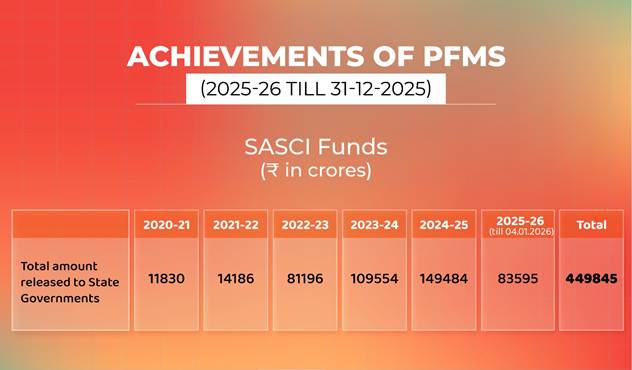
      So far, ₹ 83,595 crores has been disbursed to State Governments under SASCI 2025-26 till 04.01.2026. Further, a total amount of ₹ 4,49,845 crores has been released to the state governments under SASCI since its inception i.e. from 2020-21 to 2025-26 (till 04.01.2026). Year-wise releases under SASCI scheme are given below - (₹in crores)
      NET BORROWING CEILINGS (NBC) FOR THE YEAR 2025-26

      As per the recommendations of Fifteenth Finance Commission [XV-FC], the normal Net Borrowing Ceiling of 3 percent of Gross State Domestic Product (GSDP) has been allowed to States for FY 2025-26.The net borrowing of the States for the year 2025-26 has been fixed at Rs. 10,29,659 crore at 3% of GSDP of the States.

      Consent of Government of India of Rs. 9,79,564 crore for raising OMB and of Rs. 95,150.20 crore for availing Negotiated loan during FY 2025- 26 have been issued under Article 293 (3) of Constitution of India as on 04th January, 2026.

      ADDITIONAL BORROWING OF 0.5% OF GSDP LINKED TO PERFORMANCE IN POWER SECTOR

      Fifteenth Finance Commission (XV-FC) has recommended performance based additional borrowing space of 0.50 percent of Gross State Domestic Product (GSDP) to States in the power sector.

      This additional borrowing of 0.50 percent of GSDP is over and above the normal net borrowing ceiling.

      The primary objectives of granting financial incentives for undertaking power sector reforms are to improve operational and economic efficiency within the sector and promote a sustained increase in paid electricity consumption.

      To be eligible for these incentives, State governments must undertake a set of mandatory reforms and meet stipulated performance benchmarks. The required reforms include:

      • Progressive assumption of responsibility for losses of public sector power distribution companies (DISCOMs) by the State Government.
      • Transparency in the reporting of financial affairs of power sector including payment of subsidies and recording of liabilities of Governments to DISCOMs and of DISCOMs to others.
      • Timely rendition of financial and energy accounts and timely audit.
      • Compliance with legal and regulatory requirements

      Upon completion of these reforms, a State's performance is evaluated based on specific criteria to determine its eligibility for the incentive amount which may range from 0.25% to 0.5% of GDP based on performance. The evaluation criteria include:

      • Percentage of metered electricity consumption against total energy consumption, including agricultural connections.
      • Subsidy payment by Direct Benefit Transfer (DBT) to consumers.
      • Achievement of targets for reduction in Aggregate Technical & Commercial (AT&C) loss.
      • Meeting the target of reduction in Average Cost of Supply and Average Realizable Revenue (ACS-ARR) Gap.
      • Reduction in cross subsidies.
      • Payment of Electricity bills by Government Departments and local bodies.
      • Installation of prepaid meters in government office.
      • Use of innovations and innovative technologies

      The initiative has spurred State Governments to initiate the reform process, and several States have come forward and submitted details of the reforms undertaken and achievements of various parameters to the Ministry of Power.

      Based on the recommendations of the Ministry of Power, the Ministry of Finance has granted permission to raise financial resources of Rs. 1,48,361 crore through additional borrowing from 2021-22 to 2024-25 to 13 State Governments for undertaking power reforms.

      For the Financial year 2025-26 also, states are eligible for additional borrowing of 0.5% of GSDP (Approx Rs. 1,71,612 crore) linked to performance in power sector as per the guidelines issued by this Department dated 02.09.2025.

      FINANCE COMMISSION GRANTS TO STATES

      Finance Commission Division (FCD), Department of Expenditure is mandated to release grants to States as per accepted recommendations of Central Finance Commissions. It also undertakes processing of and follows up action on the various recommendations of the Central Finance Commission. Currently award of 15th Finance Commission is being implemented for the period 2021-22 to 2025-26.

      For the year 2025-26, the 15th Finance Commission has recommended the grants-in-aid namely, Post Devolution Revenue Deficit Grant, Grants to Local Bodies, Health Sector grant, Central share of State Disaster Response Fund and State Disaster Mitigation Fund. We also release additional Central assistance from National Disaster Response Fund (NDRF) and National Disaster Mitigation Fund (NDMF) to the State Governments in case of severe disasters.

      Based on the recommendations of Ministry of Home Affairs, Ministry of Finance (Department of Expenditure) released a total amount of Rs. 18276.4 crore as Central share of State Disaster Response Fund and ₹ 5288.8 Crore as Central share of State Disaster Mitigation Fund for the F.Y 2025-26. Additionally, a total assistance of Rs.994.05 crore has been released for Expansion and Modernization of Fire Services in the States.

      The details of funds released as per the recommendations of 15thFC to the State Governments for various components during current financial year 2025-26 are as under:

                                                                                                                                             (Rs. in crore)

      S/

      No.

      Components

      Grants release during 2025-26  (from 1/4/2025 to 31/12/2025)

      1.

      Post Devolution Revenue Deficit Grant (Himachal Pradesh, Manipur, Mizoram, Nagaland, Tripura and Uttarakhand)

      10278.75

        2.

      Grants in aid for Urban Local Bodies

      8870.9

      3.

      Grants in aid for Rural Local Bodies

      16788.3

      4.

      Grants for Shared Municipal Services

      224.99

      5.

      Grant for Health Sector

      12968.36

      6.

      Central Share of State Disaster Response Fund

      18276.4

      7.

      Central Share of State Disaster Mitigation Fund

      5288.8

      8.

      Central assistance from National Disaster Response fund of which

      4177.15

      8.1

      Assistance for severe natural calamities in States including for recovery and reconstruction activities.

      2598.03

      8.2

      Assistance for preparedness and Capacity Building Funding Window under NDRF of which

      1579.12

      8.2.1

      For Expansion and Modernization of Fire Services in the States

      994.05

      9 .

      Release of  Central assistance  from National Disaster Mitigation Fund for

      • Glacial Lake Outburst Flood Project in Arunachal Pradesh, Himachal Pradesh and Uttarakhand (₹ 27.87 Cr)
      • National Landslide Risk Mitigation Programme in Uttarakhand, Sikkim, Himachal Pradesh and Manipur (₹ 69.04 Crore)
      • Assistance for catalytic 12 most drought prone States released to Andhra Pradesh, Karnataka, Madhya Pradesh, Maharashtra, Odisha, Rajasthan, Tamil Nadu and Telangana (₹ 400 Crore)
      • Urban Floods in Tamil Nadu and Assam(₹ 270.75 Crore)
      • Restoration and Rejuvenation of wetlands in Assam(₹ 155.71 Crore)

      923.37


      Grand Total

      77797.02

      CENTRAL PAY COMMISSION (CPC)

      The Government has constituted the 8th Central Pay Commission (CPC) to review pay, allowances, pensions, and service conditions of central government employees.

      ***

      Topics

      ActsIncome Tax
