Political contribution deductions require genuine transactions; banking records and party registration alone cannot defeat evidence of accommodation e...
Post-death GST liability permits fresh proceedings against legal representatives, while discontinued-business recovery remains limited to the inherite...
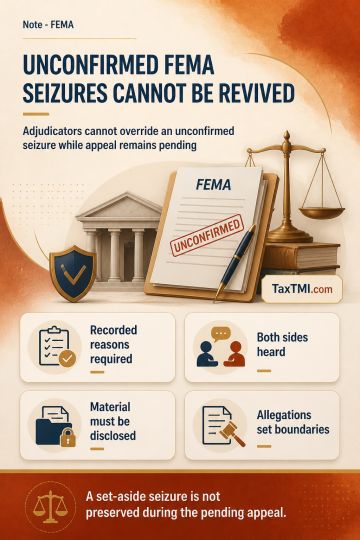
Non-confirmation of FEMA seizure prevents adjudicators from overriding pending appellate findings on recorded reasons and suspected foreign asset hold...
CESTAT allowed appellant's appeal and set aside the impugned order dated 30.09.2019, directing refund of excess CENVAT credit of Rs.12,86,186/-. The tribunal held that Section 142(3) of CGST Act, 2017 provides transitional arrangements enabling cash refund of unutilized CENVAT credit when transitioning from service tax regime to GST. The lower authority erroneously rejected the refund application on grounds that no provision existed for cash refund of CENVAT credit. CESTAT ruled that Section 142 contains non-obstante clause with overriding effect over Central Excise Act provisions, except Section 11B(2) relating to unjust enrichment. Since Central Excise Act was repealed and CENVAT Credit Rules superseded during GST implementation, Section 142 adequately provides legal framework for sanctioning cash refunds of excess transitional credits.
CESTAT allowed appellant's appeal and set aside the impugned order dated 30.09.2019, directing refund of excess CENVAT credit of Rs.12,86,186/-. The tribunal held that Section 142(3) of CGST Act, 2017 provides transitional arrangements enabling cash refund of unutilized CENVAT credit when transitioning from service tax regime to GST. The lower authority erroneously rejected the refund application on grounds that no provision existed for cash refund of CENVAT credit. CESTAT ruled that Section 142 contains non-obstante clause with overriding effect over Central Excise Act provisions, except Section 11B(2) relating to unjust enrichment. Since Central Excise Act was repealed and CENVAT Credit Rules superseded during GST implementation, Section 142 adequately provides legal framework for sanctioning cash refunds of excess transitional credits.
Note: It is a system-generated summary and is for quick reference only.
 TaxTMI
  TaxTMI