Political contribution deductions require genuine transactions; banking records and party registration alone cannot defeat evidence of accommodation e...
Post-death GST liability permits fresh proceedings against legal representatives, while discontinued-business recovery remains limited to the inherite...
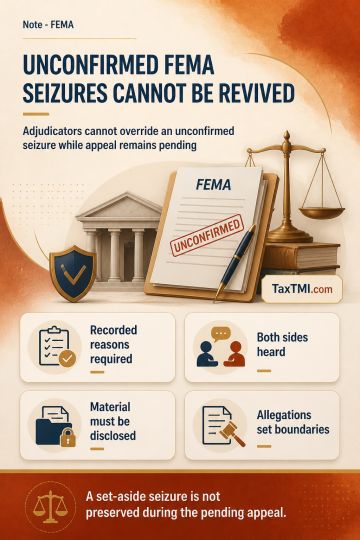
Non-confirmation of FEMA seizure prevents adjudicators from overriding pending appellate findings on recorded reasons and suspected foreign asset hold...
ITAT set aside penalty u/s 271(1)(c) after finding no deliberate concealment. The Tribunal noted two key disallowances: first, estimated expense addition was already directed for deletion by CIT(A), and second, TDS disallowance u/s 40(a)(ia) was previously deleted in quantum proceedings. Relying on Supreme Court precedent in Reliance Petroproducts, the Tribunal held that mere expense disallowance does not automatically warrant penalty. The Assessing Officer was directed to delete the penalty, with the assessee's appeal grounds being allowed, effectively nullifying the original penalty order.
ITAT set aside penalty u/s 271(1)(c) after finding no deliberate concealment. The Tribunal noted two key disallowances: first, estimated expense addition was already directed for deletion by CIT(A), and second, TDS disallowance u/s 40(a)(ia) was previously deleted in quantum proceedings. Relying on Supreme Court precedent in Reliance Petroproducts, the Tribunal held that mere expense disallowance does not automatically warrant penalty. The Assessing Officer was directed to delete the penalty, with the assessee's appeal grounds being allowed, effectively nullifying the original penalty order.
Note: It is a system-generated summary and is for quick reference only.
 TaxTMI
  TaxTMI