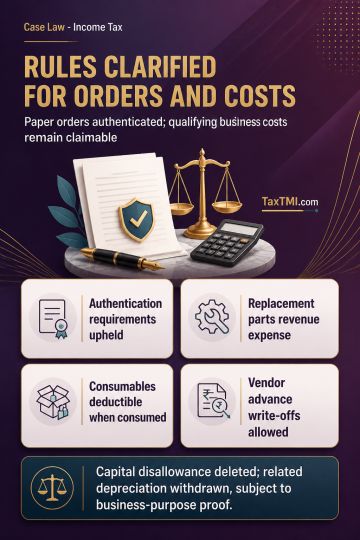
Authentication of paper assessment orders upheld, while qualifying repairs, consumables and vendor advance write-offs remain deductible business claim...
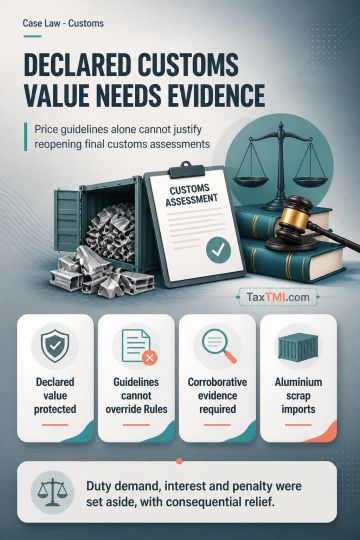
Transaction value cannot be rejected solely on non-statutory valuation guidelines without corroborative evidence supporting reassessment of final cust...
Cross-examination rights and corroborated evidence limit customs penalties for misdeclaration in genuine import transactions involving documented clea...
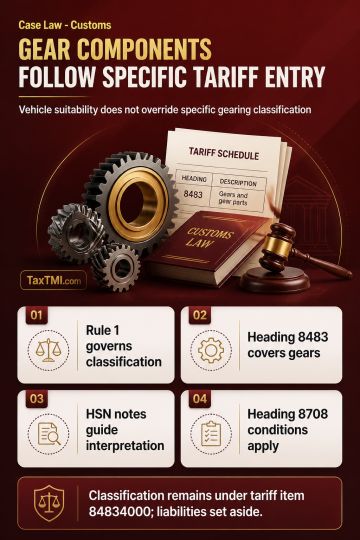
Tariff classification of vehicle gear components follows the specific gearing entry, displacing motor-vehicle parts classification and related liabili...
Page of 4794
Press 'Enter' after typing page number.
541 to 560 of 95875 Results
❮
❯
❯❯
0 / 200
Expand Note
Add to Folder
No Folders have been created
+
Are you sure you want to delete "My most important" ?
CESTAT adjudicated a service tax dispute involving a governmental authority's tax liability. The tribunal rejected the appellant's claims of exemption under Notification No.25/2012-ST, finding no merit in their arguments about agricultural extension services. The tribunal determined that the appellant deliberately suppressed service tax information in ST-3 returns, warranting invocation of extended limitation period. The tribunal found the appellant's services taxable under the Finance Act, 1994, and upheld penalties under Sections 77 and 78. Ultimately, the appeal was partially allowed, with the case remanded to the original authority to recompute tax demand while allowing cum tax benefit, recognizing that service tax was not separately collected from service recipients.
CESTAT adjudicated a service tax dispute involving a governmental authority's tax liability. The tribunal rejected the appellant's claims of exemption under Notification No.25/2012-ST, finding no merit in their arguments about agricultural extension services. The tribunal determined that the appellant deliberately suppressed service tax information in ST-3 returns, warranting invocation of extended limitation period. The tribunal found the appellant's services taxable under the Finance Act, 1994, and upheld penalties under Sections 77 and 78. Ultimately, the appeal was partially allowed, with the case remanded to the original authority to recompute tax demand while allowing cum tax benefit, recognizing that service tax was not separately collected from service recipients.
Note: It is a system-generated summary and is for quick reference only.
 TaxTMI
 of 4794







 Join Channel


 TaxTMI