Nature-dependent electricity contracts receive new Ind AS accounting, hedge designation, transition and financial-statement disclosure requirements fr...
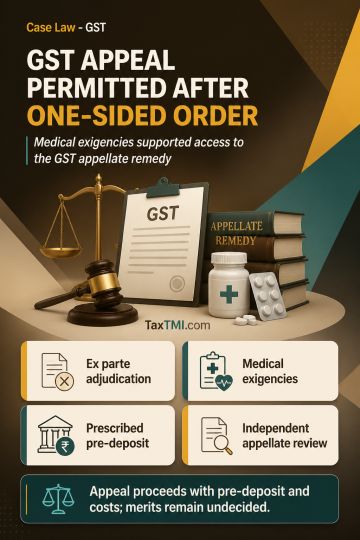
Alternative GST remedy permitted protective writ intervention for ex parte adjudication, preserving independent appellate review of input tax credit d...
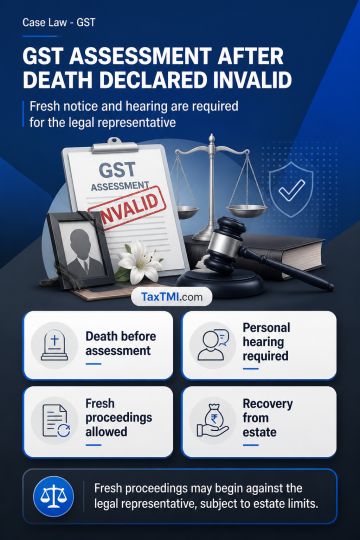
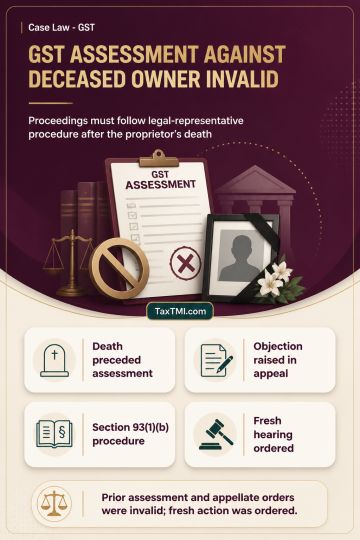
Assessment against deceased sole proprietor requires proceedings against the legal representative, rendering prior assessment and appellate orders inv...
Residential waste collection classification under SAC 999423 defeats composite-supply exemption where facilitating goods are not transferred to the lo...
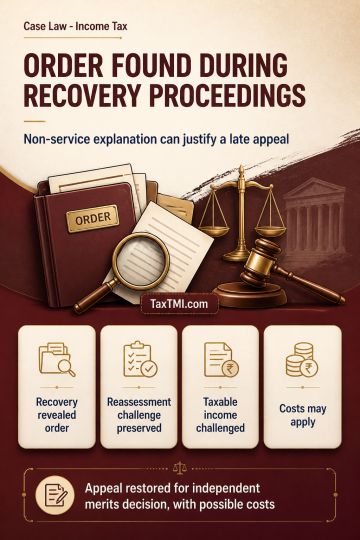
Condonation of delay permits statutory appeal restoration where inadequate service explanation prevented consideration of reassessment and taxable-inc...
The case pertains to the revision of an assessment order u/s 263 regarding the applicability of the higher tax rate u/s 115BBE on unexplained expenditure u/s 69C. The assessee had purchased excess stock using unexplained funds, which the Assessing Officer (AO) treated as unexplained expenditure but charged tax at normal rates. The Principal Commissioner of Income Tax (PCIT) invoked Section 263, contending that the higher tax rate u/s 115BBE should have been applied. However, the Tribunal held that when the AO has conducted proper inquiries and taken a plausible view, the PCIT cannot substitute their view for the AO's unless the AO's view is unsustainable in law. The Tribunal relied on the Supreme Court's decision in Malabar Industrial Co. Ltd., which stated that every loss of revenue due to the AO's order cannot be treated as prejudicial to revenue interests u/s 263. If two views are possible and the AO has taken one view, it cannot be treated as an erroneous order unless the AO's view is unsustainable in law. Consequently, the Tribunal decided in favor of the assessee.
The case pertains to the revision of an assessment order u/s 263 regarding the applicability of the higher tax rate u/s 115BBE on unexplained expenditure u/s 69C. The assessee had purchased excess stock using unexplained funds, which the Assessing Officer (AO) treated as unexplained expenditure but charged tax at normal rates. The Principal Commissioner of Income Tax (PCIT) invoked Section 263, contending that the higher tax rate u/s 115BBE should have been applied. However, the Tribunal held that when the AO has conducted proper inquiries and taken a plausible view, the PCIT cannot substitute their view for the AO's unless the AO's view is unsustainable in law. The Tribunal relied on the Supreme Court's decision in Malabar Industrial Co. Ltd., which stated that every loss of revenue due to the AO's order cannot be treated as prejudicial to revenue interests u/s 263. If two views are possible and the AO has taken one view, it cannot be treated as an erroneous order unless the AO's view is unsustainable in law. Consequently, the Tribunal decided in favor of the assessee.
Note: It is a system-generated summary and is for quick reference only.
 TaxTMI








 Join Channel


 TaxTMI

