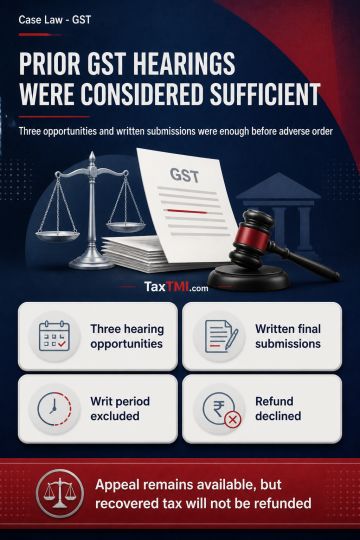
Personal hearing requirements in GST adjudication were satisfied by prior opportunities and written submissions; appellate limitation received writ-pe...
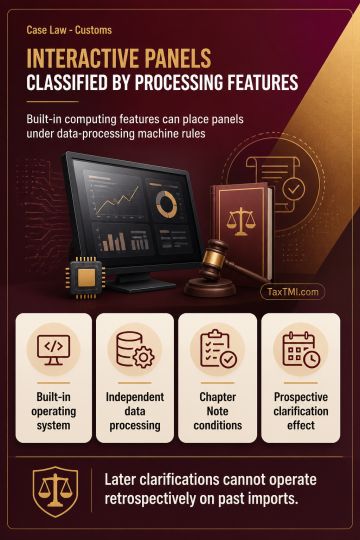
Interactive flat panels meeting automatic data processing conditions are distinguished from monitors, while later classification clarifications apply ...
Page of 4798
Press 'Enter' after typing page number.
761 to 780 of 95957 Results
❮
❯
❯❯
0 / 200
Expand Note
Add to Folder
No Folders have been created
+
Are you sure you want to delete "My most important" ?
A bail application was rejected in a case involving the creation of fake companies, appointment of fictitious directors/ partners/ proprietors, and illegal passing of inadmissible Input Tax Credit under the Goods and Services Tax (GST) laws. The accused, without the knowledge of the purported directors/staff, utilized invoices from fictitious suppliers to wrongfully avail and pass on ineligible Input Tax Credit, resulting in substantial revenue loss to the government. The court emphasized that economic offenses involving deep-rooted conspiracies and massive public fund losses should be viewed seriously as grave offenses affecting the nation's economy. Citing a Supreme Court precedent, the court held that such white-collar criminals, driven by personal profit motives and impeding national development through calculated dishonesty, warrant a different approach to bail. Considering the allegations, verified materials, and the cognizance order for offenses under GST laws and the Indian Penal Code, the court rejected the bail application.
A bail application was rejected in a case involving the creation of fake companies, appointment of fictitious directors/ partners/ proprietors, and illegal passing of inadmissible Input Tax Credit under the Goods and Services Tax (GST) laws. The accused, without the knowledge of the purported directors/staff, utilized invoices from fictitious suppliers to wrongfully avail and pass on ineligible Input Tax Credit, resulting in substantial revenue loss to the government. The court emphasized that economic offenses involving deep-rooted conspiracies and massive public fund losses should be viewed seriously as grave offenses affecting the nation's economy. Citing a Supreme Court precedent, the court held that such white-collar criminals, driven by personal profit motives and impeding national development through calculated dishonesty, warrant a different approach to bail. Considering the allegations, verified materials, and the cognizance order for offenses under GST laws and the Indian Penal Code, the court rejected the bail application.
Note: It is a system-generated summary and is for quick reference only.
 TaxTMI
 of 4798









 Join Channel


 TaxTMI